The Role of Gender and Literature in Alison Bechdel’s [Fun Home]

Front cover of Alison's Bechdel's Fun Home (2007 paperback version)
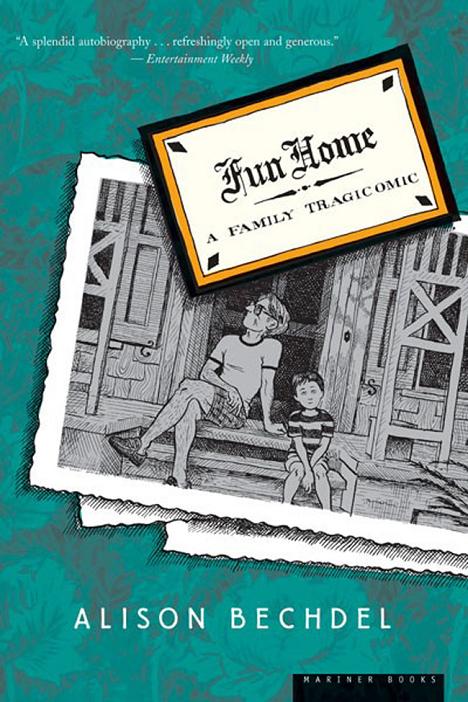
Front cover of Alison’s Bechdel’s Fun Home (2007 paperback version)

Originally published in 2006, Fun Home: A Family Tragicomic is a graphic memoir that led Alison Bechdel to commercial and critical success. Reminiscent of Art Spiegelman’s MausFun Home explores the relationship between Alison and her closeted father, Bruce Bechdel, to shed light on themes such as gender, the coming-out process, and the complicated dynamics of family life. The exploration of these themes are facilitated through discussions of death, life, and literature–triggered by Alison’s efforts to illustrate an accurate portrait of her complicated connection with her father, particularly after he commits suicide.

Alison and her father share many traits: they are both queer (even though the father remains closeted and married to his wife throughout the entire duration of the memoir), they both have a love for reading and for art, and they both wish that they were born the opposite sex. Despite these similarities, they never seem to forge a strong and intense bond due to their reserved personalities and their divergence in terms of gendered affiliations. Whereas Bruce tends to express traits that can typically be approached as feminine, Alison admits that she has been “a connoisseur of masculinity” (95) since she was a child. Thus, even though their share many similarities, their divergence in terms of their gender alignment creates significant tension between the two characters.

Not only does Alison approach herself and her father as “inversions” of each other, but she also makes note of how she struggles to emphasize her masculinity while her father struggles to prevent her from expressing it. She approaches her father’s attempts to feminize her as an almost pathetic effort embody femininity (vicariously) through his daughter, which leads to what Alison calls “a war of cross purposes” that is “doomed to perpetual escalation” (98). Thus, differences of gender are not invoked to uphold the division between men and women, but rather, to illustrate the differences and tensions that exist between Alison and her father.
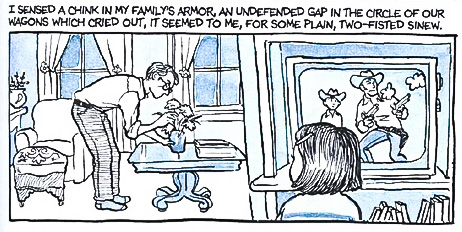
Figure 1. Page 95.
Figure 1. Page 95. Many of the images in Fun Home stress the dichotomous view of Bruce as a feminine presence and Alison as a masculine presence. In the image above, notice how Bruce engages in an activity that is stereotypically approached  as feminine. The wall unit splits this panel into two sections, thus highlighting Alison’s placement in front of the television showing a Western movie. Keep in mind that this memoir is not necessarily upholding gender binaries–a man with feminine characteristics and a girl with masculine characteristics, in due course, challenges the binary in the first place.

Bruce’s reserved and temperamental nature is attributed to the fact that he’s had to keep his sexuality a secret due to his upbringing in a society where homosexuality is considered a disgrace. It is suggested in the memoir that Bruce’s repressed nature, his wife’s request for a divorce, and the fact that Alison is able to live an open life as a lesbian (whereas he was not) are the events that prompt him to commit suicide by running in front of a truck. This suicide is the event that prompts Alison to explore her father’s life through memoir, while in turn coming to a more enlightened understanding of the influence that she and her father had on each other. This exploration, however, does not take place in a linear or organized fashion. Fun Home is as a pastiche or decoupage of many elements presented in a non-chronological fashion. The comic panels are supplemented by snippets of other literary texts, photographs, letters, and even newspaper clippings. Furthermore, the narrative itself is supplemented with Bechdel’s interpretations of the events that she lived, in addition to theoretical interventions from areas such as gender and psychoanalysis.

I am deeply interested in the role of literature and literary texts in Fun Home, not only because they add more depth and nuance to the memoir, but also because literature (particularly novels) is a crucial element that must be kept in mind when interpreting and understanding the central developments in the graphic memoir. For instance, literature is the catalyst that helps Alison to discover that she’s a lesbian–leading her to describe her lesbianism as “a revelation not of the flesh, but of the mind” (74). At the age of thirteen, she first encounters the word “lesbian” in a dictionary. She later reads a book focused on offering biographies of queer figures, which leads her on an obsessive mission to read and consume as many queer texts as she possibly can, such as E.M. Forster’s Maurice and Radcliffe Hall’s The Well of Loneliness. 

The very act of accessing and reading this literature is depicted as a deeply political and almost revolutionary act, for it entails developing the courage to buy these books in spite of their overtly queer titles, or to borrow them from public libraries, “heedless of the risks” (75). These books inspire her to attend a gay union meeting at her university, and to come out to her parents in a letter. Whereas her father seems quite accepting of her sexuality, claiming that “everyone should experiment” (77), her mother responds with mild disapproval, approaching her lesbianism as “a threat” (77) to her work and her family.
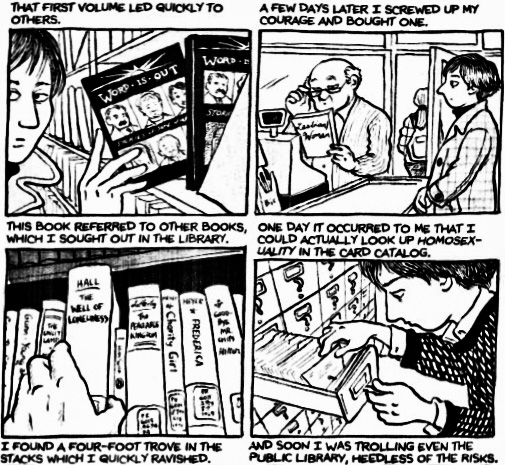
Figure 2.

Literature is associated with almost every single significant event that takes place in the novel. Alison’s first relationship blossoms when she meets a poet named Joan. Every time they are shown in bed together, they are surrounded by novels and other books. The images depict them reading even when being intimate with one another, and they critique and analyze books even when sprawled naked on their beds (see pages 80-81). The importance of books is her life is unsurprising when taking into account that her father was an English teacher at their local high school, and he spent a lot of time recommending and discussing books with Alison.

Even though Bruce engages in sexual acts with other men, and even boys, the memoir highlights novels and literature as the outlet of escapism that Bruce used to express his sexual frustrations, and even his subconscious sexual desires. His favorite books, such as Fitzgerald’s The Great Gatsby and Joyce’s Ulysses, touch upon matters and themes that are central to Bruce’s characterization. The Great Gatsby, for instance, highlights the pains of yearning for someone or something we cannot possess, whereas Ulysses depicts how characters can cross each other’s paths without affecting one another in a significant way (reflecting Alison’s complex relationship with her father). Given how closely Bruce’s books are tied to his suppression, his secrecy, and his hidden desires, it is no wonder that his wife gets rid of most of his book collection after he dies.

It is literature that allows Bruce and Alison to achieve a degree of closeness that they’ve never felt before. It turns out that Alison ends up taking English with her father in twelfth grade, and she realizes that she really likes the books that her father wanted her to read, such as J.D. Salinger’s The Catcher in the Rye. She becomes deeply invested in discussing these books with her father within the classroom–and her interest leads her to develop “a sensation of intimacy” (199) that she has never felt before with her father. When Alison leaves to college, she grows even closer to Bruce, calling him every once in a while to discuss the books that she reads for her English class. Their connection reaches a peak when Bruce lends his daughter a copy of Earthly Paradise by Colette (an autobiography with lesbian themes) even though she has not revealed her lesbianism to him. The book sparks a conversation between the two, leading Bruce to open and honestly discuss his sexual orientation with Alison for the first time.
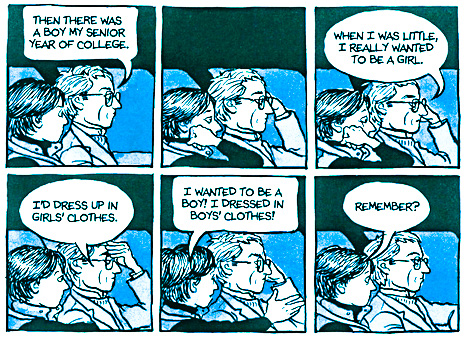
Figure 1. Alison and her father have their first frank discussion regarding his sexuality. Although their relationship is cold and distant, this marks one of the moments in which they begin to grow closer to each other.
Figure 3. Page 221. Alison and her father have their first frank discussion regarding his sexuality. Although their relationship is cold and distant, this marks one of the moments in which they begin to grow closer to each other.

Literature becomes the agent that allows Alison to forge a connection with her father. Although she admits that her intellectual connection and her intimacy with her father is seen as unusual to other people, she still seems to thoroughly enjoy and appreciate it. Alison does, however, lament that they “were close. But not close enough” (225). However, despite the fact that they were not as close or as intimate as she wanted them to be, she cherishes the fact that “he was there to catch [her] when [she] leapt” (232).

I can’t even begin to describe how much I enjoyed this memoir. It is complex, rich, funny, heartbreaking, and deeply insightful. I’m sure that this book is going to contribute significantly to my academic work, and I can’t wait to re-read this memoir in the near future.

You can purchase a copy of Bechdel’s memoir by clicking here.

Work Cited

Bechdel, Alison. Fun Home: A Family Tragicomic. Boston: Houghton Mifflin, 2007. Print (Paperback edition).

John Barth’s “Lost in the Funhouse”: A Postmodern Critique of the Developmental Narrative

“Lost in the Funhouse” is a short story in John Barth’s book of the same name, originally published in 1968.  The stories within this collection are typically approached as postmodern due to their self-reflexivity, their self-awareness, and their use of self-reference. The short story “Life in the Funhouse,” in particular, is known for its active destabilization of truth, linearity, and structure, and it is an ideal text to study when engaging in the frustrating exercise of defining postmodernity as it pertains to the study of literary texts.

Plot-wise, not much occurs within this narrative. In a nutshell, a teenage boy named Ambrose travels with his family to Ocean City, Maryland, where they spend most of their time sunbathing at the beach, going on amusement park rides, and entertaining themselves with games at the Ocean City boardwalk. Ambrose is nervous because he really likes this girl named Magda, and wants to develop the courage to confess his love for her. Although he eventually invites Magda to go into a funhouse with him, Magda eventually trails off with Ambrose’s brother, Peter, leaving him alone and isolated within the dark confines of the funhouse. The rest of the narrative traces Ambrose’s thoughts and dissatisfaction caused not only by his inability to express his feelings, but also  by his inability to escape from the funhouse.

This plot, however, constitutes a really small part of the narrative. “Lost in the Funhouse” is peppered with moments of self-reflexivity and meta-awareness, and the narrator often deviates from the plot in order to make claims regarding the intricacies of language, the difficulties of writing, and the impossibility of literary innovation. Within this narrative, we have a triangulation of three perspectives: the perspective of the protagonist, the perspective of the author, and the perspective of the speaker/narrator (who also shares most of the meta-fictional elements within the short story). Given the fact that this text is a meta-fiction, the elements within the story should be approached not only by how they develop the plot, but also by their commentary as pertaining to the acts of writing and reading fiction. This is particularly why close-reading and deconstruction are crucial in terms of determining what the text is trying to achieve. In an attempt to highlight the complexity and richness of this story, let me turn my attention to unpacking the following passage:

One reason for not writing a lost-in-the-funhouse story is that either everybody’s felt what Ambrose feels, in which case it goes without saying, or else no normal person feels such things, in which case Ambrose is a freak. “Is anything more tiresome, in fiction, than the problems of sensitive adolescents?” And it’s all too long and rambling, as if the author. For all a person knows the first time through, the end could be just around the corner; perhaps, not impossibly it’s been within the reach any number of times. On the other hand he may be scarcely past the start, with everything yet to get through, an intolerable idea. (88)

Although plot-wise there is an actual or concrete funhouse, the term is also being invoked as a symbol for narrative, fiction, or perhaps even the mind of the protagonist. “Lost in the Funhouse” is an exploratory narrative that delves into the woes that Ambrose faces when analyzing his own precociousness, and when confronting the confusing and contradictory issues that arise when one grows up–making the story, in essence, a coming-of-age narrative. In the passage above, the narrator uses quotation marks to bring up the tired and overwrought nature of the coming-of-age genre. Furthermore, the quote asks readers to reflect on how sensitive protagonists within this genre suffer from the woes of over-thinking, and how they often share thoughts that are deemed to be too advanced or “unrealisitic” given the protagonist’s age.

It becomes important to question why Barth shares this critique of the “lost-in-the-funhouse” narrative when the story itself incorporates every single element that is critiqued: the protagonist of the story is a sensitive character, who often offers long, rambling, and contradictory interpretations of himself and the people that surround him. The text explores the perceived incongruity of sensitive adolescents expressing ideas that surpass their faculties, at least within fiction: “Is it likely, does it violate the principle of verisimilitude, that a thirteen-year-old boy could make such a sophisticated observation?” (70). Despite this questioning, the protagonist still  engages with intense philosophical and existential ideas, leading the reader to come with their own answers to the aforementioned question. Not only can this be approached as an attempt to destabilize stereotypes in terms of what adolescents are or are not capable of deliberating, but it also pushes the reader to question the foundations that generate these so-called truisms and verisimilitudes.  Is it possible for a teen to conceive of sophisticated ideas? Is there a specific age that a person must reach before being able to formulate complex ideas?

It can be said that the narrator considers the coming-of-age genre to be important or useful given its universality, but at the same time, the text makes overt critiques on the use of conventions and patterns to portray universal themes. Growth, development, and linearity (both from a textual and non-textual perspective) are thus prominent themes that are scrutinized within the depths of the funhouse.

Narrative
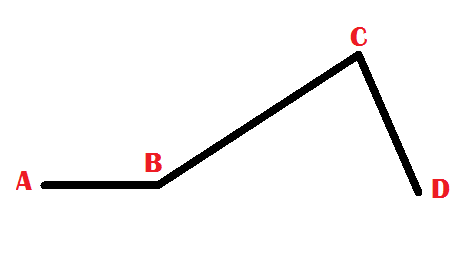
Figure 1. This graphic is a replication of the diagram found in page 91 of “Lost in the Funhouse,” in which the narrator discusses the general pattern that most fictional narratives follow: exposition, conflict, complication, climax, and resolution.

The narrator of the story makes a critique of patterns by illustrating the conventions that narratives usually appropriate in order to assure that they are effective. The text painstakingly depicts the usual structures and conventions that narratives employ to deliver a story (see Figure 1). “Lost in the Funhouse” deviates immensely from the conventional and linear plot, and it is self aware of this deviation: “The beginning should recount the events between Ambrose’s first sight of the funhouse early in the afternoon and his entering it with Magda and Peter in the evening. The middle would narrate all relevant events from the time he loses his way; middles have the double and contradictory function of delaying the climax while at the same time preparing the reader for it” (74). Although the narrator stresses that this is how stories should be structured, “Lost in the Funhouse” deliberately refutes these conventions by delivering a narrative with a prolonged exposition that is contradictory and that does not follow typical patterns of resolution. Details of the plot’s so-called climax, introduction, and conclusion are also scrambled throughout the text, and are not found within the expected locations. Although the narrator admits that this deviation forsakes “the effects of drama” that are possible in the short story, he also makes it clear that this deviation of narrative conventions “can better effect” the dramatic possibilities of the story (91).

With this in mind, it can be argued that the narrator is not necessarily refuting the importance of fiction with sensitive adolescents, but rather, he is contesting the usefulness of a linear narrative to do justice to the multifaceted, complicated, and fragmentary nature of the issues that are faced during the coming-of-age process. I thought this notion was particularly apparent as Ambrose ventures through the maze of mirrors in the funhouse. As Ambrose sees multiple selves being reflected as he tunnels through those mirrored paths, he realizes the futility of trying to approach the self as a single, atomized unit:

Stepping from the treacherous passage at last into the mirror-maze, he saw once again, more clearly than ever, how readily he deceived himself into supposing he was a person. He even foresaw, wincing at his dreadful self-knowledge, that he would repeat the deception, at ever-rarer intervals, all his wretched life, so fearful were the alternatives. (90)

The passage above is one of the most overt critiques on linearity, development, and the conventions that are usually invoked when writing developmental narratives. It attacks the notion of teleology and fulfillment, going as far as to argue that development is not always achieved by following points A to D. Furthermore, this passage refutes the notion of self-fulfillment by highlighting the cyclic nature and the folly of trying to pin down a clear and clean definition of the self. The self is always more fragmented and unreachable than narratives of development usually convey, and the self is always found in a state of constant change and growth. Thus, “Lost in the Funhouse” offers an alternative way of thinking about and approaching the process of development. The narrative implies that it would be foolish to approach an individual’s development through how well he or she complies with conventions of growth, maturation, and development–just as it would be equally foolish to judge this text by how well it adheres to narrative conventions.

When it comes to truth, perhaps the narrator is right when asserting that “we will never get out of the funhouse” (74).

Work Cited

 Barth, John. Lost in the Funhouse. New York: Bantam Books, 1980. Print.