
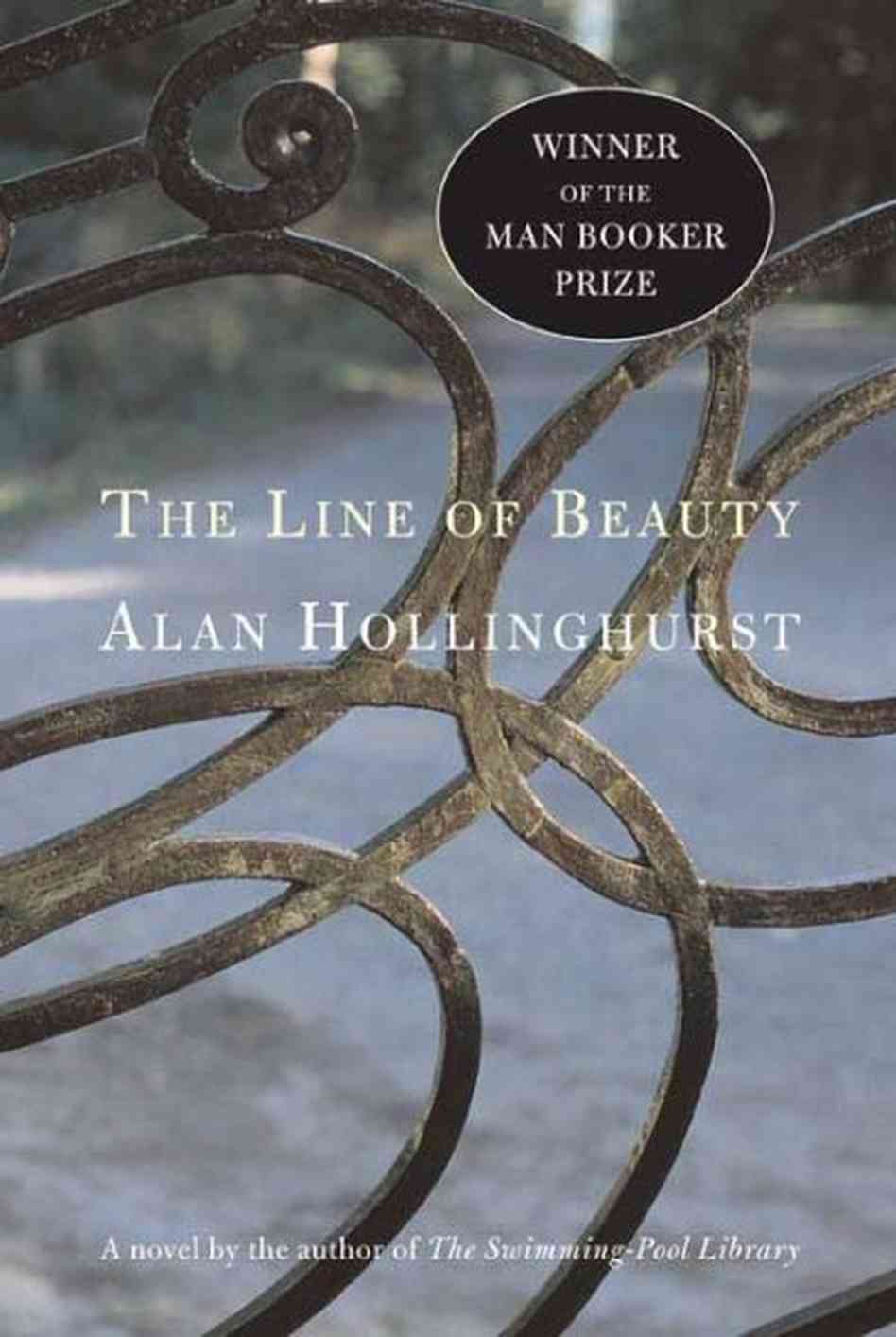
I find it so easy to get lost in the elegance and artistry of Alan Hollinghurst’s The Line of Beauty. I originally planned to read this book in a day or two, but it took me a while longer simply because I was so enthralled and moved by the novel’s baroque descriptions and its aesthetic focus on issues pertaining to gayness and queerness during the 1980s. Blurring the lines between gay historical fiction, the Bildungsroman, and the novel of manners, The Line of Beauty explores the lines that divide British upper-class and middle-class society, and the relationship between homosexual identity and class during the conservative boom in the United Kingdom under the rule of Margaret Thatcher. Even more so, Hollinghurst’s novel offers readers an opportunity to examine the heartbreaking effects of AIDS during the rise of the disease.
The novel centers on the life and experiences of Nick Guest in his early twenties, as he graduates from Oxford University and begins a postgraduate degree in English at another university–where he specializes on the issue of style in the works of Henry James. Nick becomes close friends with Toby and Catherine, who are the children of Gerald Fedden, a wealthy Member of the British Parliament. Although Toby and Nick are best friends, Nick becomes very close and intimate with Catherine, a manic-depressive. Because of Nick’s ability to understand and help Catherine, Gerald invites Nick to stay in his mansion so that he can keep a watchful eye over his daughter. Nick stays at the Fedden residence for four years; here, he not only learns about the radical differences that exist between the lavish lifestyle of the Feddens and his own middle-class upbringing, but he also begins to explore his gay identity by dating an older and much more experienced black council worker named Leo. Although Nick is out to the Fedden family, the issue of homosexuality instills a sense of discomfort in Gerald and his wife, Rachel. The family’s attitude towards homosexuality is made apparent early in the novel, when the family discusses the case of Hector Maltby, a junior minister of the Foreign Office who was caught having sex with a rent boy in his Jaguar:
The story had been all over the papers last week, and it was silly of Nick to feel as self-conscious as he suddenly did, blushing as if he’d been caught in a Jaguar himself. It was often like this when the homosexual subject came up, and even in the Fedden’s tolerant kitchen he stiffened in apprehension about what might carelessly be said–some indirect insult to swallow, a joke to be weakly smiled at. (22)
The residents of the Fedden estate are characterized not only by their social hypocrisy, but also by their silences: by refusing to talk of certain issues, they strive to act as if said issues are minor, non-consequential, and non-existent. As a matter of fact, Nick is characterized by his penchant for concealing or hiding information to assure that certain perceptions or attitudes are upheld in the Fedden residence. For instance, at the beginning of the novel, Nick discovers that Catherine, who has already attempted to harm herself, has been storing sharp tools within her bedroom. Rather than discussing this detail with Catherine’s parents, he decides to keep this information concealed to avoid upsetting Gerald and Rachel when they return from their trip. Nick not only conceals truths that he believes will upset the Fedden family, but he also has issues when it comes to separating fact from fiction–which leads to the manifestation of the vicious cycles that are so characteristic of postmodern texts:
In the course of their long conversations about men he had let one or two of his fantasies assume the status of fact, had lied a little, and had left some of Catherine’s assumptions about him unchallenged. His confessed but entirely imaginary seductions took on–partly through the special effort required to invent them and repeat them consistently–the quality of real memories. (24)
Sometimes his memory of books he pretended to have read became almost as vivid as books he had read and half-forgotten, by some fertile process of auto-suggestion. (48)
As evidenced above, Nick not only strives to conceal truth to uphold his social image, but he also fabricates stories to uphold a socially appealing facade. He frets when it comes to revealing his lack of knowledge or his lack of sexual experience–to the point where his fabrications become entirely real to him, or even worse, to the point where he deliberately forgets or represses truths about himself. This is perhaps most apparent when the novel, which is comprised of three parts, transitions from part one to part two. Part one, which takes place in 1983, concludes with Nick and Leo sleeping together in the Fedden’s house. The second part of the book takes place three years later, and it begins with a description of Nick’s affair with Wani Ouradi, a multi-millionaire of Lebanese descent who is engaged to a woman. This temporal leap leaves a gap in the narrative of the story. As readers, we have no clue what happened between Leo and Nick during this three-year span–all we are sure of is that they are no longer together, and that Nick’s relationship with Wani is masochistic and unhealthy. Not only is Wani into promiscuous and unsafe sex with strangers, but he is also addicted to porn and cocaine, and he is also deeply closeted. Nick, however, remains by Wani’s side not because the relationship is practical, but rather, because Wani is beautiful. This connects to one of the novel’s main themes, in which appearances trump pragmatics and livability. This desire for beauty and for appearance ultimately affects Nick’s ability to face his own truths, as is seen in the instance in which he encounters Wani seducing a stranger:
He went across the room and put the car keys down on the side table, and when he looked back Ricky and Wani were snogging, nothing had been said, there were sighs of consent, a moment’s glitter of saliva before a shockingly tender second kiss. Nick gave a breathy laugh, and looked away, in the grip of a misery unfelt since childhood, and too fierce and shaming to be allowed to last. (173)
Later on in the novel, Nick finds out that Leo has died due to AIDS-related complications. As Leo’s sister tells Nick the news, he at first wants to lie to her by stating that Leo dumped him, but he recognizes that this lie would seem petty, especially when considering the fact that Leo is no longer alive. Although Nick convinces himself that Leo was seeing someone else, we realize that he develops this “memory” to conceal the fact that he broke up with Leo soon after finding out that he was sick– “to screen a glimpse he’d had of a much worse story, that Leo was ill” (350). It becomes clear at this point that the three-year gap in the novel represents Nick’s unwillingness to deal with or recall the truths behind his relationship with Leo. Leo’s illness, in Nick’s eyes, would corrupt his beauty and make him imperfect, which is why he pursues a relationship with the physically flawless and beautiful Wani. However, towards the conclusion of the novel, it is revealed that Wani is also dying of AIDS-related complications–thus forcing Nick to meet truth face-to-face, while simultaneously forcing him to confront the realities of his own life.
I find it interesting that Catherine, the manic-depressive sisterly figure of the novel, is represented as the only person capable of dealing with truth and looking beyond the lies fabricated by her peers. For instance, when one of her friends, Pat, dies of AIDS, her family desperately tries to conceal that he died of this illness to prevent themselves being associated with a so-called “gay-related” disease. Catherine, however, forces the family to face the truth about Pat’s death, even though this confrontation leads to public shame and embarrassment. She later tries to convince Nick that “People are lovely because we love them, not the other way round” (304), to make him realize how toxic his relationship with Wani truly is, and to prove to him that the value that we bestow to people and objects should be based on more than just aesthetics. Catherine ultimately induces both the downfall of Nick and of her father, by revealing truths to the press: she not only reveals the fact that her father is having an affair with another woman, but she also reveals how Nick and Wani’s affair is taking place within the Fedden household–thus collapsing the differences between the gay and the straight world upheld by the Fedden family. The novel isn’t explicit of whether Catherine’s thirst for truth is triggered by her depression, or whether her depression was caused by her desire for truth in a mendacious environment–but it is interesting to observe how a character with a non-normative state of mind is able to look beyond the social masks and constructs that haunt the lives of these characters.
I love this novel. It is dense, thematically rich, and it is full of gaps and plot holes. It is not an easy novel to read or follow, but it excels at portraying the triumphs and failures of characters who are enticed and enslaved by the pursuit of beauty, even at the cost of truth, pragmatism, and reality. I also appreciate how this novel uses pastiche in order to invoke historical conceptions of AIDS in a contemporary platform–especially since discussions of AIDS have unfortunately diminished since the normativization of the disease due to the advent of anti-viral medications.
What are your thoughts or impressions of this novel? Feel free to add to this conversation!
You can purchase a copy of Hollinghurst’s novel by clicking here.
Work Cited
Hollinghurst, Alan. The Line of Beauty. New York: Bloomsbury, 2004. Print (hardcover edition).


 Angel Daniel Matos