On the Decentralization of Truth and Memory in Achy Obejas’ [Memory Mambo]

Front cover of Achy Obejas' Memory Mambo (1996)
Front cover of Achy Obejas’ Memory Mambo (1996)

Achy Obejas’ Lambda Award-winning novel, Memory Mambo, is a text that simmers and lingers within the mind long after it is read. I initially decided to read this novel because it centers on the life of a Cuban-American lesbian who administrates a laundry service in the Midwest, however, it is a much more complex and rich read when compared to your average LGBTQ novel. True to its name, I would say that this text is ultimately an exploration of the strengths and fallacies of memory, especially when it comes to understanding and interpreting of truth. Even more so, Memory Mambo, at least in my view, is a novel that is first and foremost about decentralization–or in other words, the redistribution of power and control away from a central unit or “command” center. In the case of this novel, decentralization is focused mostly on the self, and it illustrates how the self is unable to account for the totality of memory and the totality of experience.

Similar to Sandra Cisnero’s 1984 novel entitled The House on Mango StreetJuani, the novel’s protagonist, is not only characterized through her own experiences and trials, but she is also characterized through elaborate stories concerning her relatives and her extended family. The novel is difficult to summarize due to its fragmented and chaotic focus. It begins with Juani questioning the nature of memory as she looks back at her childhood in Cuba. As a child, Juani and her parents escaped to the United States on a boat in an effort to leave behind the social and political climate of the island. The narrative segues into an exploration of Juani’s close family members, such as her mother, her father, her siblings, and her cousins. The first chapter focusing exclusively on her father is very revealing in terms of the novel’s aims and themes. He is described as a fabricator of stories. For instance, he claims to be the inventor of duct tape, and he also accuses the CIA of stealing his invention. The father tells this story to every person he encounters, and every time, the father bends the truth to suit his moods and to appease his audiences’ tastes. The father’s tendency to fabricate and alter stories reifies the novel’s aim of highlighting the flexible and malleable nature of truth, in addition to illustrating how truth and memory are dependent on others besides the self.

Although the novel has multiple story arcs, there are two in particular that stand out:

  • The tumultuous relationship between Juani’s cousin, Caridad, and Caridad’s husband, Jimmy. Jimmy is a chauvinistic, sadistic man who abuses Caridad emotionally and physically–doing things such as beating her, preventing her from going out, and going as far as to buy Caridad a washing machine even when her family owns the local laundry-mat. Juani and Jimmy loathe each other, mostly because Jimmy perceives Juani to be the same way he is. Jimmy perceives Juani’s lesbianism to be a threat, and he is constantly trying to sexually harass her, claiming that she is nothing but a victim of penis envy. One of the novel’s highest poinst of tension occurs when Jimmy covers up a violent incident that Juani is involved in, in order to make Juani feel as if she is indebted to him. Because of this “debt,” Jimmy tries to persuade Juani to cover for him after he is caught sexually molesting Rosa, the baby of Juani’s cousin, Pauli.
  • The “main” arc of the novel would be Juani’s unstable relationship with Gina, a Puerto Rican socialist and activist with strong political convictions and views. Gina is approached as a hypocrite by other characters because although she claims to be a feminist and an activist, she is deeply closeted and refuses to show any signs that she’s going to come out: “Gina wasn’t out, didn’t have any plans to come out, and wasn’t in a hurry to even consider it. For Gina, what we had was wonderful, but passing; thrilling, but temporary; an adventure, but only for memory’s sake” (121). Juani finds herself in a position in which she significantly has to change who she is in order to please Gina–she changes everything from her taste in music to her taste in clothing in order to appeal to Gina’s environmentalist and feminist sensibilities. Gina’s closeted sexuality in addition to her radically different political ideologies, lead to the escalation of tension between her and Juani. This tension explodes with a brutally violent fight between the two women, which leads to broken noses and bitten breasts. Their fight is the incident that Jimmy helps to conceal in order to assure that Juani’s family doesn’t get upset with her.

This novel, as can be seen above, is very violent and charged, but the deep and almost philosophical musings that take place in the narrative certainly compensate for the presence of many shocking and disturbing scenes. Seeing as the novel centers immensely on the notions of memory and truth, I was often captivated and intrigued by the difficulties that Juani had when it came to understanding and accepting events and realities in her life. The first chapter of the novel eloquently opens with a questioning of memory as a distinct, individualistic, and unified phenomenon–leading Juani to question whether her memories are constructions based on the stories told by other people. Because of this, the divides between fact and fiction, and lived reality and narrated reality, collapse from the get go. Even more so, Juani seems to approach memory as an entity that is shared amongst many people–memory, in this case, is approached as a decentralized phenomenon:

Sometimes I’m sure that I couldn’t have heard the stories about the memories anymore than lived through them–that both of the experiences are false for me–and yet the memory itself will be so fresh, so fantastic and detailed, that I’ll think maybe my family and I are just too close to each other. Sometimes I wonder if we’re not together too much, day in and day out, working and eating side by side, sleeping in the same rooms, fusing dreams. Sometimes I wonder if we know where we each end and the others begin. (9)

What I find fascinating about this passage is that memory, rather than being approached as a hard drive or a disk, seems to be depicted in a fashion that is more reminiscent of an internet network, in which memory is shared, interconnected, fragmented, and alterable. In Memory Mambo, it is clearly shown that most of the novel’s major tensions and issues surface when truth, like memory, is approached as an individualistic and solitary force, when in reality, most of these problems could be solved if only the truth were shared and decentralized in a similar fashion to memory. This notion is exemplified with Juani’s discussion of her lesbian cousin, Titi, who has tried to escape Cuba, unsuccessfully, several times. Although Titi does have affairs with other women, these affairs must remain private within the insular confines of Cuba. Juani believes that Titi’s desire to escape Cuba is fueled by her longing to express truth beyond the confines of the private. As Juani asserts, all of Titi’s lovers are unable to satisfy her need “to be loved in daylight–to walk down the street arm in arm with her lover without the pretense of a mere friendship, to be utterly and ordinarily in love” (76).

Titi’s issues mirror Juani’s own issues when it comes to her sexuality. Juani admits that she creates a divide between her family life and her sexuality, deliberately maintaining borders and distance in order to assure that her family isn’t disrupted or disturbed by Juani’s non-normativity. Juani walks the balancing line between complete honesty and secrecy–tethering truth to the unstable power of language. What I mean by this is that although Juani’s family knows about her lesbianism, they do not speak about it because it would reify certain details of Juani’s life that would tarnish the family’s so-called normalcy. Juani’s father, in particular, never seeks the truth from his daughter, and he even goes as far as to help Juani conceal the truth about her sexuality when other family members are probing her. His motivations for doing so are quite selfish and heartbreaking: “His motivation isn’t to spare me discomfort but to save himself. Because he’s afraid I won’t lie, it’s vital to him that I not be provoked into the truth. In my family, this is always the most important thing” (80).

It is when Juani is provoked into truth that she realizes how fragmented and decentralized memory truly is. This moment of truth takes place when Gina asks Juani whether she would have left Cuba if she were old enough to make a choice. This question leads Juani to take a close look at her childhood, but this attempt at introspection is thwarted by her inability to recall any real or factual memories during her time at Cuba:

And I realized that I’d left Cuba too young to remember anything but snatches of color an scattered words, like the cutout letters in a ransom note. And what little I could put together had since been forged and painted over by the fervor, malice and nostalgia of others. What did I really know? And who did I believe? Who could I believe? (133)

In due course, Memory Mambo approaches truth and memory as anything but stable and individualistic phenomena. The end of the novel becomes even more suggestive as Juani deliberately tries to deny or recognize the truth of witnessing Rosa being molested by Jimmy. However, her attempt to avoid remembering this instance is ruined when she discovers that her other cousins know the truth about the incident, leaving Juani in a position in which she is unable to lie or conceal the truth. This final incident goes on to exemplify how truth and memory are decentralized agents, and how they exist in networks that cannot be suppressed or contained.

This novel is definitely worth a read. I can’t even begin to list the wide range of emotions that I felt when reading this book, and my mind is currently on overdrive trying to process everything that it is discussed within its pages. The prose is simple to read, but the structure and ideas present in this work are anything but simple.

As always, feel free to add to this conversation in the comments section below!

Work Cited

Obejas, Achy. Memory Mambo. Pittsburgh: Cleis Press, 1996. Print.

For the source of this post’s cover image (neurons), click here.

Gender and Non-Normativity in Jeanette Winterson’s [Oranges Are Not the Only Fruit]

Front cover of Jeanette Winterson's Oranges Are Not the Only Fruit (1985)
Front cover of Jeanette Winterson’s Oranges Are Not the Only Fruit (1985)

Oranges Are Not the Only Fruit (henceforth OANOF) is a 1985 Bildungsroman (novel of development) centered on the life of Jeanette, a girl who is adopted and raised by a woman who happens to be a fundamentalist Christian. Jeanette’s mother believes in literal translations of the Bible, and she freely uses religious rhetoric to accommodate her black and white fashion of viewing the world. As Jeanette, the narrator, mentions early on in the novel, her mother “had never heard of mixed feelings. There were friends and there were enemies” (3). Although Jeanette happens to feel greatly connected to her church and her church’s teachings, this fidelity towards the supposed perfection of the church becomes challenged as she realizes that she is sexually and romantically drawn towards women. OANOF focuses most of its attention on the tensions and frictions that spark when Jeanette’s sexual life clashes with her religious life, and on the drastic measures that her church takes to drive the “demon” of “unnatural passions” away from her.

Although Jeanette’s development and moral growth is most certainly the focus of this novel, a lot of the content is focused on her strange relationship with her mother, and even more so, on the mother’s blind and ritualistic devotion to her church. The mother desperately tries to shield Jeanette from evils, especially those associated with gender and sexuality. For instance, when Jeanette develops a friendship with an ostensibly lesbian couple that runs a paper shop, the mother soon forbids Jeanette from going to that store because there was a rumor that “they dealt in unnatural passions” (7). Seeing as the mother doesn’t speak to her daughter about matters of gender, sexuality, and the body, Jeanette naively believes that “unnatural passions” are referring to the fact that the couple puts chemicals in their sweets.

This desire to protect Jeanette from evil, in addition to the mother’s penchant for explaining phenomena using religious rhetoric, makes it increasingly difficult for Jeanette to adjust to the outer world. For instance, Jeanette goes deaf for three months in the novel. Rather than taking Jeanette to the hospital, the mother begins to inform everyone that Jeanette is “in a state of rapture” (23), and she prevents people from speaking to her. It is Miss Jewsbury, a closeted lesbian, who brings Jeanette to the hospital to be treated for her condition. Jeanette realizes that her condition is due to biological processes rather than spiritual rapture, and it is in this moment that she begins to question the perfection and infallibility of her church:

Since I was born I had assumed that the world ran on very simple lines, like a larger version of our church. Now I was finding that even the church was sometimes confused. This was a problem. But not one I chose to deal with for many years more. (27)

It is in this moment that Jeanette begins her process of development and maturation: it is the moment in which she realizes that her mother doesn’t have all of the right answers, and neither does the church. Thus, rather than resorting to donning the mother’s ideological perspective of the world, which consists of viewing things as either good or bad, Jeanette must learn to challenge herself to explore areas of contradiction and ambiguity that do not necessarily conform with the notions of right or wrong.

It is  during Jeanette’s time time at the hospital that that the motif of oranges becomes heavily introduced into the narrative, for her mother constantly sends her oranges along with some “get better soon” letters when she doesn’t have the time to visit Jeanette. Throughout the novel, the only fruit that Jeanette’s mother will give to her is the orange, for it is “The only fruit” (29). Little is said as to why oranges are deemed to be the only fruit worthy of consumption. However, the meaning behind the orange is not necessarily based on the fruit itself, but rather, on how the fruit is used. First and foremost, oranges become a way of further characterizing Jeanette’s mother, showing how she perceives the world categorically, and showing how she desires to limit the options that Jeanette can have. Furthermore, since oranges are the only fruit that are validated from the mother’s perspective, all of other fruit go on to lack legitimacy. Much later on in the novel, when Jeanette gets slightly ill, her mother brings her a bowl of oranges, and the following scenario takes place:

I took out the largest and tried to peel it. The skin hung stubborn, and soon I lay panting, angry and defeated. What about grapes or bananas? I did finally pull away the other shell, and, cupping both hands round, tore open the fruit. (113)

In this context, it becomes a little more clear that oranges are representing either gender or heterosexuality. By questioning why she can’t have other fruit, Jeanette puts into question the limitations that are imposed on her in terms of her choices and preferences. Notice that she has trouble accessing the orange’s pulp, which can symbolize the difficulty that Jeanette has towards complying with a simplistic, limited, heteronormative view of the world. It would be much easier for her to eat grapes or bananas, however, we observe that Jeanette’s mother is still coercing her to struggle with oranges.

The entire spectrum of fruit, in this interpretive view, would go on to represent the entire spectrum of gender–the mother’s efforts to impose oranges as the only good fruit go on to represent efforts to approach a single gender or sexual orientation has valid and legitimate. As can be expected, the mother’s views toward fruit also apply towards her views on gender and sexuality: “I remembered the famous incident of the man who’d come to our church with his boyfriend. At least, they were holding hands. ‘Should have been a woman that one,’ my mother had remarked” (127). This leads Jeanette to one of her many philosophical musings, in which she recognizes the fact that her mother is unable to interpret the world without resorting to the use of binaristic thinking. Instead of accepting the fact that these two men are, in due course, simply men, she resorts to approaching one of the men as a woman. But, as Jeanette remarks:

This was clearly not true. At that point I had no notion of sexual politics, but I knew that a homosexual is further from a woman than a rhinoceros. Now that I do have a number of notions about sexual politics, this early observation holds good. There are shades of meaning, but a man is a man, wherever you find it. (128)

The desire to steer away from convention and normativity is a staple of this novel. Just as Jeanette desires another fruit besides an orange, she also desires to be romantically involved with someone besides a man. Jeanette’s penchant for non-normativity is even expressed in her artistic inclinations and projects. While Jeanette is in school, she truly strives to win a prize in the school’s various artistic competitions. While at first she loses these competitions because of her adherence to religious doctrine, she notices that she still continues to lose competitions even when she presents projects that are non-religious in their themes. For instance, in an Easter Egg painting competition, Jeanette creates an elaborate diorama that recreates a scene from Richard Wagner’s Der Ring des NibelungenHowever, she loses to a a student who covers eggs in cotton in order with the title of “Easter Bunnies” (48). Jeanette realizes that even though her masterpiece was definitely the best project submitted to the competition, she loses simply because she steers away from convention. Rather than creating a habitual Easter-themed project for the competition, she strives to be different and creative, which essentially makes Jeanette a queer character in many other aspects besides her sexuality.

As I mentioned previously, Jeanette’s queerness certainly causes her a lot of pain and heartache, which is perhaps epitomized when she is publicly accused for being a lesbian while in church. The church members deem that Jeanette and her girlfriend, Melanie, have engaged in homosexual activity because they are possessed by demons. This accusation sparks a lot of commotion in the church, and thus, one of the most confusing and convoluted sections of this novel takes place. After the accusation, Jeanette escapes the church and goes to Miss Jewbury’s home. Miss Jewbury does her best to comfort Jeanette, and out of the blue, the two have sex: “We made love and I hated it and hated it, but would not stop” (106). When Jeanette returns home after her encounter with Jewbury, the tension of the novel escalates to an unprecedented degree as members of her church congregation perform an intense exorcism on her. The members stay from 8:30 a.m. to 10:30 p.m. “praying over [her], laying hands on [her], urging [her] to repent [her] sins before the Lord” (107). The exorcism ultimately culminates with Jeanette being locked up in a room for 36 hours without food, and she only claims to be repentant in order to get access to food.

The resolution and “conclusion” of the novel focus on Jeanette becoming closely involved with the church as she also begins a relationship with a new church member named Katy. Contrary to the beliefs of her congregation, Jeanette firmly believes that her spiritual and sexual life are able to coexist. She is soon caught in a compromising situation with Katy, and her mother proceeds to kick her out of their home. This so-called failure pushes Jeanette to move to a city and start a new life–while unfortunately being deprived of her family and her history. She eventually returns to her old home to visit her mother, who seems to express a degree of ambivalence towards Jeanette–they do talk, but they never discuss Jeanette’s love life. The conclusion, however, shows a surprising revelation: Jeanette’s mother starts its first mission with black people–and she serves them pineapple because “she thought that’s what they ate” (172). Because of this, Jeanette’s mother ends up eating many dishes with pineapple in it, while claiming, philosophically, that “oranges are not the only fruit” (172). Thus, while the novel certainly ends in a sad note, indicating that many people still believe that Jeanette is possessed, the mother’s acceptance of other fruit leads the reader to believe that perhaps the mother is not viewing the world in the conceptually simplistic fashion that she used to. Just like white and black communities are starting to coexist in the mother’s church, the mother’s black and white conceptual distinctions start to blur.

On a personal note, this novel is fabulous. It is touching, shocking, and even funny at times. This novel is definitely a cornerstone of LGBTQ lit, even though the author does not necessarily consider OANOF to be a lesbian novel.  While I do recognize the universality of the themes present in the novel, I can particularly see how LGBTQ readers would appreciate and love this masterpiece.

You can purchase a copy of Winterson’s novel here.

Thoughts? Comments? Opinions? Please feel free to engage in this conversation using the comments section below!

Work Cited

Winterson, Jeanette. Oranges Are Not the Only Fruit. London: Pandora, 1989. Print (paperback edition).

Masculinity in Robert Cormier’s [The Chocolate War]

Front cover of Robert Cormier's The Chocolate War
Front cover of Robert Cormier’s The Chocolate War

It’s 1:53 a.m. and I currently can’t sleep because of this book. I was going to wait and write about it in the morning, but I really need to engage in the cathartic process of writing in order to make sense of all of the thoughts that are fireworking in my head. I was expecting a tale that discusses the triumph of good over evil–a tale of empowerment for individualistic resistance over systematic injustice. I received the opposite. Don’t get me wrong, I think The Chocolate War has earned a place in my top-ten list of favorite YA novels, but I will warn you that the book is ultimately very bleak and depressing. If your positive judgment of a book depends on a happy ending, then I suggest that you skip this novel.

The Chocolate War is a book that is told from a subjective third person point-of-view, but this perspective carousels through the thoughts and emotions of particular students at Trinity School: a private, religiously-affiliated high school in the New England area. Although the story centers on the thoughts of various students in the school, it can be said that Jerry Renault is the novel’s protagonist, and he is also the source of the novel’s main tension. Although the Trinity School is technically run by the Brethren that teach and administer the educational system, the thoughts and actions of students are also dictated by a secret school society known as The Vigils, who use scare tactics and intimidation in order to secure their influence.

Students are often given “assignments” by The Vigils, which can be approached as a type of hazing that the secret society uses to assure that it is perceived as a force to be reckoned with. Assignments can include mundane things such as forcing students to get up from their seats every time a teacher mentions the word “environment,” to more serious matters, such as destabilizing all of the desks and chairs in a classroom. During the school’s annual chocolate fundraiser, Jerry Renault is given the assignment to deny selling chocolates for ten days–a problem, seeing as every student besides Renault decides to sell chocolate. The main issue in the novel arises when Jerry continues to resist selling chocolates after the ten day period in an act of defiance towards The Vigils and the school administration. The bulk of the novel focuses on the ostracism that Jerry faces when trying to defy The Vigils, and the measures that they take to assure their power and dominance in Trinity School. By taking a stand, Jerry tries to follow and understand the words of T.S. Eliot by asking himself whether he dares to “disturb the universe,” (see Eliot’s “The Love Song of J. Alfred Prufrock“) a quote found on a poster that Jerry has in his locker.

The Chocolate War is a very gendered novel, which is partly unsurprising given the fact that Trinity School focuses on single-sex male education. Various elements within the novel emphasize maleness and the traits that are usually (and stereotypically) associated with it, such as power, dominance, and violence. Sports such as boxing and football are the most popular and revered activities that take place within the school; their practice often demonstrates how physical prowess often trumps intelligence and creativity in this environment. All teachers within the school are religiously affiliated men, and they are addressed as Brother by students. As a matter of fact, there is little to no feminine or maternal presence in the novel. When girls are mentioned by students, they are usually presented as objects of sexual attraction. Even Jerry is known for his lack of a maternal figure, since early in the novel it is established that his mother passed away during the spring before his freshman year (the time period in which the novel takes place). This lack of a feminine presence is in no way a mishap, and it actually serves as a motif to foreground the power struggles and dynamics that are in the heart of The Chocolate War. 

The characters’ efforts to uphold a visage of traditional masculinity is overwhelming. Whenever certain characters, such as Archie (the novel’s twisted and manipulative villain), encounter another figure that is trumping them in terms of authority, they automatically regress into an irrational inner struggle of Patrick Bateman-esque proportions. Take for instance, Archie’s reaction when The Vigils’ president threatens him:

Blood stung Archie’s cheeks and a pulse throbbed dangerously in his temple. No one had ever talked to him that way before, not in front of everyone like this. With an effort he made himself stay loose, kept that smile on his lips like a label on a bottle, hiding his humiliation. (187)

Many other characters in the novel are unable to contain their fits of tears and frustration when encountering the many injustices triggered by the rule of The Vigils. However, the most salient trait that is exemplified through this constructed masculine space would be violence–not only subjective violence, as in fist-fights, bullying, and physiological reactions, but also objective violence as represented through hate speech and through the manipulation and control enforced by the secret society and the school administration (please see Zizek’s Violence for more information on these types of violence). At first, Jerry’s decision to refuse selling chocolates can be considered an act of resistance towards the objective violence that is systematically imposed upon all students at Trinity High. The downward spiral for Jerry, however, occurs when this objective violence flourishes into downright brutal and subjective violence. The moment of this transition is seen quite literally in the novel, when a bully by the name of Janza is blackmailed into harassing Jerry to the point that he reciprocates violence with more violence (rather than resistance). As can be seen in the following exchange between Jerry and Janza:

“Hiding what? Hiding from who?” [Jerry]

“From everybody. From yourself, even. Hiding that deep dark secret.”

“What secret?” Confused now.

“That you’re a fairy. A queer. Living in the closet, hiding away.”

Vomit threatened Jerry’s throat, a nauseous geyser he could barely hold down.

“Hey, you’re blushing,” Janza said. “The fairy’s blushing . . .”

“Listen . . .” Jerry began but not knowing, really, how to begin or where. The worst thing in the world–to be called queer. (211-212)

After this exchange, Jerry retorts by calling Janza a “son of a bitch,” which leads Janza to summon a group of kids that brutally bash Jerry. Note here that what fuels Jerry’s wrath is the fact that he is called queer. Up to that point, he had done a decent job of resisting the taunts and threats of his peers due to his refusal to sell chocolates. What I find interesting in this chapter is that in essence, Jerry can be approached as a queer (or non-normative) character due to the fact that he denies engaging in the activity that will make him normal or orthodox–if he didn’t want to set himself apart, all he had to do was sell chocolates. His resistance, however, can be approached as queer resistance because he wanted to break away from the norm: “Mainly, he didn’t want to fight for the same reason he wasn’t selling the chocolates–he wanted to make his own decisions, do his own thing, like they said” (211).

Despite his penchant for non-normativity, being called a queer was too offensive and disruptive given the masculine attitudes that permeate his surroundings. Thus, Jerry’s hatred towards Janza for calling him queer even pushes him to engage in the boxing match at the end, a boxing match that leads to his demise. The final chapters of the novel end with Jerry proclaiming his regret towards being non-normative, he proceeds to think about how one must ultimately comply with the will of “superior powers” and authority figures if one desires to have a livable life. He thinks about the new “knowledge” he has obtained as he lies bloodied and broken in the arms of his friend, Goober:

He had to tell Goober to play ball, to play football, to run, to make the team, to sell the chocolates, to sell whatever they wanted you to sell, to do whatever they wanted you to do. He tried to voice the words but there was something wrong with his mouth, his teeth, his face. But he went ahead anyway, telling Goober what he needed to know. They tell you to do your thing but they don’t mean it. They don’t want you to do your thing, not unless it happens to be their thing, too. It’s a laugh, Goober, a fake. Don’t disturb the universe, Goober, no matter what the posters say. (p. 259)

The ending may be bleak and downright depressing, but I don’t necessarily think that the novel is designed to perpetuate a dislike of rebellion, nor do I think that it presents all resistance movements as futile. I think that Jerry’s loss of faith in himself and in his ability to disturb the universe rests not on his failure, but on the fact that he was left alone in his pursuit of non-normativity. What I found deeply disturbing is that nobody takes a stand for Jerry during the boxing match that leads to his demise, not even his close friend, Goober, who just sits and watches Jerry be beaten to a pulp with the rest of the students from Trinity High. Without a doubt, Jerry is presented as a scapegoat figure, meant to absorb all of the negativity, the tensions, and the evils of his community that are perpetuated through masculinity and through corrupt power.

The novel is ambiguous in terms of its stance on disturbing the universe. On one hand, we can accept Jerry’s defeat as a cautionary tale. On the other hand, we can accept it as a challenge to ourselves–a challenge that pushes us to question the extent to which we can or should disturb the universe ourselves.

Do yourself a favor, and read the book! And as always, please feel free to add to this conversation or to challenge anything discussed in this post!

You can purchase a copy of Cormier’s novel here.

Work Cited

Cormier, Robert. The Chocolate War. New York: Dell Laurel-Leaf, 1974. Print.

J.C. Lillis’ [How to Repair a Mechanical Heart]: A Gay YA Novel on Fandom, Religion, and Canonicity

Front cover of J.C. Lillis' How to Repair a Mechanical Heart (2012)
Front cover of J.C. Lillis’ How to Repair a Mechanical Heart (2012)

If there is one thing that gay young adult fiction should be thankful for, that thing would be the internet. Because of the advent of the web, we have witnessed the increase of self-published e-novels distributed through online stores such as Amazon and Barnes and Noble. Self-publishing, in my opinion, greatly expands the possibilities of gay young adult fiction, not only because authors are free to be more experimental and explicit when it comes to the novel’s content and structure, but also because they do not have to comply with the expectations and demands of a publishing house or an editor. J.C. Lillis’ How to Repair a Mechanical Heart (2012) is definitely one of the most unique gay YA novels that I have read this year, not only in terms of its content, but also in terms of its narrative techniques and devices. Although, on the surface level, the novel is centered on the blossoming relationship between two teenage boys, How to Repair a Mechanical Heart, offers readers a fresh take on the uneasy tension that exists between religion and homosexuality.

Now, religion is a topic that is found in many YA books dealing with homosexuality. Some of these novels, such as Alex Sanchez’s The God Box, take a more didactic and realistic approach to the issue, going as far as to present characters that discuss homosexuality by directly citing a barrage of Biblical rhetoric. Other novels, such as Timothy Carter’s Evil?, take a more fantastical and satirical (and hilarious) approach to the tension between religion and homosexuality through the incorporation of characters such as demons and fallen angels. How to Repair a Mechanical Heart tackles the issue of religion and homosexuality through a realistic approach, however, the exploration of this issue is framed through an exploration of fandom subculture. Although at first I was skeptical about whether a gay YA novel could pull off discussing tough issues through fan culture (which includes Comic Con-esque events, the reading and creation of fan fiction, and even the critique of television shows via vlogs), by the end, I thought that Lillis managed to pull it off beautifully. This novel turned out to be an entertaining, complex, and funny read in spite of its often heavy-handed themes and events.

The novel focuses on Brandon and Abel, two fans of a science fiction show entitled Castaway Planet. This show centers on the space adventures of two main characters: Cadmus, a hot-headed, impulsive, and unpredictable explorer; and Sim, an android who is intelligent, calculating, and incapable of feeling human emotion. Brandon and Abel are the hosts of a Castaway Planet vlog, where they deconstruct episodes of the television series, and where they offer critiques of Castaway Planet fan fiction that they dislike. The fan fiction that really grind their gears, however, would be those that ship Cadmus and Sim, for they deem that this relationship is absolutely implausible and disjointed from the themes and reality of the show. Their dislike for this type of fan fiction leads them to partake on a road trip across the country with their friend, Bec, in order to interview the show’s actors in hopes of discrediting any fanfic author who ships Cadmus and Sim. Their anger toward this shipping arises from the fact that Brandon and Abel believe that it demonstrates “zero respect for canon or for Cadmus or Sim as characters” (Lillis).

Throughout this road trip, Brandon and Abel not only develop an increasing appreciation towards the shipping of the Castaway Planet characters, but they also discover their true feelings towards each other. However, these feelings are complicated by the fact that Brandon is still unable to let go of the Catholic doctrine that has shaped his views and understanding of amorous relationships. Brandon is ultimately constructed as a dualistic character in that his mind has come to terms with his sexual orientation, but his heart has not. Brandon’s struggles are intensified not only because his childhood priest approaches celibacy as the only viable life choice for a Catholic gay man, but also because Abel previously has had his heart broken by Jonathan, a boy who decided to end their relationship due to the tension that it caused with his religion. Whenever Brandon is engaging in behavior that may be deemed “gay,” Catholic guilt manifests within his consciousness in the form of his childhood priest, who often reprimands him for his poor decisions that supposedly contradict the teachings of the Catholic church.

Lillis’ novel does an excellent job of creating a multi-layered text in which all the layers are not only interconnected but also capable of illuminating important tensions and resolutions in the novel. While at first fandom, fan fiction, Catholism, and homosexuality seem to have little to no relation to one another, Lillis combines them in a unique way that sheds light not only on the construction of identity, but also the personal negotiations that individuals must undergo when facing cultural demands and when fabricating narratives. For instance, discussions of Cadmus and Sim obviously reflect the tensions that exist between Brandon and Abel. Brandon considers that religion has made his heart mechanical in that it runs in an automated fashion that cannot be fixed or controlled. This motif is central in the novel, for religion is approached as the element mechanizes Brandon’s heart and prevents him from fully loving Abel with no regrets or qualms. Abel, on the other hand, resembles Cadmus, for he is approached as an impulsive character who carelessly disregards the difficulties that Brandon faces when trying to repair his mechanical heart.

Surprisingly, fandom and fan fiction were also very useful and illuminating motifs that Lillis incorporates into the novel in order to offer a unique spin on the treatment of homosexuality within the gay YA novel. Fan fiction, most of the times, disregards realism and canonicity in favor of crafting a narrative that goes in accordance with the tastes, expectations, and desires of the fan fiction writer. Fan fiction is a particularly noteworthy genre of writing because it becomes a venue that allows viewers to assume an active role within the fictional universe created by a show, a book, or a movie. Furthermore, fan fiction allows the recipients of a cultural artifact to explore alternative narratives, outcomes, and possibilities that are not restricted to canonical norms. For instance, if I’m upset that Ross and Rachel end up together in the series finale of Friends, I can write a fanfic in which Rachel ends up going to Paris and begins a life without Ross.

The creation of fan fiction can be approached as a very queer process, especially when it comes to its focus on alternative outcomes, non-normativity, and a mode driven purely by individualistic desire. In How to Repair a Mechanical Heart, the act of participating within the fan fiction universe is linked to the process of embracing a gay identity, for it involves a refutation of rules and so-called truths in order to seek life alternatives that invoke comfort and livability. Fan fiction and queerness entail a refusal of a normative entity (the canon or heteronormativity) that seeks to regulate “sub par” existences and fictions. This notion becomes particularly apparent near the novel’s conclusion, when Brandon meets the creator of Castaway Planet. When Brandon seems to approach fan fiction with slight “disgust,” and when he approaches the creator of the show as the sole bearer of the show’s truth, the creator reacts very harshly to Brandon’s assumptions:

“Listen, you runt. I saw that self-righteous eyeroll when you said fanfiction. Let me tell you something: I fucking love fanfiction. Why do you think I made up these characters? So I could play with dolls in public and tell everyone else ‘hands off’? So I could spoon-feed you stories from on high about the mysteries of love and free will and giant alien spiders?” He shows me his palms, then the backs of his hands. “I am one man with a laptop. When I give the world my characters, it’s because I don’t want to keep them for myself. You don’t like what I made them do? Fucking tell me I’m wrong! Rewrite the story. Throw in a new plot twist. Make up your own ending. Castaway Planet is supposed to be a living piece of art! (Lillis, location 3278)

The show’s creator overtly refutes any desire to regulate how his characters are used or appropriated. He expresses how people should feel free to take the “truth” depicted by the canon and transform it in ways that go in accordance with their individual wants and desires. The canon is not mechanical in that it requires preciseness and exactness to function, but rather, it is approached as a living entity capable of transformation. In due course, Brandon begins to approach religion in a similar fashion, realizing that he can grow comfortable with belief in a God if he accepts that certain elements within the doctrine are not only open to interpretation, but can also be rewritten to go in accordance with an alternative truth.

Although How to Repair a Mechanical Heart, at times, seems slightly moralizing and repetitive in its treatment of religion, it presents one of the freshest approaches towards spirituality and belief within the confines of a gay YA novel. I think that this novel is very innovative in terms of framing its central issues through fandom subculture, and I especially enjoyed the novel’s overt and explicit decoupage of narrative conventions. While the structure of this text generally follows the linear conventions found within most gay coming-of-age fiction, it consciously employs the style and conventions of the fan fiction genre to add some much needed flair and whimsy to the often stale and dry treatment of religion and homosexuality in YA fiction. I highly recommend this novel for its likable characters, its queer potentiality, and its unique structure and motifs.

You can purchase a copy of Lillis’ novel here, and you can read more about it by clicking here

Work Cited

Lillis, J.C. How to Repair a Mechanical Heart. Amazon Digital Services, 2012. Kindle text.

John Barth’s “Lost in the Funhouse”: A Postmodern Critique of the Developmental Narrative

“Lost in the Funhouse” is a short story in John Barth’s book of the same name, originally published in 1968.  The stories within this collection are typically approached as postmodern due to their self-reflexivity, their self-awareness, and their use of self-reference. The short story “Life in the Funhouse,” in particular, is known for its active destabilization of truth, linearity, and structure, and it is an ideal text to study when engaging in the frustrating exercise of defining postmodernity as it pertains to the study of literary texts.

Plot-wise, not much occurs within this narrative. In a nutshell, a teenage boy named Ambrose travels with his family to Ocean City, Maryland, where they spend most of their time sunbathing at the beach, going on amusement park rides, and entertaining themselves with games at the Ocean City boardwalk. Ambrose is nervous because he really likes this girl named Magda, and wants to develop the courage to confess his love for her. Although he eventually invites Magda to go into a funhouse with him, Magda eventually trails off with Ambrose’s brother, Peter, leaving him alone and isolated within the dark confines of the funhouse. The rest of the narrative traces Ambrose’s thoughts and dissatisfaction caused not only by his inability to express his feelings, but also  by his inability to escape from the funhouse.

This plot, however, constitutes a really small part of the narrative. “Lost in the Funhouse” is peppered with moments of self-reflexivity and meta-awareness, and the narrator often deviates from the plot in order to make claims regarding the intricacies of language, the difficulties of writing, and the impossibility of literary innovation. Within this narrative, we have a triangulation of three perspectives: the perspective of the protagonist, the perspective of the author, and the perspective of the speaker/narrator (who also shares most of the meta-fictional elements within the short story). Given the fact that this text is a meta-fiction, the elements within the story should be approached not only by how they develop the plot, but also by their commentary as pertaining to the acts of writing and reading fiction. This is particularly why close-reading and deconstruction are crucial in terms of determining what the text is trying to achieve. In an attempt to highlight the complexity and richness of this story, let me turn my attention to unpacking the following passage:

One reason for not writing a lost-in-the-funhouse story is that either everybody’s felt what Ambrose feels, in which case it goes without saying, or else no normal person feels such things, in which case Ambrose is a freak. “Is anything more tiresome, in fiction, than the problems of sensitive adolescents?” And it’s all too long and rambling, as if the author. For all a person knows the first time through, the end could be just around the corner; perhaps, not impossibly it’s been within the reach any number of times. On the other hand he may be scarcely past the start, with everything yet to get through, an intolerable idea. (88)

Although plot-wise there is an actual or concrete funhouse, the term is also being invoked as a symbol for narrative, fiction, or perhaps even the mind of the protagonist. “Lost in the Funhouse” is an exploratory narrative that delves into the woes that Ambrose faces when analyzing his own precociousness, and when confronting the confusing and contradictory issues that arise when one grows up–making the story, in essence, a coming-of-age narrative. In the passage above, the narrator uses quotation marks to bring up the tired and overwrought nature of the coming-of-age genre. Furthermore, the quote asks readers to reflect on how sensitive protagonists within this genre suffer from the woes of over-thinking, and how they often share thoughts that are deemed to be too advanced or “unrealisitic” given the protagonist’s age.

It becomes important to question why Barth shares this critique of the “lost-in-the-funhouse” narrative when the story itself incorporates every single element that is critiqued: the protagonist of the story is a sensitive character, who often offers long, rambling, and contradictory interpretations of himself and the people that surround him. The text explores the perceived incongruity of sensitive adolescents expressing ideas that surpass their faculties, at least within fiction: “Is it likely, does it violate the principle of verisimilitude, that a thirteen-year-old boy could make such a sophisticated observation?” (70). Despite this questioning, the protagonist still  engages with intense philosophical and existential ideas, leading the reader to come with their own answers to the aforementioned question. Not only can this be approached as an attempt to destabilize stereotypes in terms of what adolescents are or are not capable of deliberating, but it also pushes the reader to question the foundations that generate these so-called truisms and verisimilitudes.  Is it possible for a teen to conceive of sophisticated ideas? Is there a specific age that a person must reach before being able to formulate complex ideas?

It can be said that the narrator considers the coming-of-age genre to be important or useful given its universality, but at the same time, the text makes overt critiques on the use of conventions and patterns to portray universal themes. Growth, development, and linearity (both from a textual and non-textual perspective) are thus prominent themes that are scrutinized within the depths of the funhouse.

Narrative
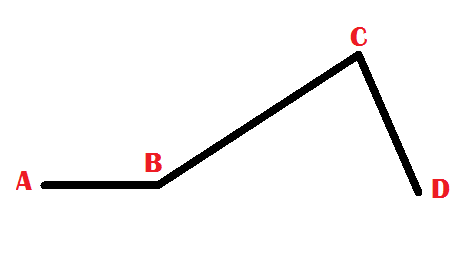
Figure 1. This graphic is a replication of the diagram found in page 91 of “Lost in the Funhouse,” in which the narrator discusses the general pattern that most fictional narratives follow: exposition, conflict, complication, climax, and resolution.

The narrator of the story makes a critique of patterns by illustrating the conventions that narratives usually appropriate in order to assure that they are effective. The text painstakingly depicts the usual structures and conventions that narratives employ to deliver a story (see Figure 1). “Lost in the Funhouse” deviates immensely from the conventional and linear plot, and it is self aware of this deviation: “The beginning should recount the events between Ambrose’s first sight of the funhouse early in the afternoon and his entering it with Magda and Peter in the evening. The middle would narrate all relevant events from the time he loses his way; middles have the double and contradictory function of delaying the climax while at the same time preparing the reader for it” (74). Although the narrator stresses that this is how stories should be structured, “Lost in the Funhouse” deliberately refutes these conventions by delivering a narrative with a prolonged exposition that is contradictory and that does not follow typical patterns of resolution. Details of the plot’s so-called climax, introduction, and conclusion are also scrambled throughout the text, and are not found within the expected locations. Although the narrator admits that this deviation forsakes “the effects of drama” that are possible in the short story, he also makes it clear that this deviation of narrative conventions “can better effect” the dramatic possibilities of the story (91).

With this in mind, it can be argued that the narrator is not necessarily refuting the importance of fiction with sensitive adolescents, but rather, he is contesting the usefulness of a linear narrative to do justice to the multifaceted, complicated, and fragmentary nature of the issues that are faced during the coming-of-age process. I thought this notion was particularly apparent as Ambrose ventures through the maze of mirrors in the funhouse. As Ambrose sees multiple selves being reflected as he tunnels through those mirrored paths, he realizes the futility of trying to approach the self as a single, atomized unit:

Stepping from the treacherous passage at last into the mirror-maze, he saw once again, more clearly than ever, how readily he deceived himself into supposing he was a person. He even foresaw, wincing at his dreadful self-knowledge, that he would repeat the deception, at ever-rarer intervals, all his wretched life, so fearful were the alternatives. (90)

The passage above is one of the most overt critiques on linearity, development, and the conventions that are usually invoked when writing developmental narratives. It attacks the notion of teleology and fulfillment, going as far as to argue that development is not always achieved by following points A to D. Furthermore, this passage refutes the notion of self-fulfillment by highlighting the cyclic nature and the folly of trying to pin down a clear and clean definition of the self. The self is always more fragmented and unreachable than narratives of development usually convey, and the self is always found in a state of constant change and growth. Thus, “Lost in the Funhouse” offers an alternative way of thinking about and approaching the process of development. The narrative implies that it would be foolish to approach an individual’s development through how well he or she complies with conventions of growth, maturation, and development–just as it would be equally foolish to judge this text by how well it adheres to narrative conventions.

When it comes to truth, perhaps the narrator is right when asserting that “we will never get out of the funhouse” (74).

Work Cited

 Barth, John. Lost in the Funhouse. New York: Bantam Books, 1980. Print.

On Asexuality and Kinship: Ellen Wittlinger’s [Hard Love]

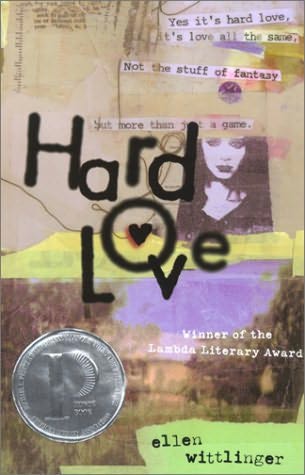
Front cover of Ellen Wittlinger's Hard Love
Front cover of Ellen Wittlinger’s Hard Love

Ellen Wittlinger’s Hard Love is at its core a novel about love, but it is quite different from other young adult novels on the subject that were written in the late 1990s. The narrative is centered on John Galardi (known by some as Gio), a junior in a high school who is still haunted by the ghosts of his parents’ divorce. On one hand, his father abandoned John and his mother because they did not comply with his self-image as an elitist literary publisher and playboy; on the other hand, because of John’s resemblance to his father, his mother has avoided physical contact with her son for over six years (no hugs, no physical proximity, nada). Because of this, John not only has difficulties expressing his emotions, but he also prevents other people from reaching out to him in order to avoid being hurt. He he poingnantly expresses this notion in a letter to his mother:

So I took all of the sadness of the divorce, and all the love I’d once had for both of you [his parents], and all the fear I had of being alone, and turned it into a stone wall to hide behind. To protect myself. I’m so protected now, dear mother, sometimes I feel like I’m barely alive. I am immune to emotion. And I hate you for it. (139)

John’s thoughts and feelings are shared with others anonymously through a zine he writes and publishes titled Bananafishwhich he writes after being inspired by a series of zines he read at a record store. He is particularly drawn to a zine titled Escape Velocitywritten by someone named Marisol, who is a self-proclaimed “Puerto Rican Cuban Yankee Cambridge, Massachusetts, rich spoiled lesbian private-school gifted-and-talented writer virgin looking for love” (9). Drawn to the rawness and honesty of Escape Velocity, John devises a way to meet Marisol at the record store the day she delivers her publication for distribution. Tethered by their emptiness, confusion, and lack of experience, John and Marisol become quick friends–and seeing as Marisol is the first person that John was able to connect to, he falls in love with her. The main tension within this novel arises through this love–John truly believes that their connection transcends labels of sexuality and sexual orientation, whereas Marisol is certain that she’s a lesbian and she can never envision herself dating a man. The narrative then explores whether their friendship can survive the incongruity that exists in terms of their love for each other.

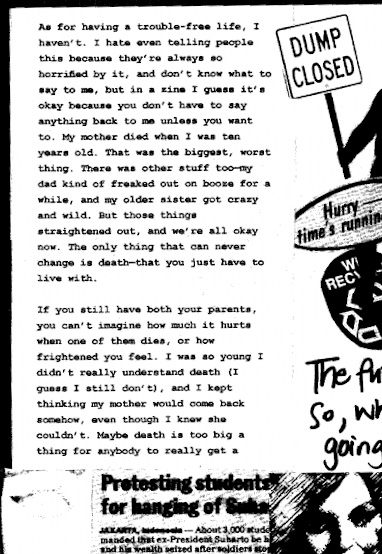
Excerpt from page 93 of Ellen Wittlinger's Hard Love. The novel is mostly told through the protagonist's perspective, and this perspective is enhanced with the novel's zine-like structure. Text is written in different fonts, images and text are combined in unique ways, and the pages sometimes give the impression that they are collages of letters, newspaper clips, and clip art.
Excerpt from page 93 of Ellen Wittlinger’s Hard Love, illustrating one of the many zines that John reads throughout the narrative. The novel is mostly told through the protagonist’s perspective, and this perspective is enhanced with the novel’s zine-like structure. Text is written in different fonts, images and text are juxtaposed in unique ways, and the pages sometimes give the impression that they are collages of letters, newspaper clips, and clip art.

As can be seen in the image above, Hard Love is structurally interesting because it is presented as a collage-like collection of letters, narrative, images, newspaper clippings, poems, autobiographical pieces, and general musings that attempt to replicate the feel of an actual zine. All of these mediums work together to give us a snapshot of John’s mind. The fragmented feel of the novel does an exemplary job of concretely depicting John’s anger, confusion, and truth while at the same time leaving enough room for the protagonist to be ambiguous and difficult to understand.  John’s characterization was very intriguing to me, not only because of the novel’s structure, but also because of his gender identity and sexuality. For instance, early on in the novel, John expresses his inability to find women attractive, and he often expresses his disdain towards his friend Brian because of the latter’s overly enthusiastic attraction to women that he has never spoken with. As a matter of fact, for a while I was convinced that John was asexual, which would’ve been amazing given that as of yet,  I’ve not encountered an explicitly asexual character in a young adult novel. I got this sense in passages such as the following:

I can’t stand it anymore, the constant talk about girls and sex. I just don’t feel like thinking about that stuff. Waybe it’s weird, but I’m not interested in it. I mean, it worries me a little sometimes, because I guess guys my age are supposed to be like Brian, lusting after pouty lips and big boobs. But to me, the mystery of female body parts is one I’d just as soon not solve. Not that I’m interested in boys either–I’m just not interested in the whole idea of locked lips or proclamations of love. (19)

John’s sexual ambiguity and his inability to discern his sexual inclinations becomes a prominent issue in the early chapters of Hard Love, and there are instances in which John is unable to deduce whether he can potentially be attracted to any sex at all. At one point, John admits to Marisol that he possible could be gay, but he hasn’t taken a moment to contemplate this possibility. My initial reading of John as potentially asexual was further evidenced by Marisol’s attempt to fix up John with her gay friend, Birdie. This fix up fails, however, because Birdie thinks John is heterosexual based on his behavior and attitudes. Let me turn my attention to the following exchange between Birdie and John after the latter is accused of not being gay:

“What do you mean? I’m not  even sure myself if I’m gay or not. I mean, I’ve been thinking maybe I am.”

You have? Are you attracted to men?” Birdie asked.

“Well, no. But I’m not attracted to women either.”

“Oh, well, that’s just dysfunctional, not gay,” Birdie announced confidently. I was lost for a comeback. (52-53)

Marisol then asks whether John was disappointed to find out that he is not gay, to which he responds “It’s just Birdie’s opinion” (53). Now, there are obvious issues of asexual representation in the exchange between Birdie and John, because asexuaity is viewed as a dysfunction rather than an alternative way of being. It is possible to perceive a tension between John’s attempt to define his sexuality while at the same time having it defined by others. John’s non-normative sexual behavior and attitudes certainly make him queer to some extent, but this queerness is somewhat subdued when John “discovers” his heterosexuality through his attraction to Marisol. Although he confesses his love to Marisol, she does not reciprocate his feelings. She admits she loves him, but only “as much as [she] can” (223). Although he is attracted to Marisol, who is a woman, John suggests that his love is not a matter of genitalia and sex, but rather, who is capable of seeing one for who they truly are:

To tell the truth it couldn’t matter less

who wears the pants or the dress, but only

who becomes visible to whom.

You saw me truly, and I saw all you let me;

I’m not lying now, and I hope I never will. (205)

What makes this novel unique is that it is a love story that focuses on a protagonist who views love as a matter of connection rather than of sex or sexual orientation–although this in turn is problematic, mostly because at times it seems like John hopes that his love for Marisol could provoke her to overcome her lesbianism. This does not happen, and thus, this novel is anything but a young adult version of Kevin Smith’s Chasing Amy. The novel also attempts to reconfigure the reader’s perceptions of friendship and family, ultimately presenting alternative ways of kinship that are not necessarily sexual or heteronormative in nature. Although it seems that John is in due course heterosexual and not asexual, there is an ambiguity and openness about him that is both refreshing, intriguing, and queer. Now, my question is: when will we have a great young adult novel with an asexual protagonist? Does anyone know about one?

You can purchase a copy of Hard Love here.

Work Cited

Wittlinger, Ellen. Hard Love. Simon Pulse, 2001. Print. (Paperback edition)

On Happy Endings and Gay Fiction: E.M. Forster’s [Maurice]

Front cover of E.M. Forster's Maurice
Front cover of E.M. Forster’s Maurice (1971)

“A happy ending was imperative. I shouldn’t have bothered to write otherwise. I was determined that in fiction anyway two men should fall in love and remain in it for the ever and ever that fiction allows, and in this sense Maurice and Alec still roam in the greenwood. […] Happiness is its keynote–which by the way has had an unexpected result: it has made the book more difficult to publish.”

(E.M. Forster, Terminal note of Maurice – p. 236)

Maurice, a central text within the gay literary canon, is by far one of the bravest creative works written within the genre of LGBT literature; arguably, it is one of the bravest texts of the early twentieth century. The novel is an essence a Bildungsroman that traces the emotional development of the eponymous hero as he deals with the repercussions of being homosexual in Edwardian England. During his time at college, Maurice Christopher Hall becomes involved in a romantic (yet strictly chaste) relationship with his Cambridge colleague, Clive Durham, until the latter decides to marry a woman–leaving Maurice desolate and heartbroken. Through his attempts to “cure” his homosexuality through hypnosis and other means, Maurice meets Alec, a gatekeeper at the Durham estate. He becomes involved both romantically and sexually with Alec, and decides to start a life with him–all while affirming his “Wildean” identity to Clive as an act of socio-cultural resistance. As Maurice admirably states in his declaration of queer embodiment to Clive:

I was yours once till death if you’d cared to keep me, but I’m someone else’s now–I can’t hang about whining for ever–and he’s mine in a way that shocks you, but why don’t you stop being shocked, and attend to your own happiness? (230)

Although written by E.M. Forster during 1913-14, he refused to publish the book during his lifetime because of the negative legal and moralistic attitudes toward homosexuality that permeated England during the advent of the century. While bravery isn’t necessarily reflected in Forster’s (perfectly reasonable) decision to withhold publishing the text during his lifetime, it is reflected in the novel’s content: to envision a world, fictional or realistic, in which two men could “fall in love and remain in it” was beyond the scope of most modernist writers. It’s also brave in terms of its optimism, for in a world in which literary merit is driven by pain, suffering, depression, and unhappy endings, writing a novel with a happy ending is indeed a deviation from the grim albeit expected nature of the “literary.”

It is no coincidence, however, that Maurice was written just before World War I. One could only imagine how this optimism would be affected if the novel were written a year or two later. Forster did edit the novel during the 1960s, and it was known for having an epilogue in which Maurice’s younger sister (Kitty) encounters him and Alec working as woodcutters (and the consequent hatred she develops once she puts two and two together). Forster decided to discard this epilogue because the novel’s action is set in 1912, and the epilogue would’ve taken place a few years later in “the transformed England of the First World War (239). Thus, even though the novel is edited decades after it was written, its narrative essence and its optimistic outlook remained unchanged because it is meant to be approached as a snapshot of homosexual love during a period in which issues of class, aristocracy, politeness, and appearance are crucial to character development. This, in conjunction with the fact that the novel was published almost sixty years after it was written, leads it to be approached as a period piece (even though it was not written to be read this way).

Given the fact that the novel was written so early during the twentieth century, it is surprising to see how forward-thinking the novel is in terms of its views on sex, homosexuality, and queerness. Maurice is shown from his early teens to sense some discomfort in terms of heterosexual courtship. This is particularly noticeable when Mr. Ducie is explaining the act of heterosexual intercourse (with diagrams and illustrations traced on sand) to a fourteen year-old Maurice at the beach. The young teen is unable to grasp the adult’s approach to the birds and the bees: “He was attentive, as was natural when he was the only one in the class, and he knew that the subject was serious and related to his own body. But he could not himself relate it; it fell to pieces as soon as Mr. Ducie put it together, like an impossible sum (7, emphasis mine). The design and mechanics of heterosexual intercourse do not mesh with Maurice’s sensibilities, thus linking homosexuality to organic or perhaps even genetic roots. Indeed, this biological perspective goes in accordance with the view of homosexuality as pathological during this period, and the hypnotist that attempts to cure Maurice of his “trouble” in the novel goes as far as to diagnose him with a case of “Congenital homosexuality” (167). This diagnosis may indeed seem problematic, but before jumping to conclusions, I want to focus my attention on an exchange that happens between Maurice and Lasker Jones (the hypnotist/therapist) during the last failed attempt to cure the former of his so-called ailment:

“And what’s to happen to me?” said Maurice, with a sudden drop in his voice. He spoke in despair, but Mr Lasker Jones had an answer to every question. “I’m afraid I can only advise you to live in some country that has adopted the Code Napoleon,” he said.

“I don’t understand.”

“France or Italy, for instance. There homosexuality is no longer criminal.”

“You mean that a Frenchman could share with a friend and yet not go to prison?”

“Share? Do you mean unite? If both are of age and avoid public indecency, certainly.”

“Will the law ever be that in England?”

“I doubt it. England has always been disinclined to accept human nature.”

Maurice understood. He was an Englishman himself, and only his troubles had kept him awake. He smiled sadly. “It comes to this then: there always have been people like me and always will be, and generally they have been persecuted.”

“That is so, Mr Hall; or, as psychiatry prefers to put it, there has been, is, and always will be every conceivable type of person. And you must remember that your type was once put to death in England.” (Forster 196)

Although homosexuality is approached as pathological in most of the novel, Lasker Jones and Maurice seem to come to the consensus that homosexuality is simply a way of being that has been policed and suppressed in an effort to further wedge the divide between the cultural and the natural. This passage is emancipatory in that it problematizes the view of homosexuals being unable to assimilate to cultural norms through an inversion of agency: the problem is not the homosexual’s inability to mesh with society, but rather, society’s inability to mesh with the homosexual (i.e. people who have existed, exist, and always will exist). This is precisely why a happy ending for the novel, as Forster put it, was imperative.

Forster could have played it safe to assure that Maurice was published during his lifetime: “If it ended unhappily, with a lad dangling from a noose or with a suicide pact, all would be well, for there is no pornography or seduction of minors” (236). But ending this novel in a tragedy would’ve not only followed the formula of countless other novels with gay content published during the time, but it also would go against the possibility of creating an active and effective identity politics. True, tragedy (and backwards feelings), in its own macabre way, has a way of inspiring and igniting a politics of identity; after all, it is pain that establishes the need for a politics of identity in the first place. However, considering all of the pain already portrayed in the novel, would it be necessary for characters to embrace death as a way of demonstrating the unfairness of the status quo? Forster suggests, in due course, that perhaps the shears needed to unravel the knot of (hetero)normativity are not found through death, solitude, and pain, but rather, through life, union, and happiness. Maurice, rather than basking in solitude, finds strength through Alec, and assures him that they “shan’t be parted no more, and that’s finished” (225). And although the forever-ness present within the lack of this parting may only be found in fiction, it is a fiction I’m willing to live through vicariously.

You can purchase a copy of Forster’s Maurice here.

Work Cited

Forster, E.M. Maurice. Toronto: Macmillan of Canada, 1971. Print.

Queer Times: An Analysis of David Levithan’s [Two Boys Kissing]

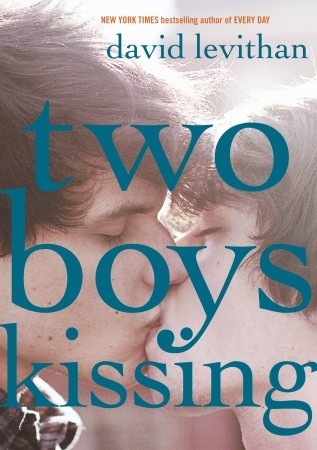
Front cover of David Levithan's Two Boys Kissing
Front cover of David Levithan’s Two Boys Kissing (2013)

In the notes and acknowledgments section written at the end of Two Boys Kissing, author David Levithan states that “This isn’t a book I could have written ten years ago” (199). Levithan is absolutely right. Back in 2003, when I was still a sophomore in high school, I could never fathom the possibility of finding a book that so openly and proudly embraces gay themes. Could you imagine walking through a bookstore in 2003 and identifying a single book written for a young reader with two boys kissing on the cover? Absolutely not. Levithan rightfully acknowledges that his book is symptomatic of the major events, challenges, and changes that the LGBT community has been facing for decades. However, Two Boys Kissing is much more than a focal point of gay and lesbian history. As I was approaching the end of this novel, I could sense that this book will trigger (or already has triggered) a major paradigm shift in the realm of gay (young adult) fiction. This is the book that we’ve been waiting for; this is the book that will change the game.

The heart of this novel’s plot is a narrative focused on two teenage boys named Craig and Harry, who are attempting to break the record for the world’s longest kiss in order to challenge heteronormative attitudes and ideologies present in their lives. But in addition to this central narrative, Levithan weaves the stories of other queer youths that are somehow connected to this record-breaking kiss: Neil and Peter,  who are in a relationship that would’ve been deemed impossible a couple of years ago; Avery, a pink-haired FTM transgender teen, and Ryan, a blue-haired boy Avery meets at an LGBT prom; Tariq Johnson, a teen who was gay-bashed–an event that inspires Craig and Harry to give a shot at breaking a world record; and Cooper Riggs, a gay teen who “could be outside his room, surrounded by people, and it would still feel like nowhere” (5). All of these narratives weave a complex web that attempts to illustrate the state of gay youth today, focusing not only on the progress that has been made throughout the decades, but also the issues that still need to be challenged in order for a progressive politics to take place.

There are two things that I find absolutely ground-breaking in terms of this novel: first and foremost, the novel is an overt attack on the lack of futurity that supposedly haunts queer lives. Rather than viewing queerness as limiting and as a domain of identity that embraces the “death drive” (think Lee Edelman), Levithan constructs a narrative that tries to disrupt these limits by constructing the future as a space that lacks precise definition but that is full of possibility. As the narrators of the novel eloquently put it:

What a powerful word, future. Of all the abstractions we can articulate to ourselves, of all the concepts we have that other animals do not, how extraordinary the ability to consider a time that’s never been experienced. And how tragic not to consider it. It galls us, we with such a limited future, to see someone brush it aside as meaningless, when it has an endless capacity for meaning, and an endless number of meanings that can be found within it. (155)

The second thing that I find groundbreaking comes into perspective when focusing on the passage above. Who are the narrators of this novel? Who are these subjects with such a limited future? The novel is narrated by the collective voice (i.e. Greek chorus) that consists of “your shadow uncles, your angel godfathers, your mother’s or your grandmother’s best friend from college, […]. We are characters in a Tony Kushner play, or names on a quilt that rarely gets taken out anymore. We are the ghosts of the remaining older generation” (3). Indeed, the novel is narrated by a generation of gay men who succumbed to AIDS during the advent and rise of disease. What we have then is a web of the present, weaved by the voices of the past, in order to enable a future. It can be argued that Levithan’s novel queers time to the extent that the boundaries of the past and present are no longer valid, turning the present into a state that can be perceived, scrutinized, and observed by voices from the past.

The attempt to bridge the past to the present creates a lot of tension within the novel, not only because the narrators seem to inhabit a space where time has no control, but also because these voices are unable to alter or change anything happening in the present. The voices are given the gift of knowledge, but they are unable to do anything with this knowledge other than observe, or give advice to the reader rather than to the characters of the novel itself (this is done several times when the narrators break the fourth wall to address the audience). Despite this tension, I think that the novel is novel in terms of altering the typical discourse of gay fiction. This discourse is altered by working towards a futuristic and emancipatory queer politics, while still keeping hold of the past–a past that triggered the need for a queer politics in the first place. Many gay works that perpetuate a sense of futurity do so by sacrificing the pain and torment found in the past. Levithan’s novel, on the other hand, embraces and highlights the pains and joys of the past-but also depicts this embrace as one that is willing to loosen its hold on queer subjects so they can continue moving forward. The past, in this case, becomes a launchpad to futurity rather than the binds that prevent any forward movement.

I think this novel greatly addresses questions pushed forth by Heather Love in her book Feeling Backwards: Loss and the Politics of Queer HistoryIn her book, Love constantly asks the reader to assess whether or not it is possible to have an awareness of the past without being consumed by it. Furthermore, Love ultimately wonders if it is possible to look back while still moving forward, or in other words, whether it is possible to work toward an emancipatory future without forgetting the past that necessitated this work in the first place. I don’t know if Levithan is familiar with Love’s work, but his novel seems to be a response, and perhaps, a solution towards the temporal issues found in queer lives. If he is not familiar with Love’s work, I think that Two Boys Kissing is the product of the same cultural demands that drove the creation of Love’s book in 2004.

Given that the genre of gay literature is usually saturated with perspectives that are driven by temporal extremes (i.e. the past and the future), it is frankly amazing to encounter an author that has been able to channel both the past and the present in order to envision a queer future. Thank you, David Levithan, for writing this book. Although you are right to establish that this book is a product of many past and current events, you are ultimately the agent that channeled a progressive queer history that still pays its homage to the past (and for young readers, nonetheless). I am more than certain that Two Boys Kissing will shift the paradigm of young adult and LGBT literature. The novel has already been nominated for the 2013 National Book Award for Young People’s Literature, and I’m sure that this is only the first of many nominations and accolades to come.

You can purchase a copy of Levithan’s novel by clicking here.

Works Cited and Consulted

Levithan, David. Two Boys Kissing. New York: Knopf, 2013. Print.

Love, Heather. Feeling Backward: Loss and the Politics of Queer History. Harvard University Press, 2007. Print

Time and Cycles in Michael Cunningham’s [The Hours]

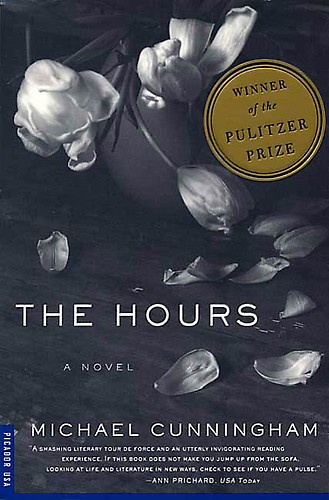
Front paperback cover of Cunningham's The Hours
Front paperback cover of Cunningham’s The Hours

Michael Cunningham’s The Hours barely needs an introduction. Not only was it the winner of the 1999 Pulitzer Prize for fiction, but it is also the source of the Oscar-winning 2002 movie of the same name. Fortunately, I had not seen the movie and I knew very little of the novel’s plot, so I was able to enjoy the narrative in its purest, with no spoilers or outlandish expectations (with the exception of the ideas discussed by Jim Collins in his discussion of the movie adaptation).

I have described many other books as haunting, but that adjective as applied to other books seems to pale in comparison to The Hours. I could praise this book in many ways, including its masterful use of the stream-of-consciousness technique, the depth of its descriptions, or the lavish beauty of its prose, but these merits have been highlighted by many other readers before me.  Similar to the narrative technique employed in Cunningham’s first novel, A Home at the End of the World, each chapter in The Hours focuses on an alternating cycle of major characters, and their perspectives weave together in order to provide cohesion to the text. This disruption of linearity not only adds to the challenge of reading the book, but it also adds an element of surprise and discovery that is more than welcome in the literary world.

In the case of The Hours, the chapters focus on subjects who are either directly or indirectly influenced by Virginia Woolf’s novel, Mrs. Dalloway during its creation and distribution after Woolf’s suicide. The main characters of the story are Virginia Woolf, the writer of Mrs. Dalloway and an eminent figure within British modernist fiction; Laura Brown, a pregnant housewife in the 50’s who is a self-proclaimed bookworm, and who is deeply unhappy with her ordinary life; and Clarissa Vaughn (also referred to as Mrs. Dalloway or Mrs. D), who is a contemporary interpretation of the main character in Woolf’s Mrs. Dalloway, who resides in New York City with her wife Sally and her daughter Julia (you can read a concise summary of the novel along with reader comments here). The novel is told through an omniscient third-person perspective, so the reader is aware of the thoughts of major, secondary, and minor characters.

The gender politics of this novel are very interesting, in my opinion, precisely because they exemplify a wide range of sexual orientations, which include lesbian mothers who embrace traditional characteristics of femininity, lesbian queer theorists, gay men, and bisexual women. The sexuality of most characters within this novel is in no way static; at times there are characters who feel intense desire and passion towards both sexes even though they can typically be categorized as either straight or gay. Similar to A Home at the End of the World, AIDS plays a prominent role within The Hours, which seems appropriate given the novel’s aim of challenging and illuminating topics such as gender, death, life, and most of all: time/temporality.

Time, as suggested by the novel’s title, is indeed the central issue within the narrative, and it is a motif that not only inflects the content of the novel, but also its structure. The three main characters of the text all share a similar story and face similar struggles, however, the nature of this struggle changes according to the social conventions of the time in which they manifest. Woolf, who is trying to cope with mental illness, depression, and suicidal tendencies in the 1920’s, mirrors the character of Laura Brown, who feels trapped by the pressures and expectations of most 50’s housewives. Both characters express a desire to escape from their world, but are unable to do so because of the people who surround them. Cunningham’s depiction of Laura Brown was particularly captivating, mostly because he effectively illustrates her failure to achieve the perfection that others expect from her, and that she expects for herself. For instance, her inability to bake and decorate a flawless and pristine cake for her husband’s birthday clearly denotes her inability to comply with the unrealistic expectations that she sets for herself as a wife and a mother.

Time also plays a role in terms of how the characters cope with their sexual urges and romantic desires. Both Virginia Woolf and Laura Brown express some degree of desire for the same sex through a kiss: Woolf through a kiss she gave to her sister, and Laura through a kiss to her neighbor who ostensibly is showing signs of imminent illness. These kisses haunt the characters, mostly because they represent a desire that could not possibly be expressed without the expected social consequences. Whereas Woolf has writing as an outlet for this desire, Laura Brown has little to no way of expressing it, thus fueling her desire to escape from her current condition.

The third main character, Clarissa, has created a home with her partner, Sally, but she is shown to oscillate between happiness towards her current condition and the anguish caused by the certainties and uncertainties of life.  What makes Clarissa so appealing as a character is her paradoxical and indecisive nature. One moment, she seems to lament the follies of materiality, the fabricated nature of her home, the investment of money in superficial and useless items. Nonetheless, she invests a lot of time and money in a party to show how much she cares about her friend Richard, who is dying of AIDS. She embraces and rejects the comforts of materiality. She struggles with her need to please others while sacrificing her own pleasures and needs. She worries about the extent to which others enjoy the gifts she gives without thinking about her own appreciation to the gifts she is given. This sense of hesitation, which involves the struggle of the self with the demands of the outside world, is something that Clarissa shares with both Woolf and Laura. This, in due course, it what I liked most about the novel: it forced me to struggle in terms of interpreting the world through the lens of solipsism or interpreting it as a space where knowledge exists beyond the self. Do we define ourselves by the roles that other people assign to us? Are the people around us merely projections of our own thoughts and desires? What agency do we really have as individuals?

I’ve decided to end this post with the most haunting paragraph in this novel, which provides the comforting yet strangely bleak idea of enjoying the hours that provide us with comfort, happiness, and glory, simply because these hours are always followed by darker ones:

We throw our parties; we abandon our families to live alone in Canada; we struggle to write books that do not change the world, despite our gifts and our unstinting efforts, our most extravagant hopes. We live our lives, do whatever we do, and then we sleep. It’s as simple and ordinary as that. A few jump out windows, or drown themselves, or take pills; more die by accident; and most of us are slowly devoured by some disease, or, if we’re very fortunate, by time itself. There’s just this for consolation: an hour here or there when our lives seem, against all odds and expectations, to burst open and give us everything we’ve ever imagined, though everyone but children (and perhaps even they) know these hours will inevitably be followed by others, far darker and more difficult. Still, we cherish the city, the morning; we hope, more than anything, for more. Heaven only knows why we love it so. (Cunningham 225-226)

 I can’t help but question if this novel is ultimately presenting life as an endurance test. What I am certain of is that the novel approaches life as ever-shifting and ever-changing, and any intent to make the self stable through the passage of time is indeed a futile effort. Life is presented as a series of cycles and repetitions. The cyclic nature of time and history is best represented with the suicides that occur within the novel in that both Woolf and Richard depart the world by affirming virtually the exact same statement to their loved-ones before killing themselves:  “I dont’ think two people could have been happier than we’ve been” (Cunningham 200). Whether or not Richard was familiar with this exact statement made by Woolf in her suicide note is unclear, but the repetition of this phrase by two different people in two different time periods is indeed an eerie thought. I guess some people are better at coping with cycles. Others desperately try to change the direction of these cycles, or halt them altogether. Others willingly or unwillingly embrace them fully. And as Cunningham firmly put it, only heaven knows why.

Source:

Cunningham, Michael. The Hours. New York: Farrar, Straus, and Giroux, 1998. Print (Hardcover Edition).

Growth and Development in Stephen Chbosky’s [The Perks of Being a Wallflower]

Update: The content of this blog post was developed into an academic article that was published by The ALAN Review. I’m thrilled to announce that this article obtained the Nilsen-Donelson award for the best academic article published in 2013. Click on the following link to download a PDF version of the full article: Writing Through Growth, Growth Through Writing: [The Perks of Being a Wallflower] and the Narrative of Development

Original cover of Stephen Chbosky’s “The Perks of Being a Wallflower” (1999)

I remember the first time that I held that bright green cover in my hands early in the morning during the Christmas of 2002. In all honesty, I had no concrete clue of what the novel was about. I just remember surfing through the web, looking for young adult books to get me through the holidays, and the title of this novel caught my attention: The Perks of Being a Wallflower. Now, it was an unusually complex title for a young adult novel, but seeing as I myself felt like a wallflower at times, something about the title spoke to me. Little did I know that I was about to read the book that led to a shift in my being… a book that affected me on levels beyond comprehension… a book that almost 14 years later continues to shape who I am.

When people ask me what is my favorite text of all time, they would probably expect me to say something that any other literary scholar would say: Shakespeare’s dramas, Milton’s poetry, Dickens’ novels, or maybe even Thoreau’s philosophies and discussions. However, my answer would undoubtedly be the aforementioned book titled Perks of Being a Wallflower, written by Stephen Chbosky. Sure, the book is not a book for everyone. Many people become “nauseated” with the protagonist’s overly sentimental musings, and others simply get angry with the protagonist’s lack of action (these were reactions that some of my past students had when first reading the novel). Others accuse the book of being a rip-off of J.D. Salinger’s The Catcher in the Rye; true, it is unsurprising to see that Salinger’s text was indeed an influence for Chbosky’s work (it is even one of the many novels that the protagonist encounters throughout the narration), but comparing the two works would be like comparing apples and pears: they have similar textures and flavor profiles, but in the end they are different fruits that possess different forms.

I consider the novel to be one-of-a-kind. Charlie, the protagonist, is one of the most vulnerable, raw, real, and honest literary characters that I have encountered within the realm of young adult fiction (and arguably, all genres of fiction). The novel is one of the few instances in which readers have the opportunity to witness the uncensored perspectives of a male character who is not afraid to share his thoughts and sentiments. As of now, it has been the only book that has been capable of making me cry. True, I read the novel during a vulnerable time: like Charlie, I was lost, and confused, and I was looking for someone to speak to. Charlie, the protagonist of the novel, ultimately became that person. But, even when reading Perks numerous times after escaping my own period of vulnerability, it still continues to “listen” to me, and to speak to me. It still continues to haunt me. And every time I read it, it says something different to me.

The film was superbly acted by Emma Watson as the vivacious and complex Samantha, and Logan Lerman as Charlie, the film’s heart-breaking and fractured protagonist.

The reason I’m bringing this book up is because I finally was able to see the film adaptation of this novel, which was written AND directed by Stephen Chbosky himself. The movie was only being shown in select theaters, but this weekend, it finally was shown in theaters across the nation. Truth be told, I was rather afraid to see the film. When our favorite books are adapted to the silver screen, there is always the fear that the adaptation won’t live up to our expectations, and that the film will never reach the standards of the original source. However, after seeing the movie last night, I realized that my feelings were misguided. The film adaptation of Perks was endearing, touching, and thought-provoking. But even more so, the movie was crafted for a generation who grew up with the ideals and thoughts manifested in Chbosky’s original text: originality, uniqueness, and loyalty. The movie invites us to ultimately find a sense of belonging in “the island of misfit toys.”

Overall, the film has received very positive reviews. It currently has a score of 8.4/10 in IMDB, and it was certified as a fresh film in Rotten Tomatoes, with a current approval rate of 86% among critics and 95% among audience members. And in all honesty, those who don’t understand the movie, or that consider it another bland coming-of-age story either fail to sympathize with the hurdles that the protagonist had to overcome, or they find it hard to connect with the notion of being an outsider (after all, not everyone is aware of the unique perspective that one develops when “standing on the fringes of life”).

In due course, the film left me inspired, and it pushed me to submit an article that I wrote on the novel last semester to the ALAN Review, the nation’s leading journal on the study and teaching of young adult literature. Frankly, I had reservations in terms of submitting the article for review, mostly because I feel like I cannot effectively do justice to my favorite novel of all time. In addition, I am aware that the article is far from perfect. However, just like Charlie had to learn how to participate, I needed to step out of the shadows and take an academic risk. I have no idea whether or not the article will be accepted for publication, but I guess there was no harm in trying.

Anyway, to conclude today’s post, I will include an excerpt from the article that I submitted. Wish me luck!

Excerpt of “Writing through Growth, Growth through Writing: The Perks of Being a Wallflower and the Narrative of Development” written by Angel Daniel Matos:

[…]

Although Perks is certainly considered epistolary in terms of its form and delivery, its content and function are definitely attuned towards the aims of developmental fiction. Given that the protagonist depicts his own developmental process through his writing, and given that the novel is written via a series of letters, it is imperative that the reader becomes attuned to how the process of writing and the process of Bildung work together to fulfill and challenge the nuances of development within the literary scope. The process of writing in Perks manifests primarily in two ways: through the letters that Charlie writes to the anonymous recipient and through the assignments and tasks that he completes for his English class in high school. Fascinatingly, Charlie’s writing is very much reflective of his own development as a person, and the writing that we encounter in the first letters of the book is more scrambled, disorganized, and “immature” in comparison to the prose found in his final letters.

For instance, here’s an example of Charlie’s writing at the beginning of the novel: “Aunt Helen told my father not to hit me in front of her ever again and my father said this was his house and he would do what he wanted and my mom was quiet and so were my brother and sister” (Chbosky, 1999, p. 6). This sentence exemplifies the writing style that is predominant during the first letters of the novel: the prose is peppered with run-on sentences, he has not mastered the art of punctuation, and his ideas many times lack coherence and cohesion. We see that his writing style, and even the topics that he discusses in his letters, begin to evolve and mature as Charlie gains more experience with the art of writing, and as he begins to delve in increasingly complicated efforts to understand himself and the people around him. Charlie’s English teacher, Bill, assumes the role of Charlie’s mentor not only from an educational standpoint, but from a formational one as well. Charlie also takes Bill’s advice and suggestions quite seriously, and although he always gives Charlie A’s on his report cards, he always labels his essays with a lower grade as a way of challenging him:

First of all, Bill gave me a C on my To Kill a Mockingbird essay because he said that I run my sentences together. I am trying now to practice not to do that. He also said that I should use the vocabulary words that I learn in class like “corpulent” and “jaundice.” I would use them here, but I really don’t think they are appropriate in this format. (Chbosky, 1999, p. 14)

After Bill’s recommendations, Charlie’s letters increasingly avoid the use of run-on sentences, and his prose becomes much clearer and more efficient, saying more using less words. It is also interesting to note that when Charlie writes about the books that Bill assigns to him, he manages to use writing as a way of evaluating the actions of the characters in the books he reads, and he always tries to establish parallels between his own life and the “life” portrayed in the books.

This notion of comparing and contrasting becomes important in terms of the content depicted in Charlie’s letters, for it is in this instance that he begins to situate himself more prominently in the actions that are represented in the letters. At first, most of what he writes about is concerned with the observations that he makes of his family. This notion of writing “empirical” observations of the people he observes becomes the main focus of Charlie’s letters until Bill begins to notice that Charlie constantly stares at people and scrutinizes them obsessively. He then asks Charlie what he thinks about when he observes people, and after he tells Bill everything he thinks about, the teacher remarks that although thinking a lot is not necessarily a bad thing, “sometimes people use thoughts to not participate in life” (Chbosky, 1999, p. 24). This remark pushes Charlie to further assess his own life and the degree to which he participates in events, talks with other people, and tries to make friends. However, the very process of writing his thoughts obliges him to become introverted and pensive, and he continues to write letters as a way of assessing his own life: “when I write letters, I spend the next two days thinking about what I figured out in my letters. I do not know if this is good or bad” (Chbosky, 1999, p. 28). The effort that Charlie puts in trying to understand his meditations is a clear indicator that Bill was right to some extent, for so much effort is put into trying to understand, that there is little room to actually live and enjoy life.

Despite the mental effort and time required in the crafting of his letters, there seems to be a radical shift in terms of the content being portrayed after Bill warns Charlie about the perils of overthinking. The focus of the letters shifts from a focus on family to a focus primarily on Charlie’s efforts to socialize and make friends. In due course, Charlie becomes very close to a group of seniors at his school, known for not being the most popular and loved people within the premises. The first friend he makes in high school is Patrick, a gay senior with a penchant for jokes and mischief, and who introduces Charlie into the world of drinking, smoking, and the unwritten rules of sexual behavior. He also befriends Sam (short for Samantha), who is Patrick’s stepsister and on whom Charlie develops an obsessive crush. The bulk of the letters depicted after this point discuss the differences that exist between Patrick, Samantha, other friends, and himself, his strivings to understand the motivations behind their thoughts and actions, and more importantly, the arduous process of integrating himself with Patrick and Samantha’s circle of friends.

Charlie develops a clearer sense of the world through this arduous process of integration, and through his immersion in new experiences such as drug use, masturbation, visits to the Rocky Horror Picture Show, and through his exposure to different literatures. His analysis of the content of his letters, and the feedback he gets from his essays at school, demonstrate that Charlie is developing the ability to make his writing more concrete and understandable due to the fact that he is undergoing experiences that provide him with a substantial analytical platform. Even more so, Charlie’s development of his writing prowess leads him to the discovery of the craft he wants to hone as a professional endeavor: “I have decided that maybe I want to write when I grow up. I just don’t know what I would write” (Chbosky, 1999, p. 46). Although at first the letters prevented him from participating due to their introspective and slightly amateurish nature, it is when Charlie combines his writing skills with the experiences that he has obtained that allows him to develop a richer image of who he is and who he wants to be. Interestingly, the more Charlie writes, the more he understands himself, and the easier it is for the recipient of the letters to develop a more defined snapshot of Charlie’s mind. In other words, the more Charlie begins to understand himself, the more others also begin to understand him.

It is unclear whether Charlie keeps copies of the letters for himself; however, Charlie consistently makes reference to past letters. Charlie compares and contrasts experiences illustrated in his letters, and he also revisits previous points of discussion in order to reevaluate his thoughts using the knowledge that his experiences have thrust upon him. For instance, Charlie once reads a poem to his friends titled “A Person/ A Paper/ A Promise Remembered,” written by Patrick Comeaux and given to him by Michael (the friend who committed suicide), which portrays the growth of a boy into a man, and concludes with the speaker’s suicide due to his disillusionment with life. At first, Charlie is unable to understand the poem clearly, and he is unwilling to understand why a person would commit suicide. But, during New Year’s Eve, Charlie writes a letter in which he confesses that a particular experience has unfortunately helped him to grasp the intended meaning of the poem:

I just remembered what made me think of all this. I’m going to write it down because maybe if I do I won’t have to think about it. And I won’t get upset. But the thing is that I can hear Sam and Craig having sex, and for the first time in my life, I understand the end of that poem. And I never wanted to. You have to believe me. (Chbosky, 1999, p. 96)

It is important to note that in this instance, Charlie is using writing for a new purpose: rather than using the letters as a means of interpreting himself and his world, he uses writing as a way of distancing himself from his thoughts, as if writing were a way of draining his worries away from his mind. Even more so, it is through looking back at his own writing that he is able to comprehend how he loses innocence, and how he is able to understand concepts that used to escape his cognizance. It is after this point that Charlie becomes a “rebel” in many aspects: he begins to smoke and drink more than ever; he begins to explore his sexual identity by hanging out more often with Patrick and kissing him every so often, and he secretly offers his sister assistance when she believes she is pregnant.

Charlie begins to realize that life does not have to be lived according to others’ expectations, and if he is to achieve any degree of happiness, he has to find a way to balance his desires and social demand. This stepping away from society’s parameters also manifests within Charlie’s writing, seeing as he begins to experiment with different styles of writing and of conveying ideas: “I wrote a paper about Walden for Bill, but this time I did it differently. I didn’t write a book report. I wrote a report pretending that I was by myself near a lake for two years. I pretended that I lived off the land and had insights. To tell you the truth, I kind of like the idea of doing that right now” (Chbosky, 1999, p. 128). Thus, rather than complying with a formula or a set of rules on how to tackle his literary interventions through writing, he delves into an experimental endeavor in which he filters the information he decodes in the book through his own set of experiences. Rather than simply being a sponge that absorbs and regurgitates ideas, Charlie begins to view the act of writing as a mediation between a conversion taking place, turning him into an active writer rather than a passive one. Thus, the parallels between emotional and mental development, or Bildung, become increasingly tied to the act of writing throughout the progression of the novel. Furthermore, notice that Charlie seems rather pleased with this new direction that he is taking.

Charlie’s progression from a passive to an active participant is not an overnight change, but rather, it is a very difficult and gradual process. Despite his small victories and attempts, Charlie still remains a wallflower towards the concluding letters of the novel. However, in the climactic letter of the novel, Samantha confronts Charlie and obliges him to face the consequences of his lack of action. Sam has broken up with her boyfriend because he was cheating on her, yet Charlie never made an attempt to date Sam now that she was newly single. In a fit of frustration, Sam confronts Charlie with the truth after he confesses that he did not take action because he was more concerned with her sadness than with trying to be with her:

It’s great that you can listen and be a shoulder to someone, but what about when someone doesn’t need a shoulder. What if they need the arms or something like that? You can’t just sit there and put everybody’s lives ahead of yours and think that counts as love. You just can’t. You have to do things. (Chbosky, 1999, p. 200)

And rather than replying to her accusations with words, Charlie approaches Sam and starts to kiss her. They soon end up on the bed, kissing passionately, but just as they are about to go all the way, Charlie begins to have a nervous breakdown. To make a long story short, Charlie slowly but surely remembers the fact that he was sexually abused as a child by his diseased aunt Helen, which explains why Charlie was so repressed and had difficulties participating in life. After a few months in the hospital after his breakdown, Charlie begins to come to grips with his repressed past, and he proposes to move on and change the direction of his life. […] Indeed, the surprising and unprecedented moment in which Charlie reawakens his repressed past is indeed heartbreaking and difficult to tolerate emotionally, but it is the moment in which Charlie truly begins to feel free from the unbearable burden of trying to figure out why he is the way he is, and why he so desperately craves to understand the world around him. And although action leads him to achieve his moment of breakthrough, it is the act of writing that helps him put his life into perspective, and that provides the missing puzzle pieces that complete the image of the self.

[…]

The main characters of “The Perks of Being a Wallflower.” From left to right: Charlie (Logan Lerman), Patrick (Ezra Miller), and Sam (Emma Watson)