I’m pleased to announce that my article entitled “Writing through Growth, Growth through Writing: The Perks of Being a Wallflower and the Narrative of Development” can now be found in The ALAN Review‘s digital archives. Here is a brief abstract of the article, which won the Nilsen-Donelson award for best article published during the volume year:
This paper calls attention to the issue of social and personal development in Stephen Chbosky’s The Perks of Being a Wallflower, focusing on how the novel appropriates and transmutes the conventions of the formation novel, formally known as the Bildungsroman. Although the novel is written in an epistolary fashion, focusing on a series of letters sent to an undisclosed recipient, I argue that there is much value in approaching the text as a formation novel for it highlights the evolving nature of the Bildungsroman genre. The overarching themes of Charlie’s musings are focused on creating a social space in which the protagonist can record, evaluate, and deliberate his own position within his social context. These epistles also provide clarification of the pains and tribulations of achieving reconciliation between personal desire and social demand. Through a close-reading of the novel, I point out the role of writing in Charlie’s personal development, and how it influences and shapes his perspective of the world.
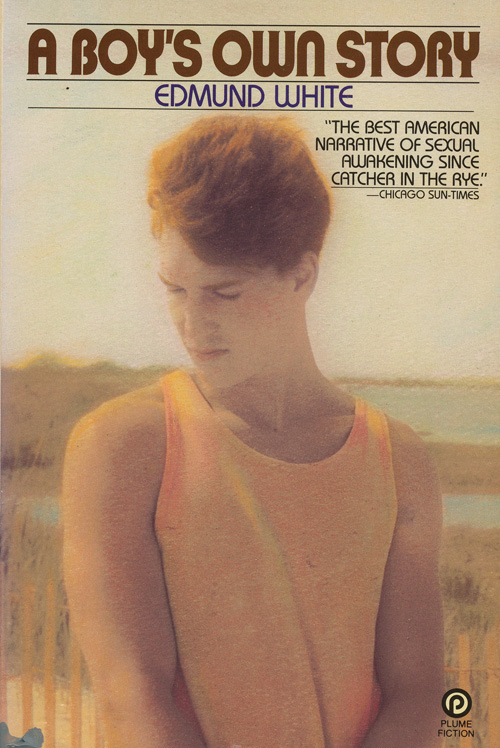
Front cover of Edmund White’s A Boy’s Own Story (1982)
Edmund White’s A Boy’s Own Story is a coming-of-age novel centered on the sexual awakening of a queer teenage boy in the Midwest during the 1950s. The novel discusses topics such as the corruption of innocence, the pressures of masculinity in the lives of young boys, the emergence of childhood sexuality, and the exploration of humanity through the lens of homosexuality. The unnamed narrator of the novel quickly addresses the issues that he has in terms of his body and his sense of masculinity. He feels as if his “feminine” qualities–such as his voice, his mannerisms, and his overall attitudes– not only prevent him from bonding with other people, but that they also prevent him from obtaining any of the power that promised to those who embody the masculine myth. The narrator notices that everything from the way he sits to the way he acts marks his body as Other, and he even goes as far as to point out that he often fails small and meaningless quizzes used to assess his masculinity:
A popular quiz for masculinity in those days asked three questions, all of which I flunked: (1) Look at your nails (a girl extends her fingers, a boy cups his in his upturned palm); (2) Look up (a girl lifts her eyes, a boy throws back his whole head); (3) Light a match (a girl strikes away from her body, a boy toward–or perhaps the reverse, I can’t recall). (9)
The structure of this novel can seem slightly confusing, especially since it deviates from the traditional linear narrative that we have come to expect when reading coming-of-age novels. The first chapter, for instance, begins when the narrator is fifteen years-old. In this chapter, he painstakingly describes a relationship that he has with Kevin, the twelve year-old son of a guest that visits his summer home. In this chapter, the narrator describes how he paradoxically wants to be considered heterosexual while still being loved by a man. His relationship with Kevin slowly but surely starts to teach him how sex is not only a physical act, but how it is also a discursive act–leading him to realize that sex is also “a social rite that registered, even brought about shifts in the balance of power, but something that was discussed more than performed” (198). Because of this realization, he notices how performance and discourse shapes and forms his relationships with other men. For instance, he approaches Kevin as the “older” and more “dominant” person in the relationship because he is the more confident person of the two, and because he controls what happens during sexual intercourse:
I was chagrined by [his] clowning because I’d already imagined Kevin as a sort of husband. No matter that he was younger; his cockiness had turned him into the Older One (23).
The first chapter concludes by depicting how the narrator and Kevin part ways, and the second chapter goes back an entire year, allowing the narrator to discuss events that shaped who he is in his present day. Subsequent chapters go back in time even further, depicting events that the narrator encounters when he was twelve and seven years-old. The jumping back and forth between the past and the present not only disrupts the linearity of the coming-of-age narrative, but it also presents, as Elizabeth Freeman would put it, a manifestation of queer time.
In Time Binds: Queer Temporalities, Queer Histories, Elizabeth Freeman describes queer time as a “hiccup in sequential time” that “has the capacity to connect a group of people beyond monogamous, enduring couplehood” (3). Furthermore, queer time allows queer subjects to envision alternative structures and forms of belonging, precisely because it deviates from the linearity and “productivity” of chrononormativity–in which human bodies arrange their time and bodies towards maximum productivity. In A Boy’s Own Story, queer time manifests through this combination of the past and the present, precisely because the narration deviates from the productive and generative elements that are closely associated with narratives of personal development. White, rather than depicting growth and development as sequential events, the narrator approaches them as fractured and disjointed processes. Rather than offering readers an equation, in which event 1, event 2, and event 3 equal the narrator, White disrupts temporality by beginning with event 3, going back to event 1, and covering the decimal points (small or micro events) that occur between these numbers. I think that this novel embraces queerness through it’s denial of both chronos (sequential time) and kairos (significant time), in favor of small non-sequential and non-significant time. This is particularly clear in the fourth chapter of the novel, in which the narrator breaks the fourth wall and addresses the reader:
in writing one draws in the rest, the forgotten parts. One even composes one’s improvisations into a quite new face never glimpsed before, the likeness of an invention. Busoni once said he prizes the most those empty passages composers make up to get from one “good part” to another. He said such womanlike but minor transitions reveal more about a composer–the actual vernacular of his imagination–than the deliberately bravura moments. I say all this by way of hoping that the lies I’ve made up to get from one poor truth to another may mean something–may even mean something most particular to you, my eccentric, patient, scrupulous reader, willing to make so much of so little, more patient and more respectful of life, or a life, than the author you’re allowing for a moment to exist again. (84)
I believe that this passage is quite significant, because it highlights the role that queer time plays in the novel’s political agenda. By disrupting linearity and by painstakingly focusing on minor events, the reader must develop patience and spend more time concentrating on the narrator’s words rather than on major events. The narrator affirms that by reading his words, the reader becomes not only more respectful of the narrator’s life, but the reader also brings the narrator back into existence. Therefore, through the act of reading, one gives the narrator a sense of legitimacy that was denied to him during his childhood. This interpretation gains even more validity when taking into account that most of the novel is focused on the narrator’s struggle to survive in his society, and even more so, his struggle to be approached and categorized as a legitimate human being. The narrator, for instance, acknowledged that he has little time to focus on “theory” or “philosophy” because he is too busy focusing on pragmatic aspects of his life such as survival. This notion is evidenced when the narrator compares himself to his jockish friend, Tom, who spends most of his time daydreaming and philosophizing:
Ironic, then, that [Tom] was the one who did all the thinking, who had the taste for philosophy–ironic but predictable, since his sovereignty gave him the ease to wonder about what it all meant, whereas I had to concentrate on means, not meaning. The meaning seemed quite clear: to survive and then to become popular. (113)
Although popularity may at first be approached as a self-centered and selfish goal, it is important to keep in mind that the narrator believes that popularity will give him the recognition and the legitimacy that he has been denied in his life, not only because he is queer, but also because he is unable to situate himself within the frame of traditional masculinity that his father upholds. Popularity would give the narrator the means to become a legitimate person rather than an unreal subject:
Being popular was equivalent to becoming a character, perhaps even a person, since if to be is to be perceived, then to be perceived by many eyes and with envy, interest, respect, or affection is to exist more densely, more articulately, ever last detail minutely observed and thereby richly rendered. (127)
All in all, A Boy’s Own Story is a rich and provocative novel that definitely raises interesting insights in terms of the role that temporality plays within the issues of livability that haunt all queer lives. The narrative is at times convoluted and difficult to follow, but getting lost is definitely an essential component towards grasping the novel’s central themes and agenda.
You can purchase a copy of White’s novel by clicking here.
Works Cited
Freeman, Elizabeth. Time Binds: Queer Temporalities, Queer Histories. Durham: Duke University Press, 2010. Print.
White, Edmund. A Boy’s Own Story. New York: Plume, 1982. Print.
Original cover of Stephen Chbosky’s “The Perks of Being a Wallflower” (1999)
I remember the first time that I held that bright green cover in my hands early in the morning during the Christmas of 2002. In all honesty, I had no concrete clue of what the novel was about. I just remember surfing through the web, looking for young adult books to get me through the holidays, and the title of this novel caught my attention: The Perks of Being a Wallflower. Now, it was an unusually complex title for a young adult novel, but seeing as I myself felt like a wallflower at times, something about the title spoke to me. Little did I know that I was about to read the book that led to a shift in my being… a book that affected me on levels beyond comprehension… a book that almost 14 years later continues to shape who I am.
When people ask me what is my favorite text of all time, they would probably expect me to say something that any other literary scholar would say: Shakespeare’s dramas, Milton’s poetry, Dickens’ novels, or maybe even Thoreau’s philosophies and discussions. However, my answer would undoubtedly be the aforementioned book titled Perks of Being a Wallflower, written by Stephen Chbosky.Sure, the book is not a book for everyone. Many people become “nauseated” with the protagonist’s overly sentimental musings, and others simply get angry with the protagonist’s lack of action (these were reactions that some of my past students had when first reading the novel). Others accuse the book of being a rip-off of J.D. Salinger’s The Catcher in the Rye; true, it is unsurprising to see that Salinger’s text was indeed an influence for Chbosky’s work (it is even one of the many novels that the protagonist encounters throughout the narration), but comparing the two works would be like comparing apples and pears: they have similar textures and flavor profiles, but in the end they are different fruits that possess different forms.
I consider the novel to be one-of-a-kind. Charlie, the protagonist, is one of the most vulnerable, raw, real, and honest literary characters that I have encountered within the realm of young adult fiction (and arguably, all genres of fiction). The novel is one of the few instances in which readers have the opportunity to witness the uncensored perspectives of a male character who is not afraid to share his thoughts and sentiments. As of now, it has been the only book that has been capable of making me cry. True, I read the novel during a vulnerable time: like Charlie, I was lost, and confused, and I was looking for someone to speak to. Charlie, the protagonist of the novel, ultimately became that person. But, even when reading Perks numerous times after escaping my own period of vulnerability, it still continues to “listen” to me, and to speak to me. It still continues to haunt me. And every time I read it, it says something different to me.
The film was superbly acted by Emma Watson as the vivacious and complex Samantha, and Logan Lerman as Charlie, the film’s heart-breaking and fractured protagonist.
The reason I’m bringing this book up is because I finally was able to see the film adaptation of this novel, which was written AND directed by Stephen Chbosky himself. The movie was only being shown in select theaters, but this weekend, it finally was shown in theaters across the nation. Truth be told, I was rather afraid to see the film. When our favorite books are adapted to the silver screen, there is always the fear that the adaptation won’t live up to our expectations, and that the film will never reach the standards of the original source. However, after seeing the movie last night, I realized that my feelings were misguided. The film adaptation of Perks was endearing, touching, and thought-provoking. But even more so, the movie was crafted for a generation who grew up with the ideals and thoughts manifested in Chbosky’s original text: originality, uniqueness, and loyalty. The movie invites us to ultimately find a sense of belonging in “the island of misfit toys.”
Overall, the film has received very positive reviews. It currently has a score of 8.4/10 in IMDB, and it was certified as a fresh film in Rotten Tomatoes, with a current approval rate of 86% among critics and 95% among audience members. And in all honesty, those who don’t understand the movie, or that consider it another bland coming-of-age story either fail to sympathize with the hurdles that the protagonist had to overcome, or they find it hard to connect with the notion of being an outsider (after all, not everyone is aware of the unique perspective that one develops when “standing on the fringes of life”).
In due course, the film left me inspired, and it pushed me to submit an article that I wrote on the novel last semester to the ALAN Review, the nation’s leading journal on the study and teaching of young adult literature. Frankly, I had reservations in terms of submitting the article for review, mostly because I feel like I cannot effectively do justice to my favorite novel of all time. In addition, I am aware that the article is far from perfect. However, just like Charlie had to learn how to participate, I needed to step out of the shadows and take an academic risk. I have no idea whether or not the article will be accepted for publication, but I guess there was no harm in trying.
Anyway, to conclude today’s post, I will include an excerpt from the article that I submitted. Wish me luck!
—
Excerpt of “Writing through Growth, Growth through Writing: The Perks of Being a Wallflower and the Narrative of Development” written by Angel Daniel Matos:
[…]
Although Perks is certainly considered epistolary in terms of its form and delivery, its content and function are definitely attuned towards the aims of developmental fiction. Given that the protagonist depicts his own developmental process through his writing, and given that the novel is written via a series of letters, it is imperative that the reader becomes attuned to how the process of writing and the process of Bildung work together to fulfill and challenge the nuances of development within the literary scope. The process of writing in Perks manifests primarily in two ways: through the letters that Charlie writes to the anonymous recipient and through the assignments and tasks that he completes for his English class in high school. Fascinatingly, Charlie’s writing is very much reflective of his own development as a person, and the writing that we encounter in the first letters of the book is more scrambled, disorganized, and “immature” in comparison to the prose found in his final letters.
For instance, here’s an example of Charlie’s writing at the beginning of the novel: “Aunt Helen told my father not to hit me in front of her ever again and my father said this was his house and he would do what he wanted and my mom was quiet and so were my brother and sister” (Chbosky, 1999, p. 6). This sentence exemplifies the writing style that is predominant during the first letters of the novel: the prose is peppered with run-on sentences, he has not mastered the art of punctuation, and his ideas many times lack coherence and cohesion. We see that his writing style, and even the topics that he discusses in his letters, begin to evolve and mature as Charlie gains more experience with the art of writing, and as he begins to delve in increasingly complicated efforts to understand himself and the people around him. Charlie’s English teacher, Bill, assumes the role of Charlie’s mentor not only from an educational standpoint, but from a formational one as well. Charlie also takes Bill’s advice and suggestions quite seriously, and although he always gives Charlie A’s on his report cards, he always labels his essays with a lower grade as a way of challenging him:
First of all, Bill gave me a C on my To Kill a Mockingbird essay because he said that I run my sentences together. I am trying now to practice not to do that. He also said that I should use the vocabulary words that I learn in class like “corpulent” and “jaundice.” I would use them here, but I really don’t think they are appropriate in this format. (Chbosky, 1999, p. 14)
After Bill’s recommendations, Charlie’s letters increasingly avoid the use of run-on sentences, and his prose becomes much clearer and more efficient, saying more using less words. It is also interesting to note that when Charlie writes about the books that Bill assigns to him, he manages to use writing as a way of evaluating the actions of the characters in the books he reads, and he always tries to establish parallels between his own life and the “life” portrayed in the books.
This notion of comparing and contrasting becomes important in terms of the content depicted in Charlie’s letters, for it is in this instance that he begins to situate himself more prominently in the actions that are represented in the letters. At first, most of what he writes about is concerned with the observations that he makes of his family. This notion of writing “empirical” observations of the people he observes becomes the main focus of Charlie’s letters until Bill begins to notice that Charlie constantly stares at people and scrutinizes them obsessively. He then asks Charlie what he thinks about when he observes people, and after he tells Bill everything he thinks about, the teacher remarks that although thinking a lot is not necessarily a bad thing, “sometimes people use thoughts to not participate in life” (Chbosky, 1999, p. 24). This remark pushes Charlie to further assess his own life and the degree to which he participates in events, talks with other people, and tries to make friends. However, the very process of writing his thoughts obliges him to become introverted and pensive, and he continues to write letters as a way of assessing his own life: “when I write letters, I spend the next two days thinking about what I figured out in my letters. I do not know if this is good or bad” (Chbosky, 1999, p. 28). The effort that Charlie puts in trying to understand his meditations is a clear indicator that Bill was right to some extent, for so much effort is put into trying to understand, that there is little room to actually live and enjoy life.
Despite the mental effort and time required in the crafting of his letters, there seems to be a radical shift in terms of the content being portrayed after Bill warns Charlie about the perils of overthinking. The focus of the letters shifts from a focus on family to a focus primarily on Charlie’s efforts to socialize and make friends. In due course, Charlie becomes very close to a group of seniors at his school, known for not being the most popular and loved people within the premises. The first friend he makes in high school is Patrick, a gay senior with a penchant for jokes and mischief, and who introduces Charlie into the world of drinking, smoking, and the unwritten rules of sexual behavior. He also befriends Sam (short for Samantha), who is Patrick’s stepsister and on whom Charlie develops an obsessive crush. The bulk of the letters depicted after this point discuss the differences that exist between Patrick, Samantha, other friends, and himself, his strivings to understand the motivations behind their thoughts and actions, and more importantly, the arduous process of integrating himself with Patrick and Samantha’s circle of friends.
Charlie develops a clearer sense of the world through this arduous process of integration, and through his immersion in new experiences such as drug use, masturbation, visits to the Rocky Horror Picture Show, and through his exposure to different literatures. His analysis of the content of his letters, and the feedback he gets from his essays at school, demonstrate that Charlie is developing the ability to make his writing more concrete and understandable due to the fact that he is undergoing experiences that provide him with a substantial analytical platform. Even more so, Charlie’s development of his writing prowess leads him to the discovery of the craft he wants to hone as a professional endeavor: “I have decided that maybe I want to write when I grow up. I just don’t know what I would write” (Chbosky, 1999, p. 46). Although at first the letters prevented him from participating due to their introspective and slightly amateurish nature, it is when Charlie combines his writing skills with the experiences that he has obtained that allows him to develop a richer image of who he is and who he wants to be. Interestingly, the more Charlie writes, the more he understands himself, and the easier it is for the recipient of the letters to develop a more defined snapshot of Charlie’s mind. In other words, the more Charlie begins to understand himself, the more others also begin to understand him.
It is unclear whether Charlie keeps copies of the letters for himself; however, Charlie consistently makes reference to past letters. Charlie compares and contrasts experiences illustrated in his letters, and he also revisits previous points of discussion in order to reevaluate his thoughts using the knowledge that his experiences have thrust upon him. For instance, Charlie once reads a poem to his friends titled “A Person/ A Paper/ A Promise Remembered,” written by Patrick Comeaux and given to him by Michael (the friend who committed suicide), which portrays the growth of a boy into a man, and concludes with the speaker’s suicide due to his disillusionment with life. At first, Charlie is unable to understand the poem clearly, and he is unwilling to understand why a person would commit suicide. But, during New Year’s Eve, Charlie writes a letter in which he confesses that a particular experience has unfortunately helped him to grasp the intended meaning of the poem:
I just remembered what made me think of all this. I’m going to write it down because maybe if I do I won’t have to think about it. And I won’t get upset. But the thing is that I can hear Sam and Craig having sex, and for the first time in my life, I understand the end of that poem. And I never wanted to. You have to believe me. (Chbosky, 1999, p. 96)
It is important to note that in this instance, Charlie is using writing for a new purpose: rather than using the letters as a means of interpreting himself and his world, he uses writing as a way of distancing himself from his thoughts, as if writing were a way of draining his worries away from his mind. Even more so, it is through looking back at his own writing that he is able to comprehend how he loses innocence, and how he is able to understand concepts that used to escape his cognizance. It is after this point that Charlie becomes a “rebel” in many aspects: he begins to smoke and drink more than ever; he begins to explore his sexual identity by hanging out more often with Patrick and kissing him every so often, and he secretly offers his sister assistance when she believes she is pregnant.
Charlie begins to realize that life does not have to be lived according to others’ expectations, and if he is to achieve any degree of happiness, he has to find a way to balance his desires and social demand. This stepping away from society’s parameters also manifests within Charlie’s writing, seeing as he begins to experiment with different styles of writing and of conveying ideas: “I wrote a paper about Walden for Bill, but this time I did it differently. I didn’t write a book report. I wrote a report pretending that I was by myself near a lake for two years. I pretended that I lived off the land and had insights. To tell you the truth, I kind of like the idea of doing that right now” (Chbosky, 1999, p. 128). Thus, rather than complying with a formula or a set of rules on how to tackle his literary interventions through writing, he delves into an experimental endeavor in which he filters the information he decodes in the book through his own set of experiences. Rather than simply being a sponge that absorbs and regurgitates ideas, Charlie begins to view the act of writing as a mediation between a conversion taking place, turning him into an active writer rather than a passive one. Thus, the parallels between emotional and mental development, or Bildung, become increasingly tied to the act of writing throughout the progression of the novel. Furthermore, notice that Charlie seems rather pleased with this new direction that he is taking.
Charlie’s progression from a passive to an active participant is not an overnight change, but rather, it is a very difficult and gradual process. Despite his small victories and attempts, Charlie still remains a wallflower towards the concluding letters of the novel. However, in the climactic letter of the novel, Samantha confronts Charlie and obliges him to face the consequences of his lack of action. Sam has broken up with her boyfriend because he was cheating on her, yet Charlie never made an attempt to date Sam now that she was newly single. In a fit of frustration, Sam confronts Charlie with the truth after he confesses that he did not take action because he was more concerned with her sadness than with trying to be with her:
It’s great that you can listen and be a shoulder to someone, but what about when someone doesn’t need a shoulder. What if they need the arms or something like that? You can’t just sit there and put everybody’s lives ahead of yours and think that counts as love. You just can’t. You have to do things. (Chbosky, 1999, p. 200)
And rather than replying to her accusations with words, Charlie approaches Sam and starts to kiss her. They soon end up on the bed, kissing passionately, but just as they are about to go all the way, Charlie begins to have a nervous breakdown. To make a long story short, Charlie slowly but surely remembers the fact that he was sexually abused as a child by his diseased aunt Helen, which explains why Charlie was so repressed and had difficulties participating in life. After a few months in the hospital after his breakdown, Charlie begins to come to grips with his repressed past, and he proposes to move on and change the direction of his life. […] Indeed, the surprising and unprecedented moment in which Charlie reawakens his repressed past is indeed heartbreaking and difficult to tolerate emotionally, but it is the moment in which Charlie truly begins to feel free from the unbearable burden of trying to figure out why he is the way he is, and why he so desperately craves to understand the world around him. And although action leads him to achieve his moment of breakthrough, it is the act of writing that helps him put his life into perspective, and that provides the missing puzzle pieces that complete the image of the self.
[…]
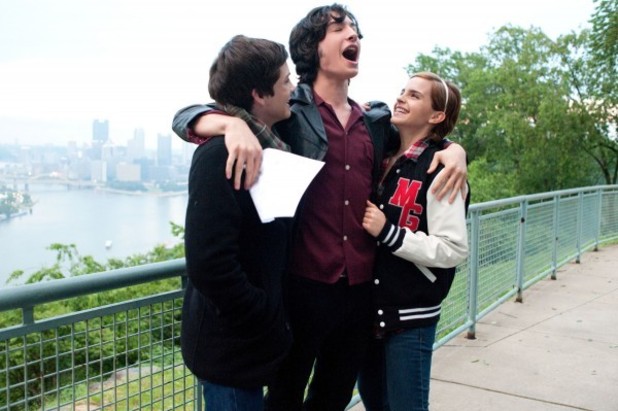
The main characters of “The Perks of Being a Wallflower.” From left to right: Charlie (Logan Lerman), Patrick (Ezra Miller), and Sam (Emma Watson)




 Angel Daniel Matos