On Closets and Straight Gazes – Bill Konigsberg’s [Openly Straight]

Front cover of Bill Konigsberg's Openly Straight
Front cover of Bill Konigsberg’s Openly Straight (2013)

I was thinking about how snakes shed their skin every year, and how awesome it would be if people did that too. In a lot of ways, that’s what I was trying to do.

As of tomorrow, I was going to have new skin, and that skin could look like anything, would feel different than anything I knew yet. And that made me feel a little bit like I was about to be born. Again.

But hopefully not Born Again.

-Bill Konigsberg’s Openly Straight (p. 4)

Bill Konigsberg’s delightful and heartwarming novel, Openly Straight, pushes readers to question the possibilities that “shedding one’s skin” offers, and the consequences that arise when reinvention threatens our sense of self. The novel is narrated by Seamus Rafael Goldberg (who usually goes by Rafe), a high school student from Colorado who transfers to Natick–an elite, all-boys school in the New England area. Although Rafe is openly gay, he decides to conceal his homosexuality while attending Natick to live a life free of labels, and to explore the possibilities of living a life unhindered by the so-called burdens of queerness.

Rafe, at first, claims that “The closet is when you say you’re not gay” (132). Problematically, he views the closet as a singular and individualistic space created by self-denial–and he fails to recognize that the act of being “out” relies on the obliteration of the many closets that appear and re-appear in our everyday lives. As pointed out by Eve Kosofsky Sedgwick in Epistemology of the Closet

every encounter with a new classfull of students, to say nothing of a new boss, social worker, loan officer, landlord, doctor, erects new closets whose fraught and characteristic laws of optics and physics exact from at least gay people new surveys, new calculations, new draughts and requisitions of secrecy or disclosure. Even an out gay person deals daily with interlocutors about whom she doesn’t know whether they know or not. (68)

Rafe’s initial failure stems from his inability to understand that stepping out of the closet is not a one-step process, for it comprises an act of revelation and disclosure each time a new closet is erected in one’s life. I was impressed with how Konigsberg manages to invoke Sedgwick’s ideas of closetedness, especially as they are experienced by contemporary youths. Given that the novel takes place in a time where homosexuality is becoming more and more acceptable by mainstream society, I was delighted that Openly Straight explores the nuances and effects of closetedness in our brave new world. As evidenced by the novel’s protagonist, closetedness can still haunt even those who are out, open, and accepted.

Rafe is born into a family that readily and openly embraces his gay identity. However, Rafe is unable to appreciate his privilege because he deems that his homosexuality eclipses the other identities that he can embody–to the point where all he is able to see when looking in the mirror is the gay subject he is expected to perform, rather than the self:

Where had Rafe gone? Where was I? The image I saw was so two-dimensional that I couldn’t recognize myself in it. I was invisible in the mirror as I was in the headline the Boulder Daily Camera had run a month earlier: Gay High School Student Speaks Out. (3)

Rafe realizes that decision to hide his homosexuality and to pass as straight do come with certain perks. He is quickly accepted by the jocks at his new school, he is able to shower with his soccer team without worrying about the repercussions of the “straight gaze,” and traits other than his queerness are recognized. His ability to keep his self-imposed secret, however, is thwarted as he grows closer to Ben, a fellow jock and philosophy enthusiast who studies at Natick. As Ben begins to show signs of fluid sexuality, and as the two boys grow closer, Rafe reflects on how the perks of his reinvention come with the cost of being able to love truly and openly.

My favorite aspect of the novel is the complex relationship between Rafe and Ben. This relationship makes you feel all the warmth that you expect in young adult novels, yet this warmth is accompanied by realistic depictions of frustration and heartache. This is unsurprising, since Rafe and Ben’s relationship is based on experimentation and sexual confusion, even though one of the two characters definitely isn’t confused. This complex relationship ultimately leads Ben and Rafe to reflect on the nature of love–how it is possible to love people in different ways, and how it is possible for different types of love to overlap. This reflection leads to my favorite passage in the novel, in which Ben contemplates his non-normative affinities with Rafe:

I guess I’d like to think of what we have as agapeA higher love. Something that transcends. Something not about sex or brotherhood but about two people truly connecting. (225)

One another note, Openly Straight, in its essence, is about gazes, and how they control how we perceive ourselves and how others perceive us. Rafe’s decision to go back into the closet is driven by the fact he is tired of being viewed as a queer object by his friends, family, and peers. Rafe’s views are not entirely unfounded–he is constantly asked by friends and teachers to give his input as a queer subject. His attitudes, beliefs, and actions are constantly being traced back to his homosexuality by other characters. Rafe, understandably, feels the weight of queerness on his shoulders–and this weight is unshakable.

Rafe, nevertheless, complains about the gaze that others fixate on him, without coming to grips with the ways he gazes at others. In one of the later chapters of the novel, Rafe finds himself scrutinizing one of his queer peers at a Gay/Straight Alliance meeting–remarking on everything from his peer’s clothes to his haircut. As Rafe’s eyes remain fixated on his peer, he remarks how this other boy could pass for a woman if he wanted to. When Rafe’s peer notices that he is staring, Rafe becomes self-conscious about his gazing. It is at this moment that Rafe realizes that he is guilty of performing the very act of “straight gazing” that drove him back into the closet in the first place:

I was staring at this effeminate kid, and judging my own masculinity, or lack thereof. And was I so different from everyone else? Who was to say that Mr. Meyers in Boulder was thinking about when he looked at me? How come I was assuming that his staring at me had anything to do with me? (306)

Gazing, according to Rafe, is not a fixation based on rejection, pity, or disgust, but rather, it is a discursive relationship between the self and an other. Thus, the gazer reflects on his or her own selfhood as contrasted to another person–which leads Rafe to deduce that he could “spend a little less time worrying about what people thought about [him], since they probably weren’t thinking about him at all” (307). In other words, Rafe realizes that the fault and blame lies in the eyes of the gazer and not on the person being gazed.

I love this novel. I have been reading queer YA fiction for years, and I must say that Openly Straight astounds me on many levels. It is a testament to how much queer YA literature has evolved over time, and it makes me feel very optimistic about the present and future of the genre. I foresee that young readers will be particularly drawn to the humor and cleverness of this work. I also admire the fact that this novel offers readers the opportunity to explore a compelling, funny, and heartfelt narrative that doesn’t shy away from the complexities of contemporary queerness.

Works Cited

Konigsberg, Bill. Openly Straight. New York: Arthur A. Levine Books, 2013. Print.

Sedgwick, Eve Kosofsky. Epistemology of the Closet. Berkeley: University of California Press, 1990. Print.

You can purchase a copy of Konigsberg’s novel by clicking here.

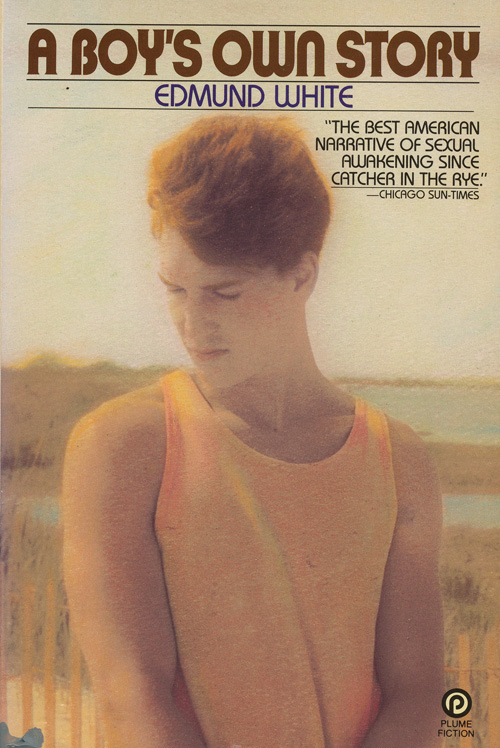
Queer Time in Edmund White’s [A Boy’s Own Story]

Front cover of Edmund White's A Boy's Own Story (1982)
Front cover of Edmund White’s A Boy’s Own Story (1982)

Edmund White’s A Boy’s Own Story is a coming-of-age novel centered on the sexual awakening of a queer teenage boy in the Midwest during the 1950s. The novel discusses topics such as the corruption of innocence, the pressures of masculinity in the lives of young boys, the emergence of childhood sexuality, and the exploration of humanity through the lens of homosexuality. The unnamed narrator of the novel quickly addresses the issues that he has in terms of his body and his sense of masculinity. He feels as if his “feminine” qualities–such as his voice, his mannerisms, and his overall attitudes– not only prevent him from bonding with other people, but that they also prevent him from obtaining any of the power that promised to those who embody the masculine myth. The narrator notices that everything from the way he sits to the way he acts marks his body as Other, and he even goes as far as to point out that he often fails small and meaningless quizzes used to assess his masculinity:

A popular quiz for masculinity in those days asked three questions, all of which I flunked: (1) Look at your nails (a girl extends her fingers, a boy cups his in his upturned palm); (2) Look up (a girl lifts her eyes, a boy throws back his whole head); (3) Light a match (a girl strikes away from her body, a boy toward–or perhaps the reverse, I can’t recall). (9)

The structure of this novel can seem slightly confusing, especially since it deviates from the traditional linear narrative that we have come to expect when reading coming-of-age novels. The first chapter, for instance, begins when the narrator is fifteen years-old. In this chapter, he painstakingly describes a relationship that he has with Kevin, the twelve year-old son of a guest that visits his summer home. In this chapter, the narrator describes how he paradoxically wants to be considered heterosexual while still being loved by a man. His relationship with Kevin slowly but surely starts to teach him how sex is not only a physical act, but how it is also a discursive act–leading him to realize that sex is also “a social rite that registered, even brought about shifts in the balance of power, but something that was discussed more than performed” (198). Because of this realization, he notices how performance and discourse shapes and forms his relationships with other men. For instance, he approaches Kevin as the “older” and more “dominant” person in the relationship because he is the more confident person of the two, and because he controls what happens during sexual intercourse:

I was chagrined by [his] clowning because I’d already imagined Kevin as a sort of husband. No matter that he was younger; his cockiness had turned him into the Older One (23).

The first chapter concludes by depicting how the narrator and Kevin part ways, and the second chapter goes back an entire year, allowing the narrator to discuss events that shaped who he is in his present day. Subsequent chapters go back in time even further, depicting events that the narrator encounters when he was twelve and seven years-old. The jumping back and forth between the past and the present not only disrupts the linearity of the coming-of-age narrative, but it also presents, as Elizabeth Freeman would put it, a manifestation of queer time. 

In Time Binds: Queer Temporalities, Queer Histories, Elizabeth Freeman describes queer time as a “hiccup in sequential time” that “has the capacity to connect a group of people beyond monogamous, enduring couplehood” (3). Furthermore, queer time allows queer subjects to envision alternative structures and forms of belonging, precisely because it deviates from the linearity and “productivity” of chrononormativity–in which human bodies arrange their time and bodies towards maximum productivity. In A Boy’s Own Story, queer time manifests through this combination of the past and the present, precisely because the narration deviates from the productive and generative elements that are closely associated with narratives of personal development. White, rather than depicting growth and development as sequential events, the narrator approaches them as fractured and disjointed processes. Rather than offering readers an equation, in which event 1, event 2, and event 3 equal the narrator, White disrupts temporality by beginning with event 3, going back to event 1, and covering the decimal points (small or micro events) that occur between these numbers. I think that this novel embraces queerness through it’s denial of both chronos (sequential time) and kairos (significant time), in favor of small non-sequential and non-significant time. This is particularly clear in the fourth chapter of the novel, in which the narrator breaks the fourth wall and addresses the reader:

in writing one draws in the rest, the forgotten parts. One even composes one’s improvisations into a quite new face never glimpsed before, the likeness of an invention. Busoni once said he prizes the most those empty passages composers make up to get from one “good part” to another. He said such womanlike but minor transitions reveal more about a composer–the actual vernacular of his imagination–than the deliberately bravura moments. I say all this by way of hoping that the lies I’ve made up to get from one poor truth to another may mean something–may even mean something most particular to you, my eccentric, patient, scrupulous reader, willing to make so much of so little, more patient and more respectful of life, or a life, than the author you’re allowing for a moment to exist again. (84)

I believe that this passage is quite significant, because it highlights the role that queer time plays in the novel’s political agenda. By disrupting linearity and by painstakingly focusing on minor events, the reader must develop patience and spend more time concentrating on the narrator’s words rather than on major events. The narrator affirms that by reading his words, the reader becomes not only more respectful of the narrator’s life, but the reader also brings the narrator back into existence. Therefore, through the act of reading, one gives the narrator a sense of legitimacy that was denied to him during his childhood. This interpretation gains even more validity when taking into account that most of the novel is focused on the narrator’s struggle to survive in his society, and even more so, his struggle to be approached and categorized as a legitimate human being. The narrator, for instance, acknowledged that he has little time to focus on “theory” or “philosophy” because he is too busy focusing on pragmatic aspects of his life such as survival. This notion is evidenced when the narrator compares himself to his jockish friend, Tom, who spends most of his time daydreaming and philosophizing:

Ironic, then, that [Tom] was the one who did all the thinking, who had the taste for philosophy–ironic but predictable, since his sovereignty gave him the ease to wonder about what it all meant, whereas I had to concentrate on means, not meaning. The meaning seemed quite clear: to survive and then to become popular. (113)

Although popularity may at first be approached as a self-centered and selfish goal, it is important to keep in mind that the narrator believes that popularity will give him the recognition and the legitimacy that he has been denied in his life, not only because he is queer, but also because he is unable to situate himself within the frame of traditional masculinity that his father upholds. Popularity would give the narrator the means to become a legitimate person rather than an unreal subject:

Being popular was equivalent to becoming a character, perhaps even a person, since if to be is to be perceived, then to be perceived by many eyes and with envy, interest, respect, or affection is to exist more densely, more articulately, ever last detail minutely observed and thereby richly rendered. (127)

All in all, A Boy’s Own Story is a rich and provocative novel that definitely raises interesting insights in terms of the role that temporality plays within the issues of livability that haunt all queer lives. The narrative is at times convoluted and difficult to follow, but getting lost is definitely an essential component towards grasping the novel’s central themes and agenda.

You can purchase a copy of White’s novel by clicking here.


Works Cited

Freeman, Elizabeth. Time Binds: Queer Temporalities, Queer Histories. Durham: Duke University Press, 2010. Print.

White, Edmund. A Boy’s Own Story. New York: Plume, 1982. Print.


Gender and Non-Normativity in Jeanette Winterson’s [Oranges Are Not the Only Fruit]

Front cover of Jeanette Winterson's Oranges Are Not the Only Fruit (1985)
Front cover of Jeanette Winterson’s Oranges Are Not the Only Fruit (1985)

Oranges Are Not the Only Fruit (henceforth OANOF) is a 1985 Bildungsroman (novel of development) centered on the life of Jeanette, a girl who is adopted and raised by a woman who happens to be a fundamentalist Christian. Jeanette’s mother believes in literal translations of the Bible, and she freely uses religious rhetoric to accommodate her black and white fashion of viewing the world. As Jeanette, the narrator, mentions early on in the novel, her mother “had never heard of mixed feelings. There were friends and there were enemies” (3). Although Jeanette happens to feel greatly connected to her church and her church’s teachings, this fidelity towards the supposed perfection of the church becomes challenged as she realizes that she is sexually and romantically drawn towards women. OANOF focuses most of its attention on the tensions and frictions that spark when Jeanette’s sexual life clashes with her religious life, and on the drastic measures that her church takes to drive the “demon” of “unnatural passions” away from her.

Although Jeanette’s development and moral growth is most certainly the focus of this novel, a lot of the content is focused on her strange relationship with her mother, and even more so, on the mother’s blind and ritualistic devotion to her church. The mother desperately tries to shield Jeanette from evils, especially those associated with gender and sexuality. For instance, when Jeanette develops a friendship with an ostensibly lesbian couple that runs a paper shop, the mother soon forbids Jeanette from going to that store because there was a rumor that “they dealt in unnatural passions” (7). Seeing as the mother doesn’t speak to her daughter about matters of gender, sexuality, and the body, Jeanette naively believes that “unnatural passions” are referring to the fact that the couple puts chemicals in their sweets.

This desire to protect Jeanette from evil, in addition to the mother’s penchant for explaining phenomena using religious rhetoric, makes it increasingly difficult for Jeanette to adjust to the outer world. For instance, Jeanette goes deaf for three months in the novel. Rather than taking Jeanette to the hospital, the mother begins to inform everyone that Jeanette is “in a state of rapture” (23), and she prevents people from speaking to her. It is Miss Jewsbury, a closeted lesbian, who brings Jeanette to the hospital to be treated for her condition. Jeanette realizes that her condition is due to biological processes rather than spiritual rapture, and it is in this moment that she begins to question the perfection and infallibility of her church:

Since I was born I had assumed that the world ran on very simple lines, like a larger version of our church. Now I was finding that even the church was sometimes confused. This was a problem. But not one I chose to deal with for many years more. (27)

It is in this moment that Jeanette begins her process of development and maturation: it is the moment in which she realizes that her mother doesn’t have all of the right answers, and neither does the church. Thus, rather than resorting to donning the mother’s ideological perspective of the world, which consists of viewing things as either good or bad, Jeanette must learn to challenge herself to explore areas of contradiction and ambiguity that do not necessarily conform with the notions of right or wrong.

It is  during Jeanette’s time time at the hospital that that the motif of oranges becomes heavily introduced into the narrative, for her mother constantly sends her oranges along with some “get better soon” letters when she doesn’t have the time to visit Jeanette. Throughout the novel, the only fruit that Jeanette’s mother will give to her is the orange, for it is “The only fruit” (29). Little is said as to why oranges are deemed to be the only fruit worthy of consumption. However, the meaning behind the orange is not necessarily based on the fruit itself, but rather, on how the fruit is used. First and foremost, oranges become a way of further characterizing Jeanette’s mother, showing how she perceives the world categorically, and showing how she desires to limit the options that Jeanette can have. Furthermore, since oranges are the only fruit that are validated from the mother’s perspective, all of other fruit go on to lack legitimacy. Much later on in the novel, when Jeanette gets slightly ill, her mother brings her a bowl of oranges, and the following scenario takes place:

I took out the largest and tried to peel it. The skin hung stubborn, and soon I lay panting, angry and defeated. What about grapes or bananas? I did finally pull away the other shell, and, cupping both hands round, tore open the fruit. (113)

In this context, it becomes a little more clear that oranges are representing either gender or heterosexuality. By questioning why she can’t have other fruit, Jeanette puts into question the limitations that are imposed on her in terms of her choices and preferences. Notice that she has trouble accessing the orange’s pulp, which can symbolize the difficulty that Jeanette has towards complying with a simplistic, limited, heteronormative view of the world. It would be much easier for her to eat grapes or bananas, however, we observe that Jeanette’s mother is still coercing her to struggle with oranges.

The entire spectrum of fruit, in this interpretive view, would go on to represent the entire spectrum of gender–the mother’s efforts to impose oranges as the only good fruit go on to represent efforts to approach a single gender or sexual orientation has valid and legitimate. As can be expected, the mother’s views toward fruit also apply towards her views on gender and sexuality: “I remembered the famous incident of the man who’d come to our church with his boyfriend. At least, they were holding hands. ‘Should have been a woman that one,’ my mother had remarked” (127). This leads Jeanette to one of her many philosophical musings, in which she recognizes the fact that her mother is unable to interpret the world without resorting to the use of binaristic thinking. Instead of accepting the fact that these two men are, in due course, simply men, she resorts to approaching one of the men as a woman. But, as Jeanette remarks:

This was clearly not true. At that point I had no notion of sexual politics, but I knew that a homosexual is further from a woman than a rhinoceros. Now that I do have a number of notions about sexual politics, this early observation holds good. There are shades of meaning, but a man is a man, wherever you find it. (128)

The desire to steer away from convention and normativity is a staple of this novel. Just as Jeanette desires another fruit besides an orange, she also desires to be romantically involved with someone besides a man. Jeanette’s penchant for non-normativity is even expressed in her artistic inclinations and projects. While Jeanette is in school, she truly strives to win a prize in the school’s various artistic competitions. While at first she loses these competitions because of her adherence to religious doctrine, she notices that she still continues to lose competitions even when she presents projects that are non-religious in their themes. For instance, in an Easter Egg painting competition, Jeanette creates an elaborate diorama that recreates a scene from Richard Wagner’s Der Ring des NibelungenHowever, she loses to a a student who covers eggs in cotton in order with the title of “Easter Bunnies” (48). Jeanette realizes that even though her masterpiece was definitely the best project submitted to the competition, she loses simply because she steers away from convention. Rather than creating a habitual Easter-themed project for the competition, she strives to be different and creative, which essentially makes Jeanette a queer character in many other aspects besides her sexuality.

As I mentioned previously, Jeanette’s queerness certainly causes her a lot of pain and heartache, which is perhaps epitomized when she is publicly accused for being a lesbian while in church. The church members deem that Jeanette and her girlfriend, Melanie, have engaged in homosexual activity because they are possessed by demons. This accusation sparks a lot of commotion in the church, and thus, one of the most confusing and convoluted sections of this novel takes place. After the accusation, Jeanette escapes the church and goes to Miss Jewbury’s home. Miss Jewbury does her best to comfort Jeanette, and out of the blue, the two have sex: “We made love and I hated it and hated it, but would not stop” (106). When Jeanette returns home after her encounter with Jewbury, the tension of the novel escalates to an unprecedented degree as members of her church congregation perform an intense exorcism on her. The members stay from 8:30 a.m. to 10:30 p.m. “praying over [her], laying hands on [her], urging [her] to repent [her] sins before the Lord” (107). The exorcism ultimately culminates with Jeanette being locked up in a room for 36 hours without food, and she only claims to be repentant in order to get access to food.

The resolution and “conclusion” of the novel focus on Jeanette becoming closely involved with the church as she also begins a relationship with a new church member named Katy. Contrary to the beliefs of her congregation, Jeanette firmly believes that her spiritual and sexual life are able to coexist. She is soon caught in a compromising situation with Katy, and her mother proceeds to kick her out of their home. This so-called failure pushes Jeanette to move to a city and start a new life–while unfortunately being deprived of her family and her history. She eventually returns to her old home to visit her mother, who seems to express a degree of ambivalence towards Jeanette–they do talk, but they never discuss Jeanette’s love life. The conclusion, however, shows a surprising revelation: Jeanette’s mother starts its first mission with black people–and she serves them pineapple because “she thought that’s what they ate” (172). Because of this, Jeanette’s mother ends up eating many dishes with pineapple in it, while claiming, philosophically, that “oranges are not the only fruit” (172). Thus, while the novel certainly ends in a sad note, indicating that many people still believe that Jeanette is possessed, the mother’s acceptance of other fruit leads the reader to believe that perhaps the mother is not viewing the world in the conceptually simplistic fashion that she used to. Just like white and black communities are starting to coexist in the mother’s church, the mother’s black and white conceptual distinctions start to blur.

On a personal note, this novel is fabulous. It is touching, shocking, and even funny at times. This novel is definitely a cornerstone of LGBTQ lit, even though the author does not necessarily consider OANOF to be a lesbian novel.  While I do recognize the universality of the themes present in the novel, I can particularly see how LGBTQ readers would appreciate and love this masterpiece.

You can purchase a copy of Winterson’s novel here.

Thoughts? Comments? Opinions? Please feel free to engage in this conversation using the comments section below!

Work Cited

Winterson, Jeanette. Oranges Are Not the Only Fruit. London: Pandora, 1989. Print (paperback edition).

J.C. Lillis’ [How to Repair a Mechanical Heart]: A Gay YA Novel on Fandom, Religion, and Canonicity

Front cover of J.C. Lillis' How to Repair a Mechanical Heart (2012)
Front cover of J.C. Lillis’ How to Repair a Mechanical Heart (2012)

If there is one thing that gay young adult fiction should be thankful for, that thing would be the internet. Because of the advent of the web, we have witnessed the increase of self-published e-novels distributed through online stores such as Amazon and Barnes and Noble. Self-publishing, in my opinion, greatly expands the possibilities of gay young adult fiction, not only because authors are free to be more experimental and explicit when it comes to the novel’s content and structure, but also because they do not have to comply with the expectations and demands of a publishing house or an editor. J.C. Lillis’ How to Repair a Mechanical Heart (2012) is definitely one of the most unique gay YA novels that I have read this year, not only in terms of its content, but also in terms of its narrative techniques and devices. Although, on the surface level, the novel is centered on the blossoming relationship between two teenage boys, How to Repair a Mechanical Heart, offers readers a fresh take on the uneasy tension that exists between religion and homosexuality.

Now, religion is a topic that is found in many YA books dealing with homosexuality. Some of these novels, such as Alex Sanchez’s The God Box, take a more didactic and realistic approach to the issue, going as far as to present characters that discuss homosexuality by directly citing a barrage of Biblical rhetoric. Other novels, such as Timothy Carter’s Evil?, take a more fantastical and satirical (and hilarious) approach to the tension between religion and homosexuality through the incorporation of characters such as demons and fallen angels. How to Repair a Mechanical Heart tackles the issue of religion and homosexuality through a realistic approach, however, the exploration of this issue is framed through an exploration of fandom subculture. Although at first I was skeptical about whether a gay YA novel could pull off discussing tough issues through fan culture (which includes Comic Con-esque events, the reading and creation of fan fiction, and even the critique of television shows via vlogs), by the end, I thought that Lillis managed to pull it off beautifully. This novel turned out to be an entertaining, complex, and funny read in spite of its often heavy-handed themes and events.

The novel focuses on Brandon and Abel, two fans of a science fiction show entitled Castaway Planet. This show centers on the space adventures of two main characters: Cadmus, a hot-headed, impulsive, and unpredictable explorer; and Sim, an android who is intelligent, calculating, and incapable of feeling human emotion. Brandon and Abel are the hosts of a Castaway Planet vlog, where they deconstruct episodes of the television series, and where they offer critiques of Castaway Planet fan fiction that they dislike. The fan fiction that really grind their gears, however, would be those that ship Cadmus and Sim, for they deem that this relationship is absolutely implausible and disjointed from the themes and reality of the show. Their dislike for this type of fan fiction leads them to partake on a road trip across the country with their friend, Bec, in order to interview the show’s actors in hopes of discrediting any fanfic author who ships Cadmus and Sim. Their anger toward this shipping arises from the fact that Brandon and Abel believe that it demonstrates “zero respect for canon or for Cadmus or Sim as characters” (Lillis).

Throughout this road trip, Brandon and Abel not only develop an increasing appreciation towards the shipping of the Castaway Planet characters, but they also discover their true feelings towards each other. However, these feelings are complicated by the fact that Brandon is still unable to let go of the Catholic doctrine that has shaped his views and understanding of amorous relationships. Brandon is ultimately constructed as a dualistic character in that his mind has come to terms with his sexual orientation, but his heart has not. Brandon’s struggles are intensified not only because his childhood priest approaches celibacy as the only viable life choice for a Catholic gay man, but also because Abel previously has had his heart broken by Jonathan, a boy who decided to end their relationship due to the tension that it caused with his religion. Whenever Brandon is engaging in behavior that may be deemed “gay,” Catholic guilt manifests within his consciousness in the form of his childhood priest, who often reprimands him for his poor decisions that supposedly contradict the teachings of the Catholic church.

Lillis’ novel does an excellent job of creating a multi-layered text in which all the layers are not only interconnected but also capable of illuminating important tensions and resolutions in the novel. While at first fandom, fan fiction, Catholism, and homosexuality seem to have little to no relation to one another, Lillis combines them in a unique way that sheds light not only on the construction of identity, but also the personal negotiations that individuals must undergo when facing cultural demands and when fabricating narratives. For instance, discussions of Cadmus and Sim obviously reflect the tensions that exist between Brandon and Abel. Brandon considers that religion has made his heart mechanical in that it runs in an automated fashion that cannot be fixed or controlled. This motif is central in the novel, for religion is approached as the element mechanizes Brandon’s heart and prevents him from fully loving Abel with no regrets or qualms. Abel, on the other hand, resembles Cadmus, for he is approached as an impulsive character who carelessly disregards the difficulties that Brandon faces when trying to repair his mechanical heart.

Surprisingly, fandom and fan fiction were also very useful and illuminating motifs that Lillis incorporates into the novel in order to offer a unique spin on the treatment of homosexuality within the gay YA novel. Fan fiction, most of the times, disregards realism and canonicity in favor of crafting a narrative that goes in accordance with the tastes, expectations, and desires of the fan fiction writer. Fan fiction is a particularly noteworthy genre of writing because it becomes a venue that allows viewers to assume an active role within the fictional universe created by a show, a book, or a movie. Furthermore, fan fiction allows the recipients of a cultural artifact to explore alternative narratives, outcomes, and possibilities that are not restricted to canonical norms. For instance, if I’m upset that Ross and Rachel end up together in the series finale of Friends, I can write a fanfic in which Rachel ends up going to Paris and begins a life without Ross.

The creation of fan fiction can be approached as a very queer process, especially when it comes to its focus on alternative outcomes, non-normativity, and a mode driven purely by individualistic desire. In How to Repair a Mechanical Heart, the act of participating within the fan fiction universe is linked to the process of embracing a gay identity, for it involves a refutation of rules and so-called truths in order to seek life alternatives that invoke comfort and livability. Fan fiction and queerness entail a refusal of a normative entity (the canon or heteronormativity) that seeks to regulate “sub par” existences and fictions. This notion becomes particularly apparent near the novel’s conclusion, when Brandon meets the creator of Castaway Planet. When Brandon seems to approach fan fiction with slight “disgust,” and when he approaches the creator of the show as the sole bearer of the show’s truth, the creator reacts very harshly to Brandon’s assumptions:

“Listen, you runt. I saw that self-righteous eyeroll when you said fanfiction. Let me tell you something: I fucking love fanfiction. Why do you think I made up these characters? So I could play with dolls in public and tell everyone else ‘hands off’? So I could spoon-feed you stories from on high about the mysteries of love and free will and giant alien spiders?” He shows me his palms, then the backs of his hands. “I am one man with a laptop. When I give the world my characters, it’s because I don’t want to keep them for myself. You don’t like what I made them do? Fucking tell me I’m wrong! Rewrite the story. Throw in a new plot twist. Make up your own ending. Castaway Planet is supposed to be a living piece of art! (Lillis, location 3278)

The show’s creator overtly refutes any desire to regulate how his characters are used or appropriated. He expresses how people should feel free to take the “truth” depicted by the canon and transform it in ways that go in accordance with their individual wants and desires. The canon is not mechanical in that it requires preciseness and exactness to function, but rather, it is approached as a living entity capable of transformation. In due course, Brandon begins to approach religion in a similar fashion, realizing that he can grow comfortable with belief in a God if he accepts that certain elements within the doctrine are not only open to interpretation, but can also be rewritten to go in accordance with an alternative truth.

Although How to Repair a Mechanical Heart, at times, seems slightly moralizing and repetitive in its treatment of religion, it presents one of the freshest approaches towards spirituality and belief within the confines of a gay YA novel. I think that this novel is very innovative in terms of framing its central issues through fandom subculture, and I especially enjoyed the novel’s overt and explicit decoupage of narrative conventions. While the structure of this text generally follows the linear conventions found within most gay coming-of-age fiction, it consciously employs the style and conventions of the fan fiction genre to add some much needed flair and whimsy to the often stale and dry treatment of religion and homosexuality in YA fiction. I highly recommend this novel for its likable characters, its queer potentiality, and its unique structure and motifs.

You can purchase a copy of Lillis’ novel here, and you can read more about it by clicking here

Work Cited

Lillis, J.C. How to Repair a Mechanical Heart. Amazon Digital Services, 2012. Kindle text.

On Happy Endings and Gay Fiction: E.M. Forster’s [Maurice]

Front cover of E.M. Forster's Maurice
Front cover of E.M. Forster’s Maurice (1971)

“A happy ending was imperative. I shouldn’t have bothered to write otherwise. I was determined that in fiction anyway two men should fall in love and remain in it for the ever and ever that fiction allows, and in this sense Maurice and Alec still roam in the greenwood. […] Happiness is its keynote–which by the way has had an unexpected result: it has made the book more difficult to publish.”

(E.M. Forster, Terminal note of Maurice – p. 236)

Maurice, a central text within the gay literary canon, is by far one of the bravest creative works written within the genre of LGBT literature; arguably, it is one of the bravest texts of the early twentieth century. The novel is an essence a Bildungsroman that traces the emotional development of the eponymous hero as he deals with the repercussions of being homosexual in Edwardian England. During his time at college, Maurice Christopher Hall becomes involved in a romantic (yet strictly chaste) relationship with his Cambridge colleague, Clive Durham, until the latter decides to marry a woman–leaving Maurice desolate and heartbroken. Through his attempts to “cure” his homosexuality through hypnosis and other means, Maurice meets Alec, a gatekeeper at the Durham estate. He becomes involved both romantically and sexually with Alec, and decides to start a life with him–all while affirming his “Wildean” identity to Clive as an act of socio-cultural resistance. As Maurice admirably states in his declaration of queer embodiment to Clive:

I was yours once till death if you’d cared to keep me, but I’m someone else’s now–I can’t hang about whining for ever–and he’s mine in a way that shocks you, but why don’t you stop being shocked, and attend to your own happiness? (230)

Although written by E.M. Forster during 1913-14, he refused to publish the book during his lifetime because of the negative legal and moralistic attitudes toward homosexuality that permeated England during the advent of the century. While bravery isn’t necessarily reflected in Forster’s (perfectly reasonable) decision to withhold publishing the text during his lifetime, it is reflected in the novel’s content: to envision a world, fictional or realistic, in which two men could “fall in love and remain in it” was beyond the scope of most modernist writers. It’s also brave in terms of its optimism, for in a world in which literary merit is driven by pain, suffering, depression, and unhappy endings, writing a novel with a happy ending is indeed a deviation from the grim albeit expected nature of the “literary.”

It is no coincidence, however, that Maurice was written just before World War I. One could only imagine how this optimism would be affected if the novel were written a year or two later. Forster did edit the novel during the 1960s, and it was known for having an epilogue in which Maurice’s younger sister (Kitty) encounters him and Alec working as woodcutters (and the consequent hatred she develops once she puts two and two together). Forster decided to discard this epilogue because the novel’s action is set in 1912, and the epilogue would’ve taken place a few years later in “the transformed England of the First World War (239). Thus, even though the novel is edited decades after it was written, its narrative essence and its optimistic outlook remained unchanged because it is meant to be approached as a snapshot of homosexual love during a period in which issues of class, aristocracy, politeness, and appearance are crucial to character development. This, in conjunction with the fact that the novel was published almost sixty years after it was written, leads it to be approached as a period piece (even though it was not written to be read this way).

Given the fact that the novel was written so early during the twentieth century, it is surprising to see how forward-thinking the novel is in terms of its views on sex, homosexuality, and queerness. Maurice is shown from his early teens to sense some discomfort in terms of heterosexual courtship. This is particularly noticeable when Mr. Ducie is explaining the act of heterosexual intercourse (with diagrams and illustrations traced on sand) to a fourteen year-old Maurice at the beach. The young teen is unable to grasp the adult’s approach to the birds and the bees: “He was attentive, as was natural when he was the only one in the class, and he knew that the subject was serious and related to his own body. But he could not himself relate it; it fell to pieces as soon as Mr. Ducie put it together, like an impossible sum (7, emphasis mine). The design and mechanics of heterosexual intercourse do not mesh with Maurice’s sensibilities, thus linking homosexuality to organic or perhaps even genetic roots. Indeed, this biological perspective goes in accordance with the view of homosexuality as pathological during this period, and the hypnotist that attempts to cure Maurice of his “trouble” in the novel goes as far as to diagnose him with a case of “Congenital homosexuality” (167). This diagnosis may indeed seem problematic, but before jumping to conclusions, I want to focus my attention on an exchange that happens between Maurice and Lasker Jones (the hypnotist/therapist) during the last failed attempt to cure the former of his so-called ailment:

“And what’s to happen to me?” said Maurice, with a sudden drop in his voice. He spoke in despair, but Mr Lasker Jones had an answer to every question. “I’m afraid I can only advise you to live in some country that has adopted the Code Napoleon,” he said.

“I don’t understand.”

“France or Italy, for instance. There homosexuality is no longer criminal.”

“You mean that a Frenchman could share with a friend and yet not go to prison?”

“Share? Do you mean unite? If both are of age and avoid public indecency, certainly.”

“Will the law ever be that in England?”

“I doubt it. England has always been disinclined to accept human nature.”

Maurice understood. He was an Englishman himself, and only his troubles had kept him awake. He smiled sadly. “It comes to this then: there always have been people like me and always will be, and generally they have been persecuted.”

“That is so, Mr Hall; or, as psychiatry prefers to put it, there has been, is, and always will be every conceivable type of person. And you must remember that your type was once put to death in England.” (Forster 196)

Although homosexuality is approached as pathological in most of the novel, Lasker Jones and Maurice seem to come to the consensus that homosexuality is simply a way of being that has been policed and suppressed in an effort to further wedge the divide between the cultural and the natural. This passage is emancipatory in that it problematizes the view of homosexuals being unable to assimilate to cultural norms through an inversion of agency: the problem is not the homosexual’s inability to mesh with society, but rather, society’s inability to mesh with the homosexual (i.e. people who have existed, exist, and always will exist). This is precisely why a happy ending for the novel, as Forster put it, was imperative.

Forster could have played it safe to assure that Maurice was published during his lifetime: “If it ended unhappily, with a lad dangling from a noose or with a suicide pact, all would be well, for there is no pornography or seduction of minors” (236). But ending this novel in a tragedy would’ve not only followed the formula of countless other novels with gay content published during the time, but it also would go against the possibility of creating an active and effective identity politics. True, tragedy (and backwards feelings), in its own macabre way, has a way of inspiring and igniting a politics of identity; after all, it is pain that establishes the need for a politics of identity in the first place. However, considering all of the pain already portrayed in the novel, would it be necessary for characters to embrace death as a way of demonstrating the unfairness of the status quo? Forster suggests, in due course, that perhaps the shears needed to unravel the knot of (hetero)normativity are not found through death, solitude, and pain, but rather, through life, union, and happiness. Maurice, rather than basking in solitude, finds strength through Alec, and assures him that they “shan’t be parted no more, and that’s finished” (225). And although the forever-ness present within the lack of this parting may only be found in fiction, it is a fiction I’m willing to live through vicariously.

You can purchase a copy of Forster’s Maurice here.

Work Cited

Forster, E.M. Maurice. Toronto: Macmillan of Canada, 1971. Print.