Fact Versus Fiction: Alan Hollinghurst’s [The Line of Beauty]

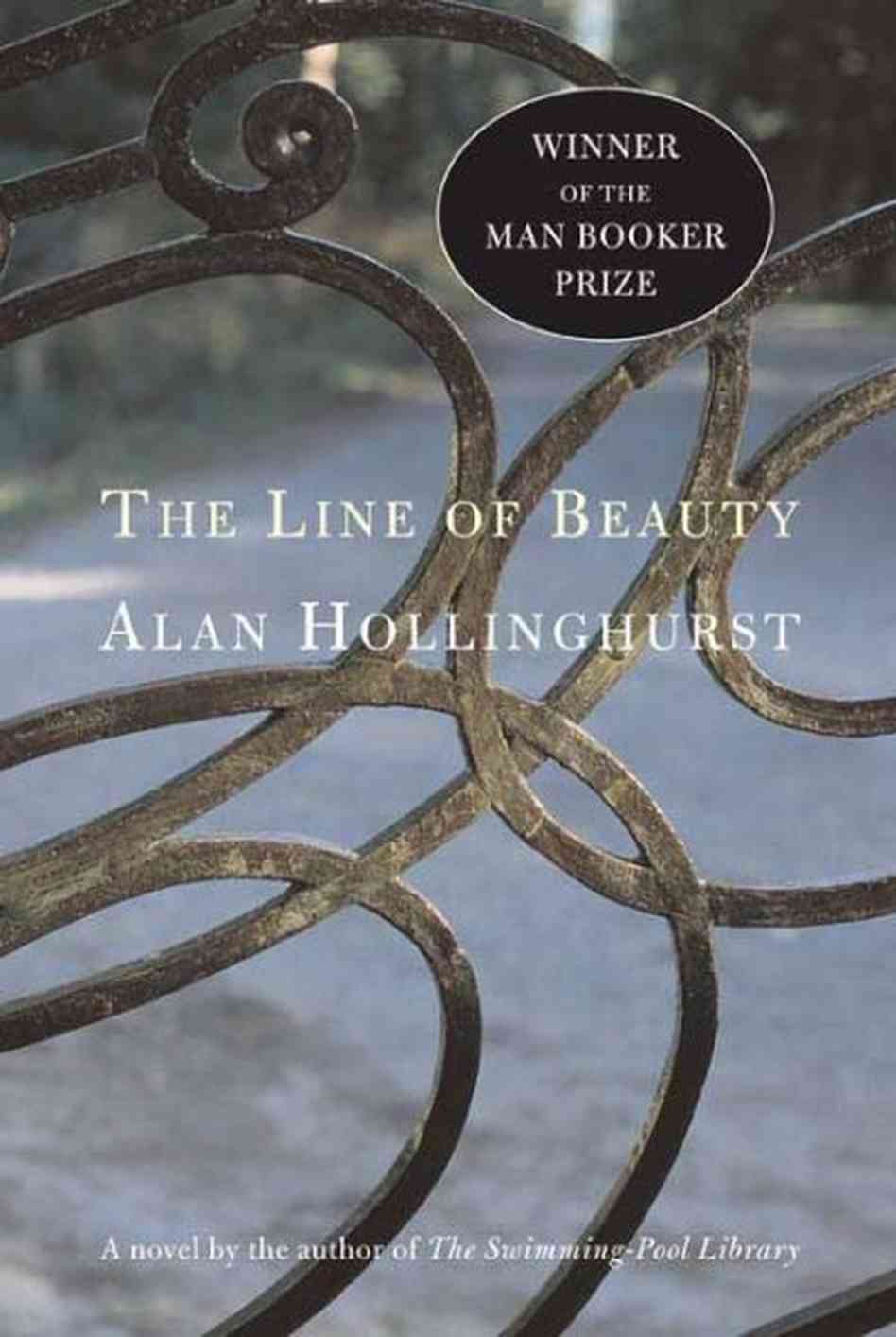
Front cover of Alan Hollinghurst's The Line of Beauty (2004)
Front cover of Alan Hollinghurst’s The Line of Beauty (2004)

I find it so easy to get lost in the elegance and artistry of Alan Hollinghurst’s The Line of Beauty. I originally planned to read this book in a day or two, but it took me a while longer simply because I was so enthralled and moved by the novel’s baroque descriptions and its aesthetic focus on issues pertaining to gayness and queerness during the 1980s. Blurring the lines between gay historical fiction, the Bildungsroman, and the novel of mannersThe Line of Beauty explores the lines that divide British upper-class and middle-class society, and the relationship between homosexual identity and class during the conservative boom in the United Kingdom under the rule of  Margaret Thatcher. Even more so, Hollinghurst’s novel offers readers an opportunity to examine the heartbreaking effects of AIDS during the rise of the disease.

The novel centers on the life and experiences of Nick Guest in his early twenties, as he graduates from Oxford University and begins a postgraduate degree in English at another university–where he specializes on the issue of style in the works of Henry James. Nick becomes close friends with Toby and Catherine, who are the children of Gerald Fedden, a wealthy Member of the British Parliament. Although Toby and Nick are best friends, Nick becomes very close and intimate with Catherine, a manic-depressive. Because of Nick’s ability to understand and help Catherine, Gerald invites Nick to stay in his mansion so that he can keep a watchful eye over his daughter. Nick stays at the Fedden residence for four years; here, he not only learns about the radical differences that exist between the lavish lifestyle of the Feddens and his own middle-class upbringing, but he also begins to explore his gay identity by dating  an older and much more experienced black council worker named Leo. Although Nick is out to the Fedden family, the issue of homosexuality instills a sense of discomfort in Gerald and his wife, Rachel. The family’s attitude towards homosexuality is made apparent early in the novel, when the family discusses the case of Hector Maltby, a junior minister of the Foreign Office who was caught having sex with a rent boy in his Jaguar:

The story had been all over the papers last week, and it was silly of Nick to feel as self-conscious as he suddenly did, blushing as if he’d been caught in a Jaguar himself. It was often like this when the homosexual subject came up, and even in the Fedden’s tolerant kitchen he stiffened in apprehension about what might carelessly be said–some indirect insult to swallow, a joke to be weakly smiled at. (22)

The residents of the Fedden estate are characterized not only by their social hypocrisy, but also by their silences: by refusing to talk of certain issues, they strive to act as if said issues are minor, non-consequential, and non-existent. As a matter of fact, Nick is characterized by his penchant for concealing or hiding information to assure that certain perceptions or attitudes are upheld in the Fedden residence. For instance, at the beginning of the novel, Nick discovers that Catherine, who has already attempted to harm herself, has been storing sharp tools within her bedroom. Rather than discussing this detail with Catherine’s parents, he decides to keep this information concealed to avoid upsetting Gerald and Rachel when they return from their trip. Nick not only conceals truths that he believes will upset the Fedden family, but he also has issues when it comes to separating fact from fiction–which leads to the manifestation of the vicious cycles that are so characteristic of postmodern texts:

In the course of their long conversations about men he had let one or two of his fantasies assume the status of fact, had lied a little, and had left some of Catherine’s assumptions about him unchallenged. His confessed but entirely imaginary seductions took on–partly through the special effort required to invent them and repeat them consistently–the quality of real memories. (24)

Sometimes his memory of books he pretended to have read became almost as vivid as books he had read and half-forgotten, by some fertile process of auto-suggestion. (48)

As evidenced above, Nick not only strives to conceal truth to uphold his social image, but he also fabricates stories to uphold a socially appealing facade. He frets when it comes to revealing his lack of knowledge or his lack of sexual experience–to the point where his fabrications become entirely real to him, or even worse, to the point where he deliberately forgets or represses truths about himself. This is perhaps most apparent when the novel, which is comprised of three parts, transitions from part one to part two. Part one, which takes place in 1983, concludes with Nick and Leo sleeping together in the Fedden’s house. The second part of the book takes place three years later, and it begins with a description of Nick’s affair with Wani Ouradi, a multi-millionaire of Lebanese descent who is engaged to a woman. This temporal leap leaves a gap in the narrative of the story. As readers, we have no clue what happened between Leo and Nick during this three-year span–all we are sure of is that they are no longer together, and that Nick’s relationship with Wani is masochistic and unhealthy. Not only is Wani into promiscuous and unsafe sex with strangers, but he is also addicted to porn and cocaine, and he is also deeply closeted. Nick, however, remains by Wani’s side not because the relationship is practical, but rather, because Wani is beautiful. This connects to one of the novel’s main themes, in which appearances trump pragmatics and livability. This desire for beauty and for appearance ultimately affects Nick’s ability to face his own truths, as is seen in the instance in which he encounters Wani seducing a stranger:

He went across the room and put the car keys down on the side table, and when he looked back Ricky and Wani were snogging, nothing had been said, there were sighs of consent, a moment’s glitter of saliva before a shockingly tender second kiss. Nick gave a breathy laugh, and looked away, in the grip of a misery unfelt since childhood, and too fierce and shaming to be allowed to last. (173)

Later on in the novel, Nick finds out that Leo has died due to AIDS-related complications. As Leo’s sister tells Nick the news, he at first wants to lie to her by stating that Leo dumped him, but he recognizes that this lie would seem petty, especially when considering the fact that Leo is no longer alive. Although Nick convinces himself that Leo was seeing someone else, we realize that he develops this “memory” to conceal the fact that he broke up with Leo soon after finding out that he was sick– “to screen a glimpse he’d had of a much worse story, that Leo was ill” (350). It becomes clear at this point that the three-year gap in the novel represents Nick’s unwillingness to deal with or recall the truths behind his relationship with Leo. Leo’s illness, in Nick’s eyes, would corrupt his beauty and make him imperfect, which is why he pursues a relationship with the physically flawless and beautiful Wani. However, towards the conclusion of the novel, it is revealed that Wani is also dying of AIDS-related complications–thus forcing Nick to meet truth face-to-face, while simultaneously forcing him to confront the realities of his own life.

I find it interesting that Catherine, the manic-depressive sisterly figure of the novel, is represented as the only person capable of dealing with truth and looking beyond the lies fabricated by her peers. For instance, when one of her friends, Pat, dies of AIDS, her family desperately tries to conceal that he died of this illness to prevent themselves being associated with a so-called “gay-related” disease. Catherine, however, forces the family to face the truth about Pat’s death, even though this confrontation leads to public shame and embarrassment. She later tries to convince Nick that “People are lovely because we love them, not the other way round” (304), to make him realize how toxic his relationship with Wani truly is, and to prove to him that the value that we bestow to people and objects should be based on more than just aesthetics. Catherine ultimately induces both the downfall of Nick and of her father, by revealing truths to the press: she not only reveals the fact that her father is having an affair with another woman, but she also reveals how Nick and Wani’s affair is taking place within the Fedden household–thus collapsing the differences between the gay and the straight world upheld by the Fedden family. The novel isn’t explicit of whether Catherine’s thirst for truth is triggered by her depression, or whether her depression was caused by her desire for truth in a mendacious environment–but it is interesting to observe how a character with a non-normative state of mind is able to look beyond the social masks and constructs that haunt the lives of these characters.

I love this novel. It is dense, thematically rich, and it is full of gaps and plot holes. It is not an easy novel to read or follow, but it excels at portraying the triumphs and failures of characters who are enticed and enslaved by the pursuit of beauty, even at the cost of truth, pragmatism, and reality. I also appreciate how this novel uses pastiche in order to invoke historical conceptions of AIDS in a contemporary platform–especially since discussions of AIDS have unfortunately diminished since the normativization of the disease due to the advent of anti-viral medications.

What are your thoughts or impressions of this novel? Feel free to add to this conversation!

You can purchase a copy of Hollinghurst’s novel by clicking here.

Work Cited

Hollinghurst, Alan. The Line of Beauty. New York: Bloomsbury, 2004. Print (hardcover edition).

The Role of Gender and Literature in Alison Bechdel’s [Fun Home]

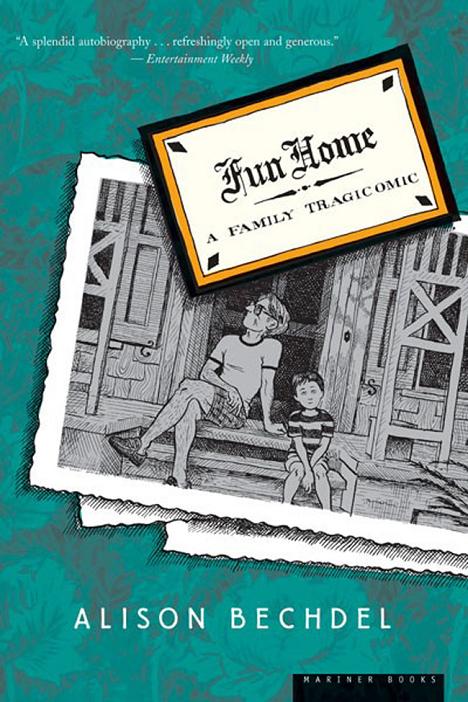
Front cover of Alison's Bechdel's Fun Home (2007 paperback version)
Front cover of Alison’s Bechdel’s Fun Home (2007 paperback version)

Originally published in 2006, Fun Home: A Family Tragicomic is a graphic memoir that led Alison Bechdel to commercial and critical success. Reminiscent of Art Spiegelman’s MausFun Home explores the relationship between Alison and her closeted father, Bruce Bechdel, to shed light on themes such as gender, the coming-out process, and the complicated dynamics of family life. The exploration of these themes are facilitated through discussions of death, life, and literature–triggered by Alison’s efforts to illustrate an accurate portrait of her complicated connection with her father, particularly after he commits suicide.

Alison and her father share many traits: they are both queer (even though the father remains closeted and married to his wife throughout the entire duration of the memoir), they both have a love for reading and for art, and they both wish that they were born the opposite sex. Despite these similarities, they never seem to forge a strong and intense bond due to their reserved personalities and their divergence in terms of gendered affiliations. Whereas Bruce tends to express traits that can typically be approached as feminine, Alison admits that she has been “a connoisseur of masculinity” (95) since she was a child. Thus, even though their share many similarities, their divergence in terms of their gender alignment creates significant tension between the two characters.

Not only does Alison approach herself and her father as “inversions” of each other, but she also makes note of how she struggles to emphasize her masculinity while her father struggles to prevent her from expressing it. She approaches her father’s attempts to feminize her as an almost pathetic effort embody femininity (vicariously) through his daughter, which leads to what Alison calls “a war of cross purposes” that is “doomed to perpetual escalation” (98). Thus, differences of gender are not invoked to uphold the division between men and women, but rather, to illustrate the differences and tensions that exist between Alison and her father.

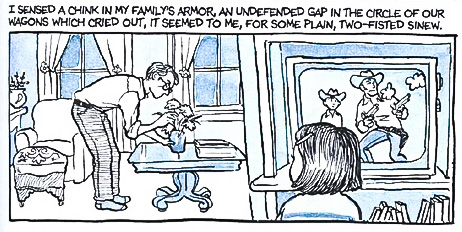
Figure 1. Page 95.
Figure 1. Page 95. Many of the images in Fun Home stress the dichotomous view of Bruce as a feminine presence and Alison as a masculine presence. In the image above, notice how Bruce engages in an activity that is stereotypically approached  as feminine. The wall unit splits this panel into two sections, thus highlighting Alison’s placement in front of the television showing a Western movie. Keep in mind that this memoir is not necessarily upholding gender binaries–a man with feminine characteristics and a girl with masculine characteristics, in due course, challenges the binary in the first place.

Bruce’s reserved and temperamental nature is attributed to the fact that he’s had to keep his sexuality a secret due to his upbringing in a society where homosexuality is considered a disgrace. It is suggested in the memoir that Bruce’s repressed nature, his wife’s request for a divorce, and the fact that Alison is able to live an open life as a lesbian (whereas he was not) are the events that prompt him to commit suicide by running in front of a truck. This suicide is the event that prompts Alison to explore her father’s life through memoir, while in turn coming to a more enlightened understanding of the influence that she and her father had on each other. This exploration, however, does not take place in a linear or organized fashion. Fun Home is as a pastiche or decoupage of many elements presented in a non-chronological fashion. The comic panels are supplemented by snippets of other literary texts, photographs, letters, and even newspaper clippings. Furthermore, the narrative itself is supplemented with Bechdel’s interpretations of the events that she lived, in addition to theoretical interventions from areas such as gender and psychoanalysis.

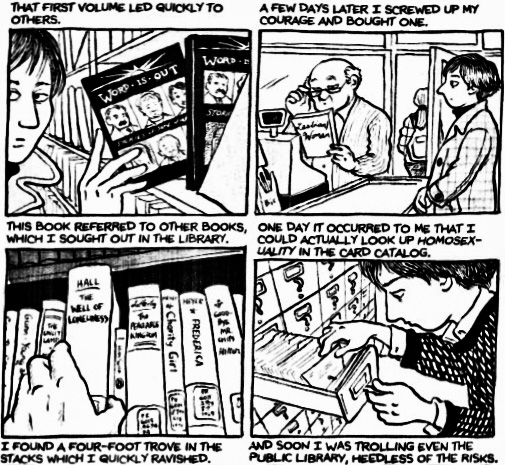
I am deeply interested in the role of literature and literary texts in Fun Home, not only because they add more depth and nuance to the memoir, but also because literature (particularly novels) is a crucial element that must be kept in mind when interpreting and understanding the central developments in the graphic memoir. For instance, literature is the catalyst that helps Alison to discover that she’s a lesbian–leading her to describe her lesbianism as “a revelation not of the flesh, but of the mind” (74). At the age of thirteen, she first encounters the word “lesbian” in a dictionary. She later reads a book focused on offering biographies of queer figures, which leads her on an obsessive mission to read and consume as many queer texts as she possibly can, such as E.M. Forster’s Maurice and Radcliffe Hall’s The Well of Loneliness. 

The very act of accessing and reading this literature is depicted as a deeply political and almost revolutionary act, for it entails developing the courage to buy these books in spite of their overtly queer titles, or to borrow them from public libraries, “heedless of the risks” (75). These books inspire her to attend a gay union meeting at her university, and to come out to her parents in a letter. Whereas her father seems quite accepting of her sexuality, claiming that “everyone should experiment” (77), her mother responds with mild disapproval, approaching her lesbianism as “a threat” (77) to her work and her family.

Figure 2.

Literature is associated with almost every single significant event that takes place in the novel. Alison’s first relationship blossoms when she meets a poet named Joan. Every time they are shown in bed together, they are surrounded by novels and other books. The images depict them reading even when being intimate with one another, and they critique and analyze books even when sprawled naked on their beds (see pages 80-81). The importance of books is her life is unsurprising when taking into account that her father was an English teacher at their local high school, and he spent a lot of time recommending and discussing books with Alison.

Even though Bruce engages in sexual acts with other men, and even boys, the memoir highlights novels and literature as the outlet of escapism that Bruce used to express his sexual frustrations, and even his subconscious sexual desires. His favorite books, such as Fitzgerald’s The Great Gatsby and Joyce’s Ulysses, touch upon matters and themes that are central to Bruce’s characterization. The Great Gatsby, for instance, highlights the pains of yearning for someone or something we cannot possess, whereas Ulysses depicts how characters can cross each other’s paths without affecting one another in a significant way (reflecting Alison’s complex relationship with her father). Given how closely Bruce’s books are tied to his suppression, his secrecy, and his hidden desires, it is no wonder that his wife gets rid of most of his book collection after he dies.

It is literature that allows Bruce and Alison to achieve a degree of closeness that they’ve never felt before. It turns out that Alison ends up taking English with her father in twelfth grade, and she realizes that she really likes the books that her father wanted her to read, such as J.D. Salinger’s The Catcher in the Rye. She becomes deeply invested in discussing these books with her father within the classroom–and her interest leads her to develop “a sensation of intimacy” (199) that she has never felt before with her father. When Alison leaves to college, she grows even closer to Bruce, calling him every once in a while to discuss the books that she reads for her English class. Their connection reaches a peak when Bruce lends his daughter a copy of Earthly Paradise by Colette (an autobiography with lesbian themes) even though she has not revealed her lesbianism to him. The book sparks a conversation between the two, leading Bruce to open and honestly discuss his sexual orientation with Alison for the first time.

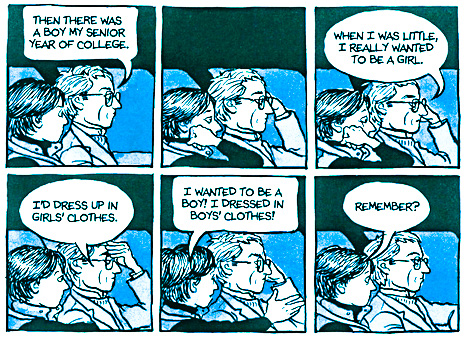
Figure 1. Alison and her father have their first frank discussion regarding his sexuality. Although their relationship is cold and distant, this marks one of the moments in which they begin to grow closer to each other.
Figure 3. Page 221. Alison and her father have their first frank discussion regarding his sexuality. Although their relationship is cold and distant, this marks one of the moments in which they begin to grow closer to each other.

Literature becomes the agent that allows Alison to forge a connection with her father. Although she admits that her intellectual connection and her intimacy with her father is seen as unusual to other people, she still seems to thoroughly enjoy and appreciate it. Alison does, however, lament that they “were close. But not close enough” (225). However, despite the fact that they were not as close or as intimate as she wanted them to be, she cherishes the fact that “he was there to catch [her] when [she] leapt” (232).

I can’t even begin to describe how much I enjoyed this memoir. It is complex, rich, funny, heartbreaking, and deeply insightful. I’m sure that this book is going to contribute significantly to my academic work, and I can’t wait to re-read this memoir in the near future.

You can purchase a copy of Bechdel’s memoir by clicking here.

Work Cited

Bechdel, Alison. Fun Home: A Family Tragicomic. Boston: Houghton Mifflin, 2007. Print (Paperback edition).

Connection Failed: An Analysis of Christopher Isherwood’s [A Single Man]

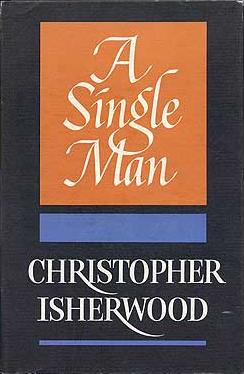
Front cover of Christopher Isherwood's A Single Man (1964)
Front cover of Christopher Isherwood’s A Single Man (1964)

Failure is found at the heart of many great works of fiction. It is a common motif used to spark an emotional connection, sympathy, and at times, anger. Failure is not only the heart of Christopher Isherwood’s A Single Man–is also the blood, the flesh, and the soul of this novel. Centered on a single day in the life of George Falconer–a gay professor from England who teaches literature at a University in Los Angeles–A Single Man traces the protagonist’s psyche as he tries to cope with the stagnant nature of living, and his inability to feel a sense of belonging or connection with those who surround him. Suffering from a chronic depression triggered by the death of his lover (Jim), George desperately struggles to find solace through unsuccessful attempts at forging meaningful interactions and relationships with other people.

The opening event of the novel focuses on George as he wakes up in the morning. Here, we are offered a very detailed and biological account of the processes that take place as a sleeping body is galvanized into a state of alertness. This opening scene creates a split between George’s body and George’s being–a motif that becomes quite prominent within the novel. Throughout the day the novel takes place, George undergoes experiences that separate his thoughts from the actions that his body partakes in–almost as if his body were engaging in auto-pilot mode, leaving the pilot of his consciousness free to do and think whatever he pleases. This auto-pilot mode is activated in many occasions:

  • When George drives to his university, his thoughts wander away as his body automatically drives to its destination: “And George, like a master who has entrusted the driving of a car to a servant, is now free to direct his attention elsewhere” (36).
  • When he teaches, he enters a mode where he begins to spew theory, facts, and jargon without being completely cognizant of what he is saying to his students.
  • When he drinks, he engages in reckless behavior, such as swimming in a rough sea during the night, even though his mind is aware of the dangers of doing so.

The novel’s tendency of splitting George’s mind away from his body fosters an effect in which the reader perceives him as a composition of many selves and not as a single individual–thus emphasizing the novel’s central characteristic of approach life, time, and space as fragmented phenomena. This fragmentation, while very postmodern in effect, serves to illustrate the sense of disconnection and the lack of wholeness that George feels towards his surroundings. Even when looking himself in the mirror, George is unable to see himself as an individualized unit:

Staring and staring into the mirror, it sees many faces within its face–the face of a child, the boy, the young man, the not-so-young man–all present still, preserved like fossils on superimposed layers, and, like fossils, dead. Their message to this live dying creature is: Look at us–we have died–what is there to be afraid of? (11)

While staring at his reflection, George sees the phantoms of his past lives–lives that he considers present but dead; relics of a life that he used to have but that is no longer present. George recognizes this fragmentation, and he struggles to defy it so that others perceive him as ‘the whole George they demand and are prepared to recognize” (11). George is characterized by being overly concerned about what other people think about him. When other characters are talking to him, George’s mind engages in a frantic interpretive mode in which he tries to determine what is going through the other speaker’s mind. However, the inability to know exactly what others are thinking of him leads George to think obsessively about the failure of language to convey ideas in an accurate or precise fashion. Language, therefore, is a contributing factor that adds to George’s notions on fragmentation and the lack of wholeness in his life.

George’s nationality and his sexuality are other elements that fuel his sense of self-fragmentation and his inability to fully connect with others. He constantly claims how his British identity converts him into an Other within academic and non-academic contexts. His sexuality pushes him to feel a desire that is nearly impossible to quench–thus forcing George to live vicariously through small interactions, touches, and brief exchanges that he has with other men. One of these moments takes place when he accompanies one of his students, Kenny, to a book store. Kenny offers to buy George a pencil sharpener, which causes George to blush “as if he has been offered a rose” (81). What is clear here is that George is a man who is starving for connection. He craves to feel part of whole, even if this connection with the whole is momentary. He makes it overtly clear that his nationality, his way of thinking, his sexuality, and even his age puts him in a position in which he is minority. This sense of dissatisfaction with not belonging to a majority leads him to deliver a “sermon” in class, in which he attacks people’s conceptions of minority communities:

A minority has its own kind of aggression. It absolutely dares the majority to attack it. It hates the majority–not without a cause, I grant you. It even hates the other minorities, because all minorities are in competition: each one proclaims that its sufferings are the worst and its wrongs are the blackest. And the more they all hate, the more they’re all persecuted, the nastier they become! Do you think it makes people nasty to be loved? You know it doesn’t! They why should it make them nice to be loathed? (72)

His passionate tirade against minority cultures is longer than the fragment I’ve included above, but I hope this passage emphasizes the degree of self-loathing and confusion that George feels towards himself for being unable to become part of a greater collective. He always has been and always will be a minority. His efforts to be part of something greater than the self always fail–even the connection that he had with Jim is severed with the latter dies in a tragic car accident. George even admits that he is living makes him part of a minority, while those who have joined the rank of the dead are part of a majority:

George is very far, right now, from sneering at any of these fellow creatures. They may be crude and mercenary and dull and low, but he is proud, is glad, is almost indecently gleeful to be able to stand up and be counted in their ranks–the ranks of that marvelous minority, The Living. They don’t know their luck, these people on the sidewalk, but George knows his–for a little while at least–because he is freshly returned from the icy presence of The Majority, which [his dying friend] is about to join. (103-4)

This passage is an eerie foreshadowing to the events that culminate the novel. As George is drunkenly walking towards his usual bar after leaving his friend’s house, he encounters Kenny alone at said bar. The two get really drunk, and they end up swimming together naked in the salty rough waves of the sea in the middle of the night. It is here that George feels a brief connection with Kenny that “transcends” the symbolic. Kenny returns home with George, leading into a scene that seems like an obvious exchange of flirtation between the two. However, despite the fact that George desires to sleep with Kenny, he ends up passing out, awakening alone in his bed–where he decides to masturbate as a way of compensating for his failure to connect with Kenny, sexually speaking.

As the novel comes to a close, George ends up in his bed once again. In a circuitous fashion, the novel ends with George’s mind disconnecting from his body, returning once again to the description of the biological processes that his body is going through as it begins to fall asleep. Unexpectedly, George dies of a heart attack during his sleep. George’s life is characterized not only by a failure to connect with others, but also by a failure to be part of a whole during his life. It’s thus heart-wrenching to realize that the only instance in which he becomes part of a majority is through his death.

This novel is simply beautiful, rich, and complex. There is much more than can be said about this novel, especially in terms of its approaches to time and temporality, especially when contrasting the importance of the past, the present, and the future. This is definitely a novel that I want to revisit once again after I’ve had time to process it a little more.

Comments? Questions? Suggestions? As always, please feel free to add to the conversation!

Work Cited

Isherwood, Christopher. A Single Man. New York: Simon and Schuster, 1964. Print (Hardcover edition).

Growth and Development in Stephen Chbosky’s [The Perks of Being a Wallflower]

Update: The content of this blog post was developed into an academic article that was published by The ALAN Review. I’m thrilled to announce that this article obtained the Nilsen-Donelson award for the best academic article published in 2013. Click on the following link to download a PDF version of the full article: Writing Through Growth, Growth Through Writing: [The Perks of Being a Wallflower] and the Narrative of Development

Original cover of Stephen Chbosky’s “The Perks of Being a Wallflower” (1999)

I remember the first time that I held that bright green cover in my hands early in the morning during the Christmas of 2002. In all honesty, I had no concrete clue of what the novel was about. I just remember surfing through the web, looking for young adult books to get me through the holidays, and the title of this novel caught my attention: The Perks of Being a Wallflower. Now, it was an unusually complex title for a young adult novel, but seeing as I myself felt like a wallflower at times, something about the title spoke to me. Little did I know that I was about to read the book that led to a shift in my being… a book that affected me on levels beyond comprehension… a book that almost 14 years later continues to shape who I am.

When people ask me what is my favorite text of all time, they would probably expect me to say something that any other literary scholar would say: Shakespeare’s dramas, Milton’s poetry, Dickens’ novels, or maybe even Thoreau’s philosophies and discussions. However, my answer would undoubtedly be the aforementioned book titled Perks of Being a Wallflower, written by Stephen Chbosky. Sure, the book is not a book for everyone. Many people become “nauseated” with the protagonist’s overly sentimental musings, and others simply get angry with the protagonist’s lack of action (these were reactions that some of my past students had when first reading the novel). Others accuse the book of being a rip-off of J.D. Salinger’s The Catcher in the Rye; true, it is unsurprising to see that Salinger’s text was indeed an influence for Chbosky’s work (it is even one of the many novels that the protagonist encounters throughout the narration), but comparing the two works would be like comparing apples and pears: they have similar textures and flavor profiles, but in the end they are different fruits that possess different forms.

I consider the novel to be one-of-a-kind. Charlie, the protagonist, is one of the most vulnerable, raw, real, and honest literary characters that I have encountered within the realm of young adult fiction (and arguably, all genres of fiction). The novel is one of the few instances in which readers have the opportunity to witness the uncensored perspectives of a male character who is not afraid to share his thoughts and sentiments. As of now, it has been the only book that has been capable of making me cry. True, I read the novel during a vulnerable time: like Charlie, I was lost, and confused, and I was looking for someone to speak to. Charlie, the protagonist of the novel, ultimately became that person. But, even when reading Perks numerous times after escaping my own period of vulnerability, it still continues to “listen” to me, and to speak to me. It still continues to haunt me. And every time I read it, it says something different to me.

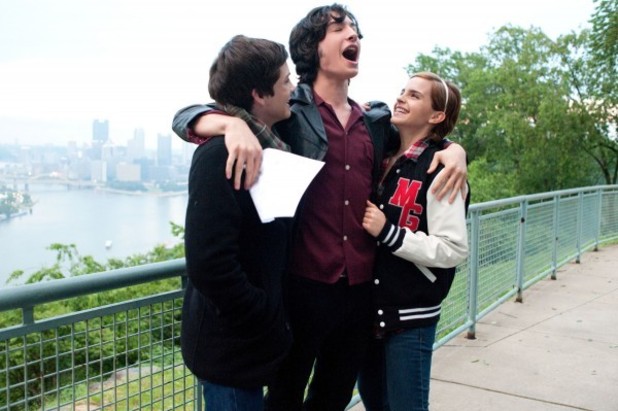
The film was superbly acted by Emma Watson as the vivacious and complex Samantha, and Logan Lerman as Charlie, the film’s heart-breaking and fractured protagonist.

The reason I’m bringing this book up is because I finally was able to see the film adaptation of this novel, which was written AND directed by Stephen Chbosky himself. The movie was only being shown in select theaters, but this weekend, it finally was shown in theaters across the nation. Truth be told, I was rather afraid to see the film. When our favorite books are adapted to the silver screen, there is always the fear that the adaptation won’t live up to our expectations, and that the film will never reach the standards of the original source. However, after seeing the movie last night, I realized that my feelings were misguided. The film adaptation of Perks was endearing, touching, and thought-provoking. But even more so, the movie was crafted for a generation who grew up with the ideals and thoughts manifested in Chbosky’s original text: originality, uniqueness, and loyalty. The movie invites us to ultimately find a sense of belonging in “the island of misfit toys.”

Overall, the film has received very positive reviews. It currently has a score of 8.4/10 in IMDB, and it was certified as a fresh film in Rotten Tomatoes, with a current approval rate of 86% among critics and 95% among audience members. And in all honesty, those who don’t understand the movie, or that consider it another bland coming-of-age story either fail to sympathize with the hurdles that the protagonist had to overcome, or they find it hard to connect with the notion of being an outsider (after all, not everyone is aware of the unique perspective that one develops when “standing on the fringes of life”).

In due course, the film left me inspired, and it pushed me to submit an article that I wrote on the novel last semester to the ALAN Review, the nation’s leading journal on the study and teaching of young adult literature. Frankly, I had reservations in terms of submitting the article for review, mostly because I feel like I cannot effectively do justice to my favorite novel of all time. In addition, I am aware that the article is far from perfect. However, just like Charlie had to learn how to participate, I needed to step out of the shadows and take an academic risk. I have no idea whether or not the article will be accepted for publication, but I guess there was no harm in trying.

Anyway, to conclude today’s post, I will include an excerpt from the article that I submitted. Wish me luck!

Excerpt of “Writing through Growth, Growth through Writing: The Perks of Being a Wallflower and the Narrative of Development” written by Angel Daniel Matos:

[…]

Although Perks is certainly considered epistolary in terms of its form and delivery, its content and function are definitely attuned towards the aims of developmental fiction. Given that the protagonist depicts his own developmental process through his writing, and given that the novel is written via a series of letters, it is imperative that the reader becomes attuned to how the process of writing and the process of Bildung work together to fulfill and challenge the nuances of development within the literary scope. The process of writing in Perks manifests primarily in two ways: through the letters that Charlie writes to the anonymous recipient and through the assignments and tasks that he completes for his English class in high school. Fascinatingly, Charlie’s writing is very much reflective of his own development as a person, and the writing that we encounter in the first letters of the book is more scrambled, disorganized, and “immature” in comparison to the prose found in his final letters.

For instance, here’s an example of Charlie’s writing at the beginning of the novel: “Aunt Helen told my father not to hit me in front of her ever again and my father said this was his house and he would do what he wanted and my mom was quiet and so were my brother and sister” (Chbosky, 1999, p. 6). This sentence exemplifies the writing style that is predominant during the first letters of the novel: the prose is peppered with run-on sentences, he has not mastered the art of punctuation, and his ideas many times lack coherence and cohesion. We see that his writing style, and even the topics that he discusses in his letters, begin to evolve and mature as Charlie gains more experience with the art of writing, and as he begins to delve in increasingly complicated efforts to understand himself and the people around him. Charlie’s English teacher, Bill, assumes the role of Charlie’s mentor not only from an educational standpoint, but from a formational one as well. Charlie also takes Bill’s advice and suggestions quite seriously, and although he always gives Charlie A’s on his report cards, he always labels his essays with a lower grade as a way of challenging him:

First of all, Bill gave me a C on my To Kill a Mockingbird essay because he said that I run my sentences together. I am trying now to practice not to do that. He also said that I should use the vocabulary words that I learn in class like “corpulent” and “jaundice.” I would use them here, but I really don’t think they are appropriate in this format. (Chbosky, 1999, p. 14)

After Bill’s recommendations, Charlie’s letters increasingly avoid the use of run-on sentences, and his prose becomes much clearer and more efficient, saying more using less words. It is also interesting to note that when Charlie writes about the books that Bill assigns to him, he manages to use writing as a way of evaluating the actions of the characters in the books he reads, and he always tries to establish parallels between his own life and the “life” portrayed in the books.

This notion of comparing and contrasting becomes important in terms of the content depicted in Charlie’s letters, for it is in this instance that he begins to situate himself more prominently in the actions that are represented in the letters. At first, most of what he writes about is concerned with the observations that he makes of his family. This notion of writing “empirical” observations of the people he observes becomes the main focus of Charlie’s letters until Bill begins to notice that Charlie constantly stares at people and scrutinizes them obsessively. He then asks Charlie what he thinks about when he observes people, and after he tells Bill everything he thinks about, the teacher remarks that although thinking a lot is not necessarily a bad thing, “sometimes people use thoughts to not participate in life” (Chbosky, 1999, p. 24). This remark pushes Charlie to further assess his own life and the degree to which he participates in events, talks with other people, and tries to make friends. However, the very process of writing his thoughts obliges him to become introverted and pensive, and he continues to write letters as a way of assessing his own life: “when I write letters, I spend the next two days thinking about what I figured out in my letters. I do not know if this is good or bad” (Chbosky, 1999, p. 28). The effort that Charlie puts in trying to understand his meditations is a clear indicator that Bill was right to some extent, for so much effort is put into trying to understand, that there is little room to actually live and enjoy life.

Despite the mental effort and time required in the crafting of his letters, there seems to be a radical shift in terms of the content being portrayed after Bill warns Charlie about the perils of overthinking. The focus of the letters shifts from a focus on family to a focus primarily on Charlie’s efforts to socialize and make friends. In due course, Charlie becomes very close to a group of seniors at his school, known for not being the most popular and loved people within the premises. The first friend he makes in high school is Patrick, a gay senior with a penchant for jokes and mischief, and who introduces Charlie into the world of drinking, smoking, and the unwritten rules of sexual behavior. He also befriends Sam (short for Samantha), who is Patrick’s stepsister and on whom Charlie develops an obsessive crush. The bulk of the letters depicted after this point discuss the differences that exist between Patrick, Samantha, other friends, and himself, his strivings to understand the motivations behind their thoughts and actions, and more importantly, the arduous process of integrating himself with Patrick and Samantha’s circle of friends.

Charlie develops a clearer sense of the world through this arduous process of integration, and through his immersion in new experiences such as drug use, masturbation, visits to the Rocky Horror Picture Show, and through his exposure to different literatures. His analysis of the content of his letters, and the feedback he gets from his essays at school, demonstrate that Charlie is developing the ability to make his writing more concrete and understandable due to the fact that he is undergoing experiences that provide him with a substantial analytical platform. Even more so, Charlie’s development of his writing prowess leads him to the discovery of the craft he wants to hone as a professional endeavor: “I have decided that maybe I want to write when I grow up. I just don’t know what I would write” (Chbosky, 1999, p. 46). Although at first the letters prevented him from participating due to their introspective and slightly amateurish nature, it is when Charlie combines his writing skills with the experiences that he has obtained that allows him to develop a richer image of who he is and who he wants to be. Interestingly, the more Charlie writes, the more he understands himself, and the easier it is for the recipient of the letters to develop a more defined snapshot of Charlie’s mind. In other words, the more Charlie begins to understand himself, the more others also begin to understand him.

It is unclear whether Charlie keeps copies of the letters for himself; however, Charlie consistently makes reference to past letters. Charlie compares and contrasts experiences illustrated in his letters, and he also revisits previous points of discussion in order to reevaluate his thoughts using the knowledge that his experiences have thrust upon him. For instance, Charlie once reads a poem to his friends titled “A Person/ A Paper/ A Promise Remembered,” written by Patrick Comeaux and given to him by Michael (the friend who committed suicide), which portrays the growth of a boy into a man, and concludes with the speaker’s suicide due to his disillusionment with life. At first, Charlie is unable to understand the poem clearly, and he is unwilling to understand why a person would commit suicide. But, during New Year’s Eve, Charlie writes a letter in which he confesses that a particular experience has unfortunately helped him to grasp the intended meaning of the poem:

I just remembered what made me think of all this. I’m going to write it down because maybe if I do I won’t have to think about it. And I won’t get upset. But the thing is that I can hear Sam and Craig having sex, and for the first time in my life, I understand the end of that poem. And I never wanted to. You have to believe me. (Chbosky, 1999, p. 96)

It is important to note that in this instance, Charlie is using writing for a new purpose: rather than using the letters as a means of interpreting himself and his world, he uses writing as a way of distancing himself from his thoughts, as if writing were a way of draining his worries away from his mind. Even more so, it is through looking back at his own writing that he is able to comprehend how he loses innocence, and how he is able to understand concepts that used to escape his cognizance. It is after this point that Charlie becomes a “rebel” in many aspects: he begins to smoke and drink more than ever; he begins to explore his sexual identity by hanging out more often with Patrick and kissing him every so often, and he secretly offers his sister assistance when she believes she is pregnant.

Charlie begins to realize that life does not have to be lived according to others’ expectations, and if he is to achieve any degree of happiness, he has to find a way to balance his desires and social demand. This stepping away from society’s parameters also manifests within Charlie’s writing, seeing as he begins to experiment with different styles of writing and of conveying ideas: “I wrote a paper about Walden for Bill, but this time I did it differently. I didn’t write a book report. I wrote a report pretending that I was by myself near a lake for two years. I pretended that I lived off the land and had insights. To tell you the truth, I kind of like the idea of doing that right now” (Chbosky, 1999, p. 128). Thus, rather than complying with a formula or a set of rules on how to tackle his literary interventions through writing, he delves into an experimental endeavor in which he filters the information he decodes in the book through his own set of experiences. Rather than simply being a sponge that absorbs and regurgitates ideas, Charlie begins to view the act of writing as a mediation between a conversion taking place, turning him into an active writer rather than a passive one. Thus, the parallels between emotional and mental development, or Bildung, become increasingly tied to the act of writing throughout the progression of the novel. Furthermore, notice that Charlie seems rather pleased with this new direction that he is taking.

Charlie’s progression from a passive to an active participant is not an overnight change, but rather, it is a very difficult and gradual process. Despite his small victories and attempts, Charlie still remains a wallflower towards the concluding letters of the novel. However, in the climactic letter of the novel, Samantha confronts Charlie and obliges him to face the consequences of his lack of action. Sam has broken up with her boyfriend because he was cheating on her, yet Charlie never made an attempt to date Sam now that she was newly single. In a fit of frustration, Sam confronts Charlie with the truth after he confesses that he did not take action because he was more concerned with her sadness than with trying to be with her:

It’s great that you can listen and be a shoulder to someone, but what about when someone doesn’t need a shoulder. What if they need the arms or something like that? You can’t just sit there and put everybody’s lives ahead of yours and think that counts as love. You just can’t. You have to do things. (Chbosky, 1999, p. 200)

And rather than replying to her accusations with words, Charlie approaches Sam and starts to kiss her. They soon end up on the bed, kissing passionately, but just as they are about to go all the way, Charlie begins to have a nervous breakdown. To make a long story short, Charlie slowly but surely remembers the fact that he was sexually abused as a child by his diseased aunt Helen, which explains why Charlie was so repressed and had difficulties participating in life. After a few months in the hospital after his breakdown, Charlie begins to come to grips with his repressed past, and he proposes to move on and change the direction of his life. […] Indeed, the surprising and unprecedented moment in which Charlie reawakens his repressed past is indeed heartbreaking and difficult to tolerate emotionally, but it is the moment in which Charlie truly begins to feel free from the unbearable burden of trying to figure out why he is the way he is, and why he so desperately craves to understand the world around him. And although action leads him to achieve his moment of breakthrough, it is the act of writing that helps him put his life into perspective, and that provides the missing puzzle pieces that complete the image of the self.

[…]

The main characters of “The Perks of Being a Wallflower.” From left to right: Charlie (Logan Lerman), Patrick (Ezra Miller), and Sam (Emma Watson)