Queer Time in Edmund White’s [A Boy’s Own Story]

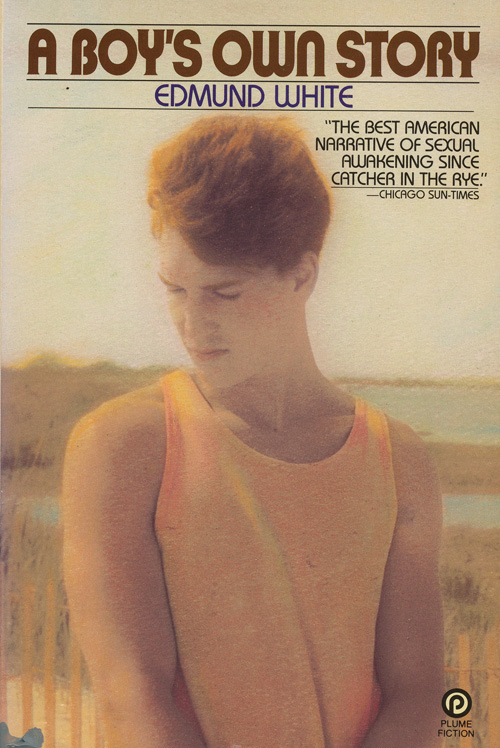
Front cover of Edmund White's A Boy's Own Story (1982)
Front cover of Edmund White’s A Boy’s Own Story (1982)

Edmund White’s A Boy’s Own Story is a coming-of-age novel centered on the sexual awakening of a queer teenage boy in the Midwest during the 1950s. The novel discusses topics such as the corruption of innocence, the pressures of masculinity in the lives of young boys, the emergence of childhood sexuality, and the exploration of humanity through the lens of homosexuality. The unnamed narrator of the novel quickly addresses the issues that he has in terms of his body and his sense of masculinity. He feels as if his “feminine” qualities–such as his voice, his mannerisms, and his overall attitudes– not only prevent him from bonding with other people, but that they also prevent him from obtaining any of the power that promised to those who embody the masculine myth. The narrator notices that everything from the way he sits to the way he acts marks his body as Other, and he even goes as far as to point out that he often fails small and meaningless quizzes used to assess his masculinity:

A popular quiz for masculinity in those days asked three questions, all of which I flunked: (1) Look at your nails (a girl extends her fingers, a boy cups his in his upturned palm); (2) Look up (a girl lifts her eyes, a boy throws back his whole head); (3) Light a match (a girl strikes away from her body, a boy toward–or perhaps the reverse, I can’t recall). (9)

The structure of this novel can seem slightly confusing, especially since it deviates from the traditional linear narrative that we have come to expect when reading coming-of-age novels. The first chapter, for instance, begins when the narrator is fifteen years-old. In this chapter, he painstakingly describes a relationship that he has with Kevin, the twelve year-old son of a guest that visits his summer home. In this chapter, the narrator describes how he paradoxically wants to be considered heterosexual while still being loved by a man. His relationship with Kevin slowly but surely starts to teach him how sex is not only a physical act, but how it is also a discursive act–leading him to realize that sex is also “a social rite that registered, even brought about shifts in the balance of power, but something that was discussed more than performed” (198). Because of this realization, he notices how performance and discourse shapes and forms his relationships with other men. For instance, he approaches Kevin as the “older” and more “dominant” person in the relationship because he is the more confident person of the two, and because he controls what happens during sexual intercourse:

I was chagrined by [his] clowning because I’d already imagined Kevin as a sort of husband. No matter that he was younger; his cockiness had turned him into the Older One (23).

The first chapter concludes by depicting how the narrator and Kevin part ways, and the second chapter goes back an entire year, allowing the narrator to discuss events that shaped who he is in his present day. Subsequent chapters go back in time even further, depicting events that the narrator encounters when he was twelve and seven years-old. The jumping back and forth between the past and the present not only disrupts the linearity of the coming-of-age narrative, but it also presents, as Elizabeth Freeman would put it, a manifestation of queer time. 

In Time Binds: Queer Temporalities, Queer Histories, Elizabeth Freeman describes queer time as a “hiccup in sequential time” that “has the capacity to connect a group of people beyond monogamous, enduring couplehood” (3). Furthermore, queer time allows queer subjects to envision alternative structures and forms of belonging, precisely because it deviates from the linearity and “productivity” of chrononormativity–in which human bodies arrange their time and bodies towards maximum productivity. In A Boy’s Own Story, queer time manifests through this combination of the past and the present, precisely because the narration deviates from the productive and generative elements that are closely associated with narratives of personal development. White, rather than depicting growth and development as sequential events, the narrator approaches them as fractured and disjointed processes. Rather than offering readers an equation, in which event 1, event 2, and event 3 equal the narrator, White disrupts temporality by beginning with event 3, going back to event 1, and covering the decimal points (small or micro events) that occur between these numbers. I think that this novel embraces queerness through it’s denial of both chronos (sequential time) and kairos (significant time), in favor of small non-sequential and non-significant time. This is particularly clear in the fourth chapter of the novel, in which the narrator breaks the fourth wall and addresses the reader:

in writing one draws in the rest, the forgotten parts. One even composes one’s improvisations into a quite new face never glimpsed before, the likeness of an invention. Busoni once said he prizes the most those empty passages composers make up to get from one “good part” to another. He said such womanlike but minor transitions reveal more about a composer–the actual vernacular of his imagination–than the deliberately bravura moments. I say all this by way of hoping that the lies I’ve made up to get from one poor truth to another may mean something–may even mean something most particular to you, my eccentric, patient, scrupulous reader, willing to make so much of so little, more patient and more respectful of life, or a life, than the author you’re allowing for a moment to exist again. (84)

I believe that this passage is quite significant, because it highlights the role that queer time plays in the novel’s political agenda. By disrupting linearity and by painstakingly focusing on minor events, the reader must develop patience and spend more time concentrating on the narrator’s words rather than on major events. The narrator affirms that by reading his words, the reader becomes not only more respectful of the narrator’s life, but the reader also brings the narrator back into existence. Therefore, through the act of reading, one gives the narrator a sense of legitimacy that was denied to him during his childhood. This interpretation gains even more validity when taking into account that most of the novel is focused on the narrator’s struggle to survive in his society, and even more so, his struggle to be approached and categorized as a legitimate human being. The narrator, for instance, acknowledged that he has little time to focus on “theory” or “philosophy” because he is too busy focusing on pragmatic aspects of his life such as survival. This notion is evidenced when the narrator compares himself to his jockish friend, Tom, who spends most of his time daydreaming and philosophizing:

Ironic, then, that [Tom] was the one who did all the thinking, who had the taste for philosophy–ironic but predictable, since his sovereignty gave him the ease to wonder about what it all meant, whereas I had to concentrate on means, not meaning. The meaning seemed quite clear: to survive and then to become popular. (113)

Although popularity may at first be approached as a self-centered and selfish goal, it is important to keep in mind that the narrator believes that popularity will give him the recognition and the legitimacy that he has been denied in his life, not only because he is queer, but also because he is unable to situate himself within the frame of traditional masculinity that his father upholds. Popularity would give the narrator the means to become a legitimate person rather than an unreal subject:

Being popular was equivalent to becoming a character, perhaps even a person, since if to be is to be perceived, then to be perceived by many eyes and with envy, interest, respect, or affection is to exist more densely, more articulately, ever last detail minutely observed and thereby richly rendered. (127)

All in all, A Boy’s Own Story is a rich and provocative novel that definitely raises interesting insights in terms of the role that temporality plays within the issues of livability that haunt all queer lives. The narrative is at times convoluted and difficult to follow, but getting lost is definitely an essential component towards grasping the novel’s central themes and agenda.

You can purchase a copy of White’s novel by clicking here.


Works Cited

Freeman, Elizabeth. Time Binds: Queer Temporalities, Queer Histories. Durham: Duke University Press, 2010. Print.

White, Edmund. A Boy’s Own Story. New York: Plume, 1982. Print.


Masculinity in Robert Cormier’s [The Chocolate War]

Front cover of Robert Cormier's The Chocolate War
Front cover of Robert Cormier’s The Chocolate War

It’s 1:53 a.m. and I currently can’t sleep because of this book. I was going to wait and write about it in the morning, but I really need to engage in the cathartic process of writing in order to make sense of all of the thoughts that are fireworking in my head. I was expecting a tale that discusses the triumph of good over evil–a tale of empowerment for individualistic resistance over systematic injustice. I received the opposite. Don’t get me wrong, I think The Chocolate War has earned a place in my top-ten list of favorite YA novels, but I will warn you that the book is ultimately very bleak and depressing. If your positive judgment of a book depends on a happy ending, then I suggest that you skip this novel.

The Chocolate War is a book that is told from a subjective third person point-of-view, but this perspective carousels through the thoughts and emotions of particular students at Trinity School: a private, religiously-affiliated high school in the New England area. Although the story centers on the thoughts of various students in the school, it can be said that Jerry Renault is the novel’s protagonist, and he is also the source of the novel’s main tension. Although the Trinity School is technically run by the Brethren that teach and administer the educational system, the thoughts and actions of students are also dictated by a secret school society known as The Vigils, who use scare tactics and intimidation in order to secure their influence.

Students are often given “assignments” by The Vigils, which can be approached as a type of hazing that the secret society uses to assure that it is perceived as a force to be reckoned with. Assignments can include mundane things such as forcing students to get up from their seats every time a teacher mentions the word “environment,” to more serious matters, such as destabilizing all of the desks and chairs in a classroom. During the school’s annual chocolate fundraiser, Jerry Renault is given the assignment to deny selling chocolates for ten days–a problem, seeing as every student besides Renault decides to sell chocolate. The main issue in the novel arises when Jerry continues to resist selling chocolates after the ten day period in an act of defiance towards The Vigils and the school administration. The bulk of the novel focuses on the ostracism that Jerry faces when trying to defy The Vigils, and the measures that they take to assure their power and dominance in Trinity School. By taking a stand, Jerry tries to follow and understand the words of T.S. Eliot by asking himself whether he dares to “disturb the universe,” (see Eliot’s “The Love Song of J. Alfred Prufrock“) a quote found on a poster that Jerry has in his locker.

The Chocolate War is a very gendered novel, which is partly unsurprising given the fact that Trinity School focuses on single-sex male education. Various elements within the novel emphasize maleness and the traits that are usually (and stereotypically) associated with it, such as power, dominance, and violence. Sports such as boxing and football are the most popular and revered activities that take place within the school; their practice often demonstrates how physical prowess often trumps intelligence and creativity in this environment. All teachers within the school are religiously affiliated men, and they are addressed as Brother by students. As a matter of fact, there is little to no feminine or maternal presence in the novel. When girls are mentioned by students, they are usually presented as objects of sexual attraction. Even Jerry is known for his lack of a maternal figure, since early in the novel it is established that his mother passed away during the spring before his freshman year (the time period in which the novel takes place). This lack of a feminine presence is in no way a mishap, and it actually serves as a motif to foreground the power struggles and dynamics that are in the heart of The Chocolate War. 

The characters’ efforts to uphold a visage of traditional masculinity is overwhelming. Whenever certain characters, such as Archie (the novel’s twisted and manipulative villain), encounter another figure that is trumping them in terms of authority, they automatically regress into an irrational inner struggle of Patrick Bateman-esque proportions. Take for instance, Archie’s reaction when The Vigils’ president threatens him:

Blood stung Archie’s cheeks and a pulse throbbed dangerously in his temple. No one had ever talked to him that way before, not in front of everyone like this. With an effort he made himself stay loose, kept that smile on his lips like a label on a bottle, hiding his humiliation. (187)

Many other characters in the novel are unable to contain their fits of tears and frustration when encountering the many injustices triggered by the rule of The Vigils. However, the most salient trait that is exemplified through this constructed masculine space would be violence–not only subjective violence, as in fist-fights, bullying, and physiological reactions, but also objective violence as represented through hate speech and through the manipulation and control enforced by the secret society and the school administration (please see Zizek’s Violence for more information on these types of violence). At first, Jerry’s decision to refuse selling chocolates can be considered an act of resistance towards the objective violence that is systematically imposed upon all students at Trinity High. The downward spiral for Jerry, however, occurs when this objective violence flourishes into downright brutal and subjective violence. The moment of this transition is seen quite literally in the novel, when a bully by the name of Janza is blackmailed into harassing Jerry to the point that he reciprocates violence with more violence (rather than resistance). As can be seen in the following exchange between Jerry and Janza:

“Hiding what? Hiding from who?” [Jerry]

“From everybody. From yourself, even. Hiding that deep dark secret.”

“What secret?” Confused now.

“That you’re a fairy. A queer. Living in the closet, hiding away.”

Vomit threatened Jerry’s throat, a nauseous geyser he could barely hold down.

“Hey, you’re blushing,” Janza said. “The fairy’s blushing . . .”

“Listen . . .” Jerry began but not knowing, really, how to begin or where. The worst thing in the world–to be called queer. (211-212)

After this exchange, Jerry retorts by calling Janza a “son of a bitch,” which leads Janza to summon a group of kids that brutally bash Jerry. Note here that what fuels Jerry’s wrath is the fact that he is called queer. Up to that point, he had done a decent job of resisting the taunts and threats of his peers due to his refusal to sell chocolates. What I find interesting in this chapter is that in essence, Jerry can be approached as a queer (or non-normative) character due to the fact that he denies engaging in the activity that will make him normal or orthodox–if he didn’t want to set himself apart, all he had to do was sell chocolates. His resistance, however, can be approached as queer resistance because he wanted to break away from the norm: “Mainly, he didn’t want to fight for the same reason he wasn’t selling the chocolates–he wanted to make his own decisions, do his own thing, like they said” (211).

Despite his penchant for non-normativity, being called a queer was too offensive and disruptive given the masculine attitudes that permeate his surroundings. Thus, Jerry’s hatred towards Janza for calling him queer even pushes him to engage in the boxing match at the end, a boxing match that leads to his demise. The final chapters of the novel end with Jerry proclaiming his regret towards being non-normative, he proceeds to think about how one must ultimately comply with the will of “superior powers” and authority figures if one desires to have a livable life. He thinks about the new “knowledge” he has obtained as he lies bloodied and broken in the arms of his friend, Goober:

He had to tell Goober to play ball, to play football, to run, to make the team, to sell the chocolates, to sell whatever they wanted you to sell, to do whatever they wanted you to do. He tried to voice the words but there was something wrong with his mouth, his teeth, his face. But he went ahead anyway, telling Goober what he needed to know. They tell you to do your thing but they don’t mean it. They don’t want you to do your thing, not unless it happens to be their thing, too. It’s a laugh, Goober, a fake. Don’t disturb the universe, Goober, no matter what the posters say. (p. 259)

The ending may be bleak and downright depressing, but I don’t necessarily think that the novel is designed to perpetuate a dislike of rebellion, nor do I think that it presents all resistance movements as futile. I think that Jerry’s loss of faith in himself and in his ability to disturb the universe rests not on his failure, but on the fact that he was left alone in his pursuit of non-normativity. What I found deeply disturbing is that nobody takes a stand for Jerry during the boxing match that leads to his demise, not even his close friend, Goober, who just sits and watches Jerry be beaten to a pulp with the rest of the students from Trinity High. Without a doubt, Jerry is presented as a scapegoat figure, meant to absorb all of the negativity, the tensions, and the evils of his community that are perpetuated through masculinity and through corrupt power.

The novel is ambiguous in terms of its stance on disturbing the universe. On one hand, we can accept Jerry’s defeat as a cautionary tale. On the other hand, we can accept it as a challenge to ourselves–a challenge that pushes us to question the extent to which we can or should disturb the universe ourselves.

Do yourself a favor, and read the book! And as always, please feel free to add to this conversation or to challenge anything discussed in this post!

You can purchase a copy of Cormier’s novel here.

Work Cited

Cormier, Robert. The Chocolate War. New York: Dell Laurel-Leaf, 1974. Print.