Unrealistic Expectations: (Meta)Narrative in Andrew Smith’s [Winger]

Front cover of Andrew Smith's Winger (2013)
Front cover of Andrew Smith’s Winger (2013)

Warning: The following post contains major spoilers for Andrew Smith’s Winger. 

After reading Andrew Smith’s Grasshopper Jungle, I immediately knew that I had to read other works written by this author–and Winger seemed like the obvious choice. I finished reading Winger a couple of weeks ago. Typically, I write analyses and reviews of books soon after I read them, but for this novel, I needed time to process many things, including the novel’s “unexpected” twist and its narrative framing. I guess it’s also important to mention that I reacted quite viscerally to the novel’s ending. At first, I approached the death of Ryan Dean’s gay best friend, Joey, as narratively pointless. I was frustrated that so little attention was given to this event in the novel’s conclusion, and I was upset that the death seemed like a dramatic and rushed way of ending the narrative. I read other reviews of this novel, and many other readers approached the ending in a similar fashion. Although I had a stark reaction to the novel’s ending, I felt as if there was a major element that I was missing when approaching Smith’s work.

I ultimately messaged the author, and asked why the novel had such a dark twist. Andrew Smith kindly responded to my question, and he pointed out how careful attention should be given to the novel’s use of metanarratives–which in the case of Winger, refers to the moments in which the narrator discusses the purpose or function of reading, writing, and literature itself. Although Winger can be approached as a coming-of-age novel, it is also a work that self-consciously explores the nature of narrative, and its relationship to truth and to the formation and understanding of the self. With this in mind, I decided to revisit the novel, paying close attention to the ways in which metanarrative aids the reader in better understanding the novel’s conclusion and its narrative framing.

When approaching Winger, it’s important to keep in mind that the novel is structured into many sections. The novel opens with a small section that depicts the protagonist, Ryan Dean, being bullied by two classmates. Afterwards, the novel can roughly be divided into four major parts: Part One (the overlap of everyone), Part Two (the sawmill), Part Three (the consequence), and Part Four (words). Each one of these parts has a main thematic focus and structure, but I will focus my attention on parts One and Four in this discussion. Part One opens with a prologue–which can be considered an introduction to the literary text that is not necessarily connected to the work’s main narrative arc. This prologue helps frame the rest of the narrative, in that it shares key points that allow the reader to grasp the novel’s core themes. Even more so, the prologue, to some extent, foreshadows the novel’s seemingly dark twist towards the end:

Joey told me nothing ever goes back exactly the way it was, that things expand and contract–like breathing, but you can never fill your lungs up with the same air twice. He said some of the smartest things I ever heard, and he’s the only one of my friends who really tried to keep me on track too. And I’ll be honest. I know exactly how hard that was. (Smith 7)

When closely reading this prologue, there a couple of things that we can infer:

  1. Joey’s thoughts and views of the world are used to open the prologue. This demonstrates that Joey is a person who significantly influences how Ryan Dean thinks, and also influences how he writes. Joey’s discussion of expansion and contraction can be connected to the novel’s major focus on the theme of change, and more precisely, the inevitability and irreversibility  of these changes.
  2. Note the verbs that Ryan Dean uses when referring to Joey: “Joey told me […] He said […] really tried to keep me on track too.” Through the use of these past-tense verbs, we are indirectly informed that Joey is no longer present in Ryan Dean’s life. We are initially given no clues to understand why he is absent. Thus, the prologue, through its use of language, foreshadows Joey’s death.
  3. Although Ryan states that Joey tried to keep him on track, the text implies that Joey’s efforts have failed. Furthermore, Ryan understands how difficult it was for Joey to watch over and guide him.

With these factors in mind, it becomes clear that the crafting of Winger‘s narrative is approached as a way for Ryan to revisit, relive, and understand the past through the process of writing. However, Ryan recognizes the futility of this endeavor to fully help him understand himself or the events that he faced. Just as he is unable to breathe the same air twice, he is unable to relive events in exactly the same fashion. The novel thus commences with the protagonist’s recognition and awareness of his own failures, and how these failures will determine what he shares and how he decides to share it. Furthermore, it is worth noting that the prologue epitomizes the central role that Joey plays in this developmental narrative, even though he is a secondary character.

The role of metanarrative in the creation of Winger becomes overt later in Part One, where Ryan Dean discusses his penchant for drawing, and the relationship between knowing a story and expressing it aesthetically. As can be seen in the following drawing found on page 21 of the novel, Ryan Dean stresses the difference between knowing a story, and representing it: img_00002_2_crop Ryan Dean’s discussion of drawing, narrative, and representation makes it clear that the novel should be approached as a carefully constructed and meditative text. The text is not presented as a work that’s produced as Ryan copes with particular events (as seen in novels such as Chbosky’s The Perks of Being a Wallflower), but rather, it presents itself as an artistic impulse to represent a story that has already been lived and experienced. The fact that Ryan mentions that he knows “the ending of the story” implies that as an artist, Ryan is struggling to identify the ways to represent the events that led to the outcome that he knows.

With this in mind, the combination of words and images in Winger can signify not only the futility of art to replicate a particular memory or event, but it can also be approached as a concretization of Ryan’s struggle to convey ideas that even he doesn’t completely understand. When Ryan attempts to depict Joey’s death in Part Four of the novel, we notice how the novel undergoes an effect of narrative dissolution or entropy. Part Four begins with a handwritten letter, in which Ryan discusses how life never follows the course that one plans, and how life’s unpredictability is capable of destabilizing the linearity that we perceive in life. Here is the letter that Ryan shares with his reader, found on page 411: img_00003_2_crop (1) It is in this letter that Ryan recognizes the futility of narrative in creating an accurate and realistic portrait of life: “I tried to make everything happen the same way it did when I was seeing it and feeling it.” Furthermore, the letter is a comment about the nature of narrative itself. When reading works in a certain genre, we have expectations about what should happen to the characters, how the novel should end, and the overall lessons that should be learned. In this letter, Ryan (through the writing prowess of Andrew Smith) brilliantly critiques the linearity and predictability that we’ve come to expect of the novels we read, particularly novels in the young adult genre. We expect narratives to be linear, we expect characters to have happy endings–but through a compliance of these expectations, the aesthetic text merely becomes an object of conformity.

Through the use of metanarrative, Winger strives to convey a greater sense of realism through an embrace of the chaos and unpredictability found in life itself.  Thus, while it may be easy to approach Joey’s death as haphazard, rushed, or as some readers have uncritically argued, homophobic, approaching his death as so would be an injustice to the novel’s overall literary, aesthetic, and narrative aims. Indeed, Joey is one of the most likable characters in the novel–but likability does not and should not make a character or person immune to the instability and dangers of the (real) world.

Thus, the possible anger and frustration that we feel towards the novel’s ending stems not from the text itself, but rather, the unrealistic expectations that we impose on the texts we read. In terms of the novel’s ending seeming contrived or unexpected, it is important to keep in mind that Ryan writes his story as a way of trying to understand the ramifications of Joey’s death.

The novel as a whole forces us to question our reliability on words and grand narratives. While Winger “fails” to live up to the expectations that we have of linear and conventional young adult narratives (and narratives in general), it is through this failure that the text is able to push us to question many things we take for granted. Part Four of the novel, in particular, refutes many of the narrative conventions that we have come to expect in the novel itself. Images are no longer used. The chapters in Part Four are no longer numbered as they are in other parts. Pages are occupied by an increasing amount of blank space. Ryan Dean, who was able to portray events with an excruciating amount of detail, can’t find a way to express his thoughts: “I need to vent. But I can’t. The words won’t come” (430). His prose becomes increasingly fragmented. This sense of fragmentation, dissolution, and chaos is able to represent pain and torment in ways that couldn’t possibly be conveyed by traditional, linear prose.

The more I think about Winger, the more I’m able to appreciate just how smart, insightful, and riveting this novel is. It’s a novel that has haunted me since I’ve read it, and it will continue to haunt me as I think about the role of (meta)narrative in young adult fiction. Andrew Smith is continuing to shape, deconstruct, and reinvent young adult fiction not only through the inclusion of fresh content, but also through the implementation of experimental narrative form. You can purchase a copy of Winger by clicking here.

Work Cited

Smith, Andrew. Winger. New York: Simon & Schuster BFYR, 2013.  Print (Hardcover edition).

Escaping the Labyrinth: Suffering in YA Fiction and the Case of John Green’s [Looking for Alaska]

Front cover of John Green's Looking for Alaska (2005)
Front cover of John Green’s Looking for Alaska (2005)


How will we ever get out of this labyrinth of suffering? –A.Y.

– John Green, Looking for Alaska (p. 158)

What is the role of suffering in young adult literature? I’ve been obsessed with answering this question since one of my dissertation committee members asked me it a couple of weeks ago. My desire to answer this question has further increased as I continue to teach a course on young adult fiction this semester. I am constantly thinking about what defines this genre of literature, especially when considering that the line between literature written for adults and young adults is so thin. Part of this has to do with the ambiguity of what a young adult is, but for the most part, the trouble in defining young adult literature is found in the plasticity of the genre itself.

Young adult literature has become an umbrella term for an ever-expanding collective of novels, dealing with everything from the real, the everyday, the fantastical, the impossible, the painful, and the imaginary. Since the scope of young adult literature is so embracing, however, it becomes increasingly difficult to establish parameters for what it can or cannot be. Does a YA novel simply require a teenage protagonist in order for it to be categorized as such? An adolescent protagonist is definitely a must–but is there a further narrative strand that binds this collective of novels together? Perhaps an exploration of suffering in these novels can provide some answers.

I’ll be the first to admit that suffering is perhaps a universal element of most, if not all novels. After all, most events that a protagonists face are in some way driven by dissatisfaction or displeasure. However, it seems that most young adult novels go at great lengths to highlight the role of suffering in aiding the development of a character over a particular span of time. In the course that I’m currently teaching, we’ve read novels such as J.D. Salinger’s The Catcher in the Rye, Katherine Paterson’s Bridge to Terabithia, and Stephen Chbosky’s The Perks of Being a Wallflower. Arguably, all of these novels center wholeheartedly on a protagonist’s suffering. Holden Caulfield is tormented by phoniness and hypocrisy–including his own. Jess copes with the death of his best friend, Leslie. Charlie is distressed by his obsession for observation and his struggle to become an active participant. This week, as we begin our discussion of John Green’s Looking for Alaska, the notion of suffering has become front and center due to the novel’s explicit and reiterative questioning of the nature of torment and dissatisfaction in the lives of contemporary teenagers.

In a nutshell, the novel centers on a year in the life of Miles Halter (a.k.a. “Pudge”), a resident of Florida who moves to a boarding school in Alabama during his junior year to seek a “Great Perhaps” (5). It is during this year that Pudge befriends colleagues such as the Colonel, a lower-class math genius with a stoic attitude and sarcastic personality, and Alaska Young, an intelligent, free-spirited, impulsive young woman (and the source of the novel’s title). Much attention is given to Pudge’s somewhat unrequited desire for Alaska, and his attempts to understand her despite her impulsiveness and her candidness.

The novel is structured into two parts: Before and After. The Before section of this novel can be approached as a countdown, in that every chapter tracks the days that are left until an unknown event occurs. With this in mind, the reader approaches this first section with an awareness that a major, plot-shifting event is about to occur–thus creating an anticipation for the event that will mark the beginning of the After section (MAJOR SPOILERS AHEAD). This event happens to be Alaska’s death, as she dies when drunkenly driving to her mother’s grave to leave flowers on the anniversary of her death. The novel, however, is unclear as to whether or not this death was intentional. Thus, the After section, which comprises about 1/3 of the novel, focuses mostly on Pudge’s and the Colonel’s attempt to cope with the grief and guilt instilled by Alaska’s passing. Although Alaska’s death certainly comes as a shock, the novel foreshadows this event various times, the most notable instances being:

  • When Pudge questions why Alaska smokes cigarettes so quickly, she responds by saying “Y’all smoke to enjoy it. I smoke to die” (44). This claim gives the reader insight into the fast-paced fashion in which Alaska lives, and furthermore, it possibly indicates an affinity that Alaska has with the death drive.
  • Further exemplifying Alaska’s connection to the death drive and self-harm, when Pudge suggests that Alaska should stop drinking so much, she responds with the following: “Pudge, what you must understand about me is that I am a deeply unhappy person” (124).

What is interesting about this novel is that although Pudge is undoubtedly its protagonist, its narrative is driven primarily by Alaska’s suffering. Her unhappiness can be traced back to her early childhood, where she witnessed her mother dying of an aneurysm, yet was too shocked and confused to help her at the moment. According to Pudge, her impulsiveness and her desire to continue moving forward is her way of making up for her supposed lack of inaction as a child. Alaska’s dissatisfaction with life, and her connection with the notion of suffering, are narratively framed by intertextual references, the most notable being a reference taken from Gabriel García Márquez’s The General in His Labyrinth–a historical novel on Simón Bolívar. Alaska points out that Bolívar’s last words are “How will I ever get out of this labyrinth!” (19). From this moment on, Bolívar’s last words become a significant motif in the novel.

The motif of the labyrinth becomes quite significant in an instance in which Pudge and Alaska are discussing futurity. Alaska expresses her disdain for the future, for it lures people into the trap of focusing on the not-yet-here rather than the here. It is in this rejection of futurity (a foreshadowing of her death, perhaps?) that the image of the labyrinth becomes associated with Alaska’s ideas of suffering:

You spend your whole life stuck in the labyrinth, thinking about how you’ll escape it one day, and how awesome it will be, and imagining that future keeps you going, but you never do it. You just use the future to escape the present. (54)

What is significant about this passage is that Alaska clearly believes that there is no way of escaping the labyrinth that we are stuck in. The passage is imbued with a crushing pessimism–to the point where Alaska is unable to envision any reality besides the one she lives. Alaska views suffering as a static presence in her life. Suffering is so crippling for her, that she is ultimately unable to envision a way of being that is different to the reality she is currently living–which leads her to reformulate the question originally penned by García Márquez: “How will we ever get out of this labyrinth of suffering?” (158). In due course, Alaska’s reformulation of this question becomes the question that haunts the novel’s characters. How do they escape the labyrinth of suffering erected by Alaska’s death?

While the novel eerily suggests that death is the only way of escaping this labyrinth, I find it interesting how the novel ultimately emphasizes the importance of the labyrinth in our everyday existence. As Pudge reflects on Alaska’s reconfiguration of the big question, he recognizes a shift in his way of thinking. Originally, Pudge thinks that the only way to cope with the labyrinth of suffering was by pretending “that it did not exist, to build a small, self-sufficient world in a back corner of the endless maze and to pretend that I was not lost, but home” (219). Pudge’s moment of growth occurs when he realizes that the labyrinth is ultimately an inseparable part of life. To live is to suffer. Life is more than the maze, but the maze is still an integral component of life. Pudge realizes that by trying to escape the maze, or by ignoring it, he is setting aside the very experience of navigating the maze, and he is focusing on the end rather than on the events that led him to the end. This exemplifies a moment of growth for Pudge, for it is here that he begins to distance himself from teleological notions: the process of navigating the maze is just as important as the process of escaping it.

The novel thus concludes with a glorification of adolescence, precisely because it is a middle ground between the beginning and the end. It is a time in which uncertainty reigns supreme–where possibilities are endless. It denotes the moment in which we navigate the maze, not when we enter it or escape it. As Pudge states in his teenage manifesto:

When adults say, “Teenagers think they are invincible” with that sly, stupid smile on their faces, they don’t know how right they are. We need never be hopeless, because we can never be irreparably broken. We think that we are invincible because we are. We cannot be born, and we cannot die. Like all energy, we can only change shapes and sizes and manifestations. They forget that when they get old.  (220)

John Green’s Looking for Alaska has given me serious food for thought, not only when it comes to the role of suffering in YA literature, but also in when it comes to considering how suffering is connected to the sense of invincibility and infinity associated with the concept of adolescence. Through the act of looking for Alaska, we find not only ourselves, but we also find more interesting ways of navigating labyrinths. When it comes to the labyrinth of young adult literature, perhaps it is time to stop finding a way out of it, and focus our energies in co-existing with it. Perhaps it is time to relish the interconnectedness of YA fiction–its ability to be all-encompassing, ever-expanding, and invincible.

Work Cited

Green, John. Looking for Alaska. New York: Dutton Books, 2005. Print (Hardcover Edition).

You can purchase a copy of Green’s novel by clicking here.

Candle cover image by coloneljohnbritt.

Queer Time in Edmund White’s [A Boy’s Own Story]

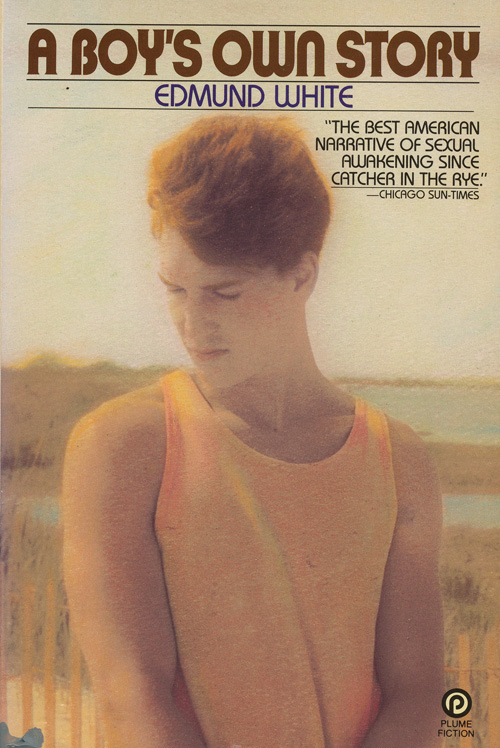
Front cover of Edmund White's A Boy's Own Story (1982)
Front cover of Edmund White’s A Boy’s Own Story (1982)

Edmund White’s A Boy’s Own Story is a coming-of-age novel centered on the sexual awakening of a queer teenage boy in the Midwest during the 1950s. The novel discusses topics such as the corruption of innocence, the pressures of masculinity in the lives of young boys, the emergence of childhood sexuality, and the exploration of humanity through the lens of homosexuality. The unnamed narrator of the novel quickly addresses the issues that he has in terms of his body and his sense of masculinity. He feels as if his “feminine” qualities–such as his voice, his mannerisms, and his overall attitudes– not only prevent him from bonding with other people, but that they also prevent him from obtaining any of the power that promised to those who embody the masculine myth. The narrator notices that everything from the way he sits to the way he acts marks his body as Other, and he even goes as far as to point out that he often fails small and meaningless quizzes used to assess his masculinity:

A popular quiz for masculinity in those days asked three questions, all of which I flunked: (1) Look at your nails (a girl extends her fingers, a boy cups his in his upturned palm); (2) Look up (a girl lifts her eyes, a boy throws back his whole head); (3) Light a match (a girl strikes away from her body, a boy toward–or perhaps the reverse, I can’t recall). (9)

The structure of this novel can seem slightly confusing, especially since it deviates from the traditional linear narrative that we have come to expect when reading coming-of-age novels. The first chapter, for instance, begins when the narrator is fifteen years-old. In this chapter, he painstakingly describes a relationship that he has with Kevin, the twelve year-old son of a guest that visits his summer home. In this chapter, the narrator describes how he paradoxically wants to be considered heterosexual while still being loved by a man. His relationship with Kevin slowly but surely starts to teach him how sex is not only a physical act, but how it is also a discursive act–leading him to realize that sex is also “a social rite that registered, even brought about shifts in the balance of power, but something that was discussed more than performed” (198). Because of this realization, he notices how performance and discourse shapes and forms his relationships with other men. For instance, he approaches Kevin as the “older” and more “dominant” person in the relationship because he is the more confident person of the two, and because he controls what happens during sexual intercourse:

I was chagrined by [his] clowning because I’d already imagined Kevin as a sort of husband. No matter that he was younger; his cockiness had turned him into the Older One (23).

The first chapter concludes by depicting how the narrator and Kevin part ways, and the second chapter goes back an entire year, allowing the narrator to discuss events that shaped who he is in his present day. Subsequent chapters go back in time even further, depicting events that the narrator encounters when he was twelve and seven years-old. The jumping back and forth between the past and the present not only disrupts the linearity of the coming-of-age narrative, but it also presents, as Elizabeth Freeman would put it, a manifestation of queer time. 

In Time Binds: Queer Temporalities, Queer Histories, Elizabeth Freeman describes queer time as a “hiccup in sequential time” that “has the capacity to connect a group of people beyond monogamous, enduring couplehood” (3). Furthermore, queer time allows queer subjects to envision alternative structures and forms of belonging, precisely because it deviates from the linearity and “productivity” of chrononormativity–in which human bodies arrange their time and bodies towards maximum productivity. In A Boy’s Own Story, queer time manifests through this combination of the past and the present, precisely because the narration deviates from the productive and generative elements that are closely associated with narratives of personal development. White, rather than depicting growth and development as sequential events, the narrator approaches them as fractured and disjointed processes. Rather than offering readers an equation, in which event 1, event 2, and event 3 equal the narrator, White disrupts temporality by beginning with event 3, going back to event 1, and covering the decimal points (small or micro events) that occur between these numbers. I think that this novel embraces queerness through it’s denial of both chronos (sequential time) and kairos (significant time), in favor of small non-sequential and non-significant time. This is particularly clear in the fourth chapter of the novel, in which the narrator breaks the fourth wall and addresses the reader:

in writing one draws in the rest, the forgotten parts. One even composes one’s improvisations into a quite new face never glimpsed before, the likeness of an invention. Busoni once said he prizes the most those empty passages composers make up to get from one “good part” to another. He said such womanlike but minor transitions reveal more about a composer–the actual vernacular of his imagination–than the deliberately bravura moments. I say all this by way of hoping that the lies I’ve made up to get from one poor truth to another may mean something–may even mean something most particular to you, my eccentric, patient, scrupulous reader, willing to make so much of so little, more patient and more respectful of life, or a life, than the author you’re allowing for a moment to exist again. (84)

I believe that this passage is quite significant, because it highlights the role that queer time plays in the novel’s political agenda. By disrupting linearity and by painstakingly focusing on minor events, the reader must develop patience and spend more time concentrating on the narrator’s words rather than on major events. The narrator affirms that by reading his words, the reader becomes not only more respectful of the narrator’s life, but the reader also brings the narrator back into existence. Therefore, through the act of reading, one gives the narrator a sense of legitimacy that was denied to him during his childhood. This interpretation gains even more validity when taking into account that most of the novel is focused on the narrator’s struggle to survive in his society, and even more so, his struggle to be approached and categorized as a legitimate human being. The narrator, for instance, acknowledged that he has little time to focus on “theory” or “philosophy” because he is too busy focusing on pragmatic aspects of his life such as survival. This notion is evidenced when the narrator compares himself to his jockish friend, Tom, who spends most of his time daydreaming and philosophizing:

Ironic, then, that [Tom] was the one who did all the thinking, who had the taste for philosophy–ironic but predictable, since his sovereignty gave him the ease to wonder about what it all meant, whereas I had to concentrate on means, not meaning. The meaning seemed quite clear: to survive and then to become popular. (113)

Although popularity may at first be approached as a self-centered and selfish goal, it is important to keep in mind that the narrator believes that popularity will give him the recognition and the legitimacy that he has been denied in his life, not only because he is queer, but also because he is unable to situate himself within the frame of traditional masculinity that his father upholds. Popularity would give the narrator the means to become a legitimate person rather than an unreal subject:

Being popular was equivalent to becoming a character, perhaps even a person, since if to be is to be perceived, then to be perceived by many eyes and with envy, interest, respect, or affection is to exist more densely, more articulately, ever last detail minutely observed and thereby richly rendered. (127)

All in all, A Boy’s Own Story is a rich and provocative novel that definitely raises interesting insights in terms of the role that temporality plays within the issues of livability that haunt all queer lives. The narrative is at times convoluted and difficult to follow, but getting lost is definitely an essential component towards grasping the novel’s central themes and agenda.

You can purchase a copy of White’s novel by clicking here.


Works Cited

Freeman, Elizabeth. Time Binds: Queer Temporalities, Queer Histories. Durham: Duke University Press, 2010. Print.

White, Edmund. A Boy’s Own Story. New York: Plume, 1982. Print.


J.C. Lillis’ [How to Repair a Mechanical Heart]: A Gay YA Novel on Fandom, Religion, and Canonicity

Front cover of J.C. Lillis' How to Repair a Mechanical Heart (2012)
Front cover of J.C. Lillis’ How to Repair a Mechanical Heart (2012)

If there is one thing that gay young adult fiction should be thankful for, that thing would be the internet. Because of the advent of the web, we have witnessed the increase of self-published e-novels distributed through online stores such as Amazon and Barnes and Noble. Self-publishing, in my opinion, greatly expands the possibilities of gay young adult fiction, not only because authors are free to be more experimental and explicit when it comes to the novel’s content and structure, but also because they do not have to comply with the expectations and demands of a publishing house or an editor. J.C. Lillis’ How to Repair a Mechanical Heart (2012) is definitely one of the most unique gay YA novels that I have read this year, not only in terms of its content, but also in terms of its narrative techniques and devices. Although, on the surface level, the novel is centered on the blossoming relationship between two teenage boys, How to Repair a Mechanical Heart, offers readers a fresh take on the uneasy tension that exists between religion and homosexuality.

Now, religion is a topic that is found in many YA books dealing with homosexuality. Some of these novels, such as Alex Sanchez’s The God Box, take a more didactic and realistic approach to the issue, going as far as to present characters that discuss homosexuality by directly citing a barrage of Biblical rhetoric. Other novels, such as Timothy Carter’s Evil?, take a more fantastical and satirical (and hilarious) approach to the tension between religion and homosexuality through the incorporation of characters such as demons and fallen angels. How to Repair a Mechanical Heart tackles the issue of religion and homosexuality through a realistic approach, however, the exploration of this issue is framed through an exploration of fandom subculture. Although at first I was skeptical about whether a gay YA novel could pull off discussing tough issues through fan culture (which includes Comic Con-esque events, the reading and creation of fan fiction, and even the critique of television shows via vlogs), by the end, I thought that Lillis managed to pull it off beautifully. This novel turned out to be an entertaining, complex, and funny read in spite of its often heavy-handed themes and events.

The novel focuses on Brandon and Abel, two fans of a science fiction show entitled Castaway Planet. This show centers on the space adventures of two main characters: Cadmus, a hot-headed, impulsive, and unpredictable explorer; and Sim, an android who is intelligent, calculating, and incapable of feeling human emotion. Brandon and Abel are the hosts of a Castaway Planet vlog, where they deconstruct episodes of the television series, and where they offer critiques of Castaway Planet fan fiction that they dislike. The fan fiction that really grind their gears, however, would be those that ship Cadmus and Sim, for they deem that this relationship is absolutely implausible and disjointed from the themes and reality of the show. Their dislike for this type of fan fiction leads them to partake on a road trip across the country with their friend, Bec, in order to interview the show’s actors in hopes of discrediting any fanfic author who ships Cadmus and Sim. Their anger toward this shipping arises from the fact that Brandon and Abel believe that it demonstrates “zero respect for canon or for Cadmus or Sim as characters” (Lillis).

Throughout this road trip, Brandon and Abel not only develop an increasing appreciation towards the shipping of the Castaway Planet characters, but they also discover their true feelings towards each other. However, these feelings are complicated by the fact that Brandon is still unable to let go of the Catholic doctrine that has shaped his views and understanding of amorous relationships. Brandon is ultimately constructed as a dualistic character in that his mind has come to terms with his sexual orientation, but his heart has not. Brandon’s struggles are intensified not only because his childhood priest approaches celibacy as the only viable life choice for a Catholic gay man, but also because Abel previously has had his heart broken by Jonathan, a boy who decided to end their relationship due to the tension that it caused with his religion. Whenever Brandon is engaging in behavior that may be deemed “gay,” Catholic guilt manifests within his consciousness in the form of his childhood priest, who often reprimands him for his poor decisions that supposedly contradict the teachings of the Catholic church.

Lillis’ novel does an excellent job of creating a multi-layered text in which all the layers are not only interconnected but also capable of illuminating important tensions and resolutions in the novel. While at first fandom, fan fiction, Catholism, and homosexuality seem to have little to no relation to one another, Lillis combines them in a unique way that sheds light not only on the construction of identity, but also the personal negotiations that individuals must undergo when facing cultural demands and when fabricating narratives. For instance, discussions of Cadmus and Sim obviously reflect the tensions that exist between Brandon and Abel. Brandon considers that religion has made his heart mechanical in that it runs in an automated fashion that cannot be fixed or controlled. This motif is central in the novel, for religion is approached as the element mechanizes Brandon’s heart and prevents him from fully loving Abel with no regrets or qualms. Abel, on the other hand, resembles Cadmus, for he is approached as an impulsive character who carelessly disregards the difficulties that Brandon faces when trying to repair his mechanical heart.

Surprisingly, fandom and fan fiction were also very useful and illuminating motifs that Lillis incorporates into the novel in order to offer a unique spin on the treatment of homosexuality within the gay YA novel. Fan fiction, most of the times, disregards realism and canonicity in favor of crafting a narrative that goes in accordance with the tastes, expectations, and desires of the fan fiction writer. Fan fiction is a particularly noteworthy genre of writing because it becomes a venue that allows viewers to assume an active role within the fictional universe created by a show, a book, or a movie. Furthermore, fan fiction allows the recipients of a cultural artifact to explore alternative narratives, outcomes, and possibilities that are not restricted to canonical norms. For instance, if I’m upset that Ross and Rachel end up together in the series finale of Friends, I can write a fanfic in which Rachel ends up going to Paris and begins a life without Ross.

The creation of fan fiction can be approached as a very queer process, especially when it comes to its focus on alternative outcomes, non-normativity, and a mode driven purely by individualistic desire. In How to Repair a Mechanical Heart, the act of participating within the fan fiction universe is linked to the process of embracing a gay identity, for it involves a refutation of rules and so-called truths in order to seek life alternatives that invoke comfort and livability. Fan fiction and queerness entail a refusal of a normative entity (the canon or heteronormativity) that seeks to regulate “sub par” existences and fictions. This notion becomes particularly apparent near the novel’s conclusion, when Brandon meets the creator of Castaway Planet. When Brandon seems to approach fan fiction with slight “disgust,” and when he approaches the creator of the show as the sole bearer of the show’s truth, the creator reacts very harshly to Brandon’s assumptions:

“Listen, you runt. I saw that self-righteous eyeroll when you said fanfiction. Let me tell you something: I fucking love fanfiction. Why do you think I made up these characters? So I could play with dolls in public and tell everyone else ‘hands off’? So I could spoon-feed you stories from on high about the mysteries of love and free will and giant alien spiders?” He shows me his palms, then the backs of his hands. “I am one man with a laptop. When I give the world my characters, it’s because I don’t want to keep them for myself. You don’t like what I made them do? Fucking tell me I’m wrong! Rewrite the story. Throw in a new plot twist. Make up your own ending. Castaway Planet is supposed to be a living piece of art! (Lillis, location 3278)

The show’s creator overtly refutes any desire to regulate how his characters are used or appropriated. He expresses how people should feel free to take the “truth” depicted by the canon and transform it in ways that go in accordance with their individual wants and desires. The canon is not mechanical in that it requires preciseness and exactness to function, but rather, it is approached as a living entity capable of transformation. In due course, Brandon begins to approach religion in a similar fashion, realizing that he can grow comfortable with belief in a God if he accepts that certain elements within the doctrine are not only open to interpretation, but can also be rewritten to go in accordance with an alternative truth.

Although How to Repair a Mechanical Heart, at times, seems slightly moralizing and repetitive in its treatment of religion, it presents one of the freshest approaches towards spirituality and belief within the confines of a gay YA novel. I think that this novel is very innovative in terms of framing its central issues through fandom subculture, and I especially enjoyed the novel’s overt and explicit decoupage of narrative conventions. While the structure of this text generally follows the linear conventions found within most gay coming-of-age fiction, it consciously employs the style and conventions of the fan fiction genre to add some much needed flair and whimsy to the often stale and dry treatment of religion and homosexuality in YA fiction. I highly recommend this novel for its likable characters, its queer potentiality, and its unique structure and motifs.

You can purchase a copy of Lillis’ novel here, and you can read more about it by clicking here

Work Cited

Lillis, J.C. How to Repair a Mechanical Heart. Amazon Digital Services, 2012. Kindle text.

John Barth’s “Lost in the Funhouse”: A Postmodern Critique of the Developmental Narrative

“Lost in the Funhouse” is a short story in John Barth’s book of the same name, originally published in 1968.  The stories within this collection are typically approached as postmodern due to their self-reflexivity, their self-awareness, and their use of self-reference. The short story “Life in the Funhouse,” in particular, is known for its active destabilization of truth, linearity, and structure, and it is an ideal text to study when engaging in the frustrating exercise of defining postmodernity as it pertains to the study of literary texts.

Plot-wise, not much occurs within this narrative. In a nutshell, a teenage boy named Ambrose travels with his family to Ocean City, Maryland, where they spend most of their time sunbathing at the beach, going on amusement park rides, and entertaining themselves with games at the Ocean City boardwalk. Ambrose is nervous because he really likes this girl named Magda, and wants to develop the courage to confess his love for her. Although he eventually invites Magda to go into a funhouse with him, Magda eventually trails off with Ambrose’s brother, Peter, leaving him alone and isolated within the dark confines of the funhouse. The rest of the narrative traces Ambrose’s thoughts and dissatisfaction caused not only by his inability to express his feelings, but also  by his inability to escape from the funhouse.

This plot, however, constitutes a really small part of the narrative. “Lost in the Funhouse” is peppered with moments of self-reflexivity and meta-awareness, and the narrator often deviates from the plot in order to make claims regarding the intricacies of language, the difficulties of writing, and the impossibility of literary innovation. Within this narrative, we have a triangulation of three perspectives: the perspective of the protagonist, the perspective of the author, and the perspective of the speaker/narrator (who also shares most of the meta-fictional elements within the short story). Given the fact that this text is a meta-fiction, the elements within the story should be approached not only by how they develop the plot, but also by their commentary as pertaining to the acts of writing and reading fiction. This is particularly why close-reading and deconstruction are crucial in terms of determining what the text is trying to achieve. In an attempt to highlight the complexity and richness of this story, let me turn my attention to unpacking the following passage:

One reason for not writing a lost-in-the-funhouse story is that either everybody’s felt what Ambrose feels, in which case it goes without saying, or else no normal person feels such things, in which case Ambrose is a freak. “Is anything more tiresome, in fiction, than the problems of sensitive adolescents?” And it’s all too long and rambling, as if the author. For all a person knows the first time through, the end could be just around the corner; perhaps, not impossibly it’s been within the reach any number of times. On the other hand he may be scarcely past the start, with everything yet to get through, an intolerable idea. (88)

Although plot-wise there is an actual or concrete funhouse, the term is also being invoked as a symbol for narrative, fiction, or perhaps even the mind of the protagonist. “Lost in the Funhouse” is an exploratory narrative that delves into the woes that Ambrose faces when analyzing his own precociousness, and when confronting the confusing and contradictory issues that arise when one grows up–making the story, in essence, a coming-of-age narrative. In the passage above, the narrator uses quotation marks to bring up the tired and overwrought nature of the coming-of-age genre. Furthermore, the quote asks readers to reflect on how sensitive protagonists within this genre suffer from the woes of over-thinking, and how they often share thoughts that are deemed to be too advanced or “unrealisitic” given the protagonist’s age.

It becomes important to question why Barth shares this critique of the “lost-in-the-funhouse” narrative when the story itself incorporates every single element that is critiqued: the protagonist of the story is a sensitive character, who often offers long, rambling, and contradictory interpretations of himself and the people that surround him. The text explores the perceived incongruity of sensitive adolescents expressing ideas that surpass their faculties, at least within fiction: “Is it likely, does it violate the principle of verisimilitude, that a thirteen-year-old boy could make such a sophisticated observation?” (70). Despite this questioning, the protagonist still  engages with intense philosophical and existential ideas, leading the reader to come with their own answers to the aforementioned question. Not only can this be approached as an attempt to destabilize stereotypes in terms of what adolescents are or are not capable of deliberating, but it also pushes the reader to question the foundations that generate these so-called truisms and verisimilitudes.  Is it possible for a teen to conceive of sophisticated ideas? Is there a specific age that a person must reach before being able to formulate complex ideas?

It can be said that the narrator considers the coming-of-age genre to be important or useful given its universality, but at the same time, the text makes overt critiques on the use of conventions and patterns to portray universal themes. Growth, development, and linearity (both from a textual and non-textual perspective) are thus prominent themes that are scrutinized within the depths of the funhouse.

Narrative
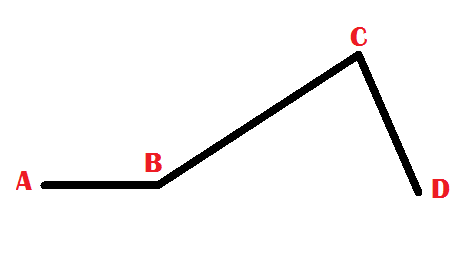
Figure 1. This graphic is a replication of the diagram found in page 91 of “Lost in the Funhouse,” in which the narrator discusses the general pattern that most fictional narratives follow: exposition, conflict, complication, climax, and resolution.

The narrator of the story makes a critique of patterns by illustrating the conventions that narratives usually appropriate in order to assure that they are effective. The text painstakingly depicts the usual structures and conventions that narratives employ to deliver a story (see Figure 1). “Lost in the Funhouse” deviates immensely from the conventional and linear plot, and it is self aware of this deviation: “The beginning should recount the events between Ambrose’s first sight of the funhouse early in the afternoon and his entering it with Magda and Peter in the evening. The middle would narrate all relevant events from the time he loses his way; middles have the double and contradictory function of delaying the climax while at the same time preparing the reader for it” (74). Although the narrator stresses that this is how stories should be structured, “Lost in the Funhouse” deliberately refutes these conventions by delivering a narrative with a prolonged exposition that is contradictory and that does not follow typical patterns of resolution. Details of the plot’s so-called climax, introduction, and conclusion are also scrambled throughout the text, and are not found within the expected locations. Although the narrator admits that this deviation forsakes “the effects of drama” that are possible in the short story, he also makes it clear that this deviation of narrative conventions “can better effect” the dramatic possibilities of the story (91).

With this in mind, it can be argued that the narrator is not necessarily refuting the importance of fiction with sensitive adolescents, but rather, he is contesting the usefulness of a linear narrative to do justice to the multifaceted, complicated, and fragmentary nature of the issues that are faced during the coming-of-age process. I thought this notion was particularly apparent as Ambrose ventures through the maze of mirrors in the funhouse. As Ambrose sees multiple selves being reflected as he tunnels through those mirrored paths, he realizes the futility of trying to approach the self as a single, atomized unit:

Stepping from the treacherous passage at last into the mirror-maze, he saw once again, more clearly than ever, how readily he deceived himself into supposing he was a person. He even foresaw, wincing at his dreadful self-knowledge, that he would repeat the deception, at ever-rarer intervals, all his wretched life, so fearful were the alternatives. (90)

The passage above is one of the most overt critiques on linearity, development, and the conventions that are usually invoked when writing developmental narratives. It attacks the notion of teleology and fulfillment, going as far as to argue that development is not always achieved by following points A to D. Furthermore, this passage refutes the notion of self-fulfillment by highlighting the cyclic nature and the folly of trying to pin down a clear and clean definition of the self. The self is always more fragmented and unreachable than narratives of development usually convey, and the self is always found in a state of constant change and growth. Thus, “Lost in the Funhouse” offers an alternative way of thinking about and approaching the process of development. The narrative implies that it would be foolish to approach an individual’s development through how well he or she complies with conventions of growth, maturation, and development–just as it would be equally foolish to judge this text by how well it adheres to narrative conventions.

When it comes to truth, perhaps the narrator is right when asserting that “we will never get out of the funhouse” (74).

Work Cited

 Barth, John. Lost in the Funhouse. New York: Bantam Books, 1980. Print.