Queer Time in Edmund White’s [A Boy’s Own Story]

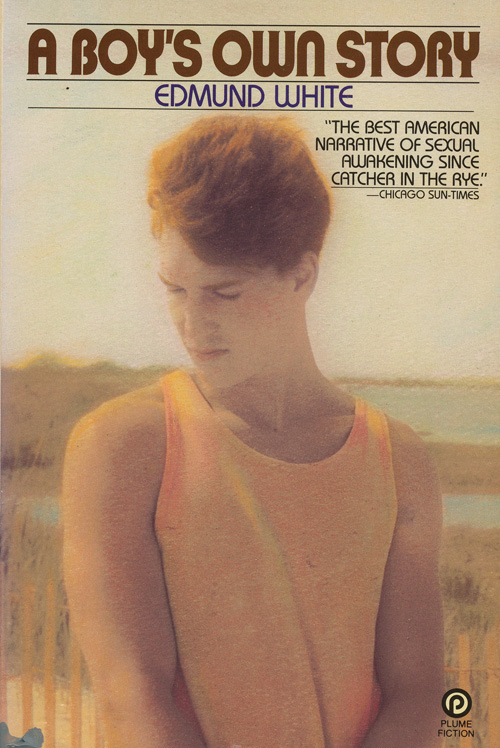
Front cover of Edmund White's A Boy's Own Story (1982)
Front cover of Edmund White’s A Boy’s Own Story (1982)

Edmund White’s A Boy’s Own Story is a coming-of-age novel centered on the sexual awakening of a queer teenage boy in the Midwest during the 1950s. The novel discusses topics such as the corruption of innocence, the pressures of masculinity in the lives of young boys, the emergence of childhood sexuality, and the exploration of humanity through the lens of homosexuality. The unnamed narrator of the novel quickly addresses the issues that he has in terms of his body and his sense of masculinity. He feels as if his “feminine” qualities–such as his voice, his mannerisms, and his overall attitudes– not only prevent him from bonding with other people, but that they also prevent him from obtaining any of the power that promised to those who embody the masculine myth. The narrator notices that everything from the way he sits to the way he acts marks his body as Other, and he even goes as far as to point out that he often fails small and meaningless quizzes used to assess his masculinity:

A popular quiz for masculinity in those days asked three questions, all of which I flunked: (1) Look at your nails (a girl extends her fingers, a boy cups his in his upturned palm); (2) Look up (a girl lifts her eyes, a boy throws back his whole head); (3) Light a match (a girl strikes away from her body, a boy toward–or perhaps the reverse, I can’t recall). (9)

The structure of this novel can seem slightly confusing, especially since it deviates from the traditional linear narrative that we have come to expect when reading coming-of-age novels. The first chapter, for instance, begins when the narrator is fifteen years-old. In this chapter, he painstakingly describes a relationship that he has with Kevin, the twelve year-old son of a guest that visits his summer home. In this chapter, the narrator describes how he paradoxically wants to be considered heterosexual while still being loved by a man. His relationship with Kevin slowly but surely starts to teach him how sex is not only a physical act, but how it is also a discursive act–leading him to realize that sex is also “a social rite that registered, even brought about shifts in the balance of power, but something that was discussed more than performed” (198). Because of this realization, he notices how performance and discourse shapes and forms his relationships with other men. For instance, he approaches Kevin as the “older” and more “dominant” person in the relationship because he is the more confident person of the two, and because he controls what happens during sexual intercourse:

I was chagrined by [his] clowning because I’d already imagined Kevin as a sort of husband. No matter that he was younger; his cockiness had turned him into the Older One (23).

The first chapter concludes by depicting how the narrator and Kevin part ways, and the second chapter goes back an entire year, allowing the narrator to discuss events that shaped who he is in his present day. Subsequent chapters go back in time even further, depicting events that the narrator encounters when he was twelve and seven years-old. The jumping back and forth between the past and the present not only disrupts the linearity of the coming-of-age narrative, but it also presents, as Elizabeth Freeman would put it, a manifestation of queer time. 

In Time Binds: Queer Temporalities, Queer Histories, Elizabeth Freeman describes queer time as a “hiccup in sequential time” that “has the capacity to connect a group of people beyond monogamous, enduring couplehood” (3). Furthermore, queer time allows queer subjects to envision alternative structures and forms of belonging, precisely because it deviates from the linearity and “productivity” of chrononormativity–in which human bodies arrange their time and bodies towards maximum productivity. In A Boy’s Own Story, queer time manifests through this combination of the past and the present, precisely because the narration deviates from the productive and generative elements that are closely associated with narratives of personal development. White, rather than depicting growth and development as sequential events, the narrator approaches them as fractured and disjointed processes. Rather than offering readers an equation, in which event 1, event 2, and event 3 equal the narrator, White disrupts temporality by beginning with event 3, going back to event 1, and covering the decimal points (small or micro events) that occur between these numbers. I think that this novel embraces queerness through it’s denial of both chronos (sequential time) and kairos (significant time), in favor of small non-sequential and non-significant time. This is particularly clear in the fourth chapter of the novel, in which the narrator breaks the fourth wall and addresses the reader:

in writing one draws in the rest, the forgotten parts. One even composes one’s improvisations into a quite new face never glimpsed before, the likeness of an invention. Busoni once said he prizes the most those empty passages composers make up to get from one “good part” to another. He said such womanlike but minor transitions reveal more about a composer–the actual vernacular of his imagination–than the deliberately bravura moments. I say all this by way of hoping that the lies I’ve made up to get from one poor truth to another may mean something–may even mean something most particular to you, my eccentric, patient, scrupulous reader, willing to make so much of so little, more patient and more respectful of life, or a life, than the author you’re allowing for a moment to exist again. (84)

I believe that this passage is quite significant, because it highlights the role that queer time plays in the novel’s political agenda. By disrupting linearity and by painstakingly focusing on minor events, the reader must develop patience and spend more time concentrating on the narrator’s words rather than on major events. The narrator affirms that by reading his words, the reader becomes not only more respectful of the narrator’s life, but the reader also brings the narrator back into existence. Therefore, through the act of reading, one gives the narrator a sense of legitimacy that was denied to him during his childhood. This interpretation gains even more validity when taking into account that most of the novel is focused on the narrator’s struggle to survive in his society, and even more so, his struggle to be approached and categorized as a legitimate human being. The narrator, for instance, acknowledged that he has little time to focus on “theory” or “philosophy” because he is too busy focusing on pragmatic aspects of his life such as survival. This notion is evidenced when the narrator compares himself to his jockish friend, Tom, who spends most of his time daydreaming and philosophizing:

Ironic, then, that [Tom] was the one who did all the thinking, who had the taste for philosophy–ironic but predictable, since his sovereignty gave him the ease to wonder about what it all meant, whereas I had to concentrate on means, not meaning. The meaning seemed quite clear: to survive and then to become popular. (113)

Although popularity may at first be approached as a self-centered and selfish goal, it is important to keep in mind that the narrator believes that popularity will give him the recognition and the legitimacy that he has been denied in his life, not only because he is queer, but also because he is unable to situate himself within the frame of traditional masculinity that his father upholds. Popularity would give the narrator the means to become a legitimate person rather than an unreal subject:

Being popular was equivalent to becoming a character, perhaps even a person, since if to be is to be perceived, then to be perceived by many eyes and with envy, interest, respect, or affection is to exist more densely, more articulately, ever last detail minutely observed and thereby richly rendered. (127)

All in all, A Boy’s Own Story is a rich and provocative novel that definitely raises interesting insights in terms of the role that temporality plays within the issues of livability that haunt all queer lives. The narrative is at times convoluted and difficult to follow, but getting lost is definitely an essential component towards grasping the novel’s central themes and agenda.

You can purchase a copy of White’s novel by clicking here.


Works Cited

Freeman, Elizabeth. Time Binds: Queer Temporalities, Queer Histories. Durham: Duke University Press, 2010. Print.

White, Edmund. A Boy’s Own Story. New York: Plume, 1982. Print.


Connection Failed: An Analysis of Christopher Isherwood’s [A Single Man]

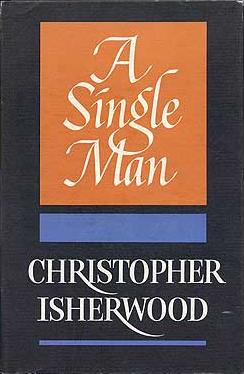
Front cover of Christopher Isherwood's A Single Man (1964)
Front cover of Christopher Isherwood’s A Single Man (1964)

Failure is found at the heart of many great works of fiction. It is a common motif used to spark an emotional connection, sympathy, and at times, anger. Failure is not only the heart of Christopher Isherwood’s A Single Man–is also the blood, the flesh, and the soul of this novel. Centered on a single day in the life of George Falconer–a gay professor from England who teaches literature at a University in Los Angeles–A Single Man traces the protagonist’s psyche as he tries to cope with the stagnant nature of living, and his inability to feel a sense of belonging or connection with those who surround him. Suffering from a chronic depression triggered by the death of his lover (Jim), George desperately struggles to find solace through unsuccessful attempts at forging meaningful interactions and relationships with other people.

The opening event of the novel focuses on George as he wakes up in the morning. Here, we are offered a very detailed and biological account of the processes that take place as a sleeping body is galvanized into a state of alertness. This opening scene creates a split between George’s body and George’s being–a motif that becomes quite prominent within the novel. Throughout the day the novel takes place, George undergoes experiences that separate his thoughts from the actions that his body partakes in–almost as if his body were engaging in auto-pilot mode, leaving the pilot of his consciousness free to do and think whatever he pleases. This auto-pilot mode is activated in many occasions:

  • When George drives to his university, his thoughts wander away as his body automatically drives to its destination: “And George, like a master who has entrusted the driving of a car to a servant, is now free to direct his attention elsewhere” (36).
  • When he teaches, he enters a mode where he begins to spew theory, facts, and jargon without being completely cognizant of what he is saying to his students.
  • When he drinks, he engages in reckless behavior, such as swimming in a rough sea during the night, even though his mind is aware of the dangers of doing so.

The novel’s tendency of splitting George’s mind away from his body fosters an effect in which the reader perceives him as a composition of many selves and not as a single individual–thus emphasizing the novel’s central characteristic of approach life, time, and space as fragmented phenomena. This fragmentation, while very postmodern in effect, serves to illustrate the sense of disconnection and the lack of wholeness that George feels towards his surroundings. Even when looking himself in the mirror, George is unable to see himself as an individualized unit:

Staring and staring into the mirror, it sees many faces within its face–the face of a child, the boy, the young man, the not-so-young man–all present still, preserved like fossils on superimposed layers, and, like fossils, dead. Their message to this live dying creature is: Look at us–we have died–what is there to be afraid of? (11)

While staring at his reflection, George sees the phantoms of his past lives–lives that he considers present but dead; relics of a life that he used to have but that is no longer present. George recognizes this fragmentation, and he struggles to defy it so that others perceive him as ‘the whole George they demand and are prepared to recognize” (11). George is characterized by being overly concerned about what other people think about him. When other characters are talking to him, George’s mind engages in a frantic interpretive mode in which he tries to determine what is going through the other speaker’s mind. However, the inability to know exactly what others are thinking of him leads George to think obsessively about the failure of language to convey ideas in an accurate or precise fashion. Language, therefore, is a contributing factor that adds to George’s notions on fragmentation and the lack of wholeness in his life.

George’s nationality and his sexuality are other elements that fuel his sense of self-fragmentation and his inability to fully connect with others. He constantly claims how his British identity converts him into an Other within academic and non-academic contexts. His sexuality pushes him to feel a desire that is nearly impossible to quench–thus forcing George to live vicariously through small interactions, touches, and brief exchanges that he has with other men. One of these moments takes place when he accompanies one of his students, Kenny, to a book store. Kenny offers to buy George a pencil sharpener, which causes George to blush “as if he has been offered a rose” (81). What is clear here is that George is a man who is starving for connection. He craves to feel part of whole, even if this connection with the whole is momentary. He makes it overtly clear that his nationality, his way of thinking, his sexuality, and even his age puts him in a position in which he is minority. This sense of dissatisfaction with not belonging to a majority leads him to deliver a “sermon” in class, in which he attacks people’s conceptions of minority communities:

A minority has its own kind of aggression. It absolutely dares the majority to attack it. It hates the majority–not without a cause, I grant you. It even hates the other minorities, because all minorities are in competition: each one proclaims that its sufferings are the worst and its wrongs are the blackest. And the more they all hate, the more they’re all persecuted, the nastier they become! Do you think it makes people nasty to be loved? You know it doesn’t! They why should it make them nice to be loathed? (72)

His passionate tirade against minority cultures is longer than the fragment I’ve included above, but I hope this passage emphasizes the degree of self-loathing and confusion that George feels towards himself for being unable to become part of a greater collective. He always has been and always will be a minority. His efforts to be part of something greater than the self always fail–even the connection that he had with Jim is severed with the latter dies in a tragic car accident. George even admits that he is living makes him part of a minority, while those who have joined the rank of the dead are part of a majority:

George is very far, right now, from sneering at any of these fellow creatures. They may be crude and mercenary and dull and low, but he is proud, is glad, is almost indecently gleeful to be able to stand up and be counted in their ranks–the ranks of that marvelous minority, The Living. They don’t know their luck, these people on the sidewalk, but George knows his–for a little while at least–because he is freshly returned from the icy presence of The Majority, which [his dying friend] is about to join. (103-4)

This passage is an eerie foreshadowing to the events that culminate the novel. As George is drunkenly walking towards his usual bar after leaving his friend’s house, he encounters Kenny alone at said bar. The two get really drunk, and they end up swimming together naked in the salty rough waves of the sea in the middle of the night. It is here that George feels a brief connection with Kenny that “transcends” the symbolic. Kenny returns home with George, leading into a scene that seems like an obvious exchange of flirtation between the two. However, despite the fact that George desires to sleep with Kenny, he ends up passing out, awakening alone in his bed–where he decides to masturbate as a way of compensating for his failure to connect with Kenny, sexually speaking.

As the novel comes to a close, George ends up in his bed once again. In a circuitous fashion, the novel ends with George’s mind disconnecting from his body, returning once again to the description of the biological processes that his body is going through as it begins to fall asleep. Unexpectedly, George dies of a heart attack during his sleep. George’s life is characterized not only by a failure to connect with others, but also by a failure to be part of a whole during his life. It’s thus heart-wrenching to realize that the only instance in which he becomes part of a majority is through his death.

This novel is simply beautiful, rich, and complex. There is much more than can be said about this novel, especially in terms of its approaches to time and temporality, especially when contrasting the importance of the past, the present, and the future. This is definitely a novel that I want to revisit once again after I’ve had time to process it a little more.

Comments? Questions? Suggestions? As always, please feel free to add to the conversation!

Work Cited

Isherwood, Christopher. A Single Man. New York: Simon and Schuster, 1964. Print (Hardcover edition).

Time and Cycles in Michael Cunningham’s [The Hours]

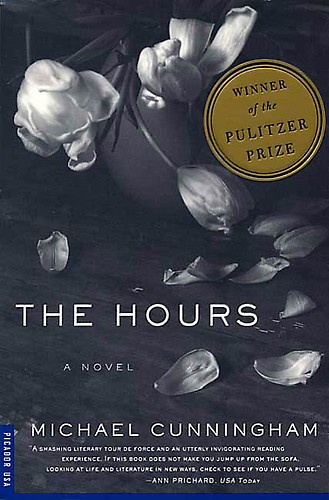
Front paperback cover of Cunningham's The Hours
Front paperback cover of Cunningham’s The Hours

Michael Cunningham’s The Hours barely needs an introduction. Not only was it the winner of the 1999 Pulitzer Prize for fiction, but it is also the source of the Oscar-winning 2002 movie of the same name. Fortunately, I had not seen the movie and I knew very little of the novel’s plot, so I was able to enjoy the narrative in its purest, with no spoilers or outlandish expectations (with the exception of the ideas discussed by Jim Collins in his discussion of the movie adaptation).

I have described many other books as haunting, but that adjective as applied to other books seems to pale in comparison to The Hours. I could praise this book in many ways, including its masterful use of the stream-of-consciousness technique, the depth of its descriptions, or the lavish beauty of its prose, but these merits have been highlighted by many other readers before me.  Similar to the narrative technique employed in Cunningham’s first novel, A Home at the End of the World, each chapter in The Hours focuses on an alternating cycle of major characters, and their perspectives weave together in order to provide cohesion to the text. This disruption of linearity not only adds to the challenge of reading the book, but it also adds an element of surprise and discovery that is more than welcome in the literary world.

In the case of The Hours, the chapters focus on subjects who are either directly or indirectly influenced by Virginia Woolf’s novel, Mrs. Dalloway during its creation and distribution after Woolf’s suicide. The main characters of the story are Virginia Woolf, the writer of Mrs. Dalloway and an eminent figure within British modernist fiction; Laura Brown, a pregnant housewife in the 50’s who is a self-proclaimed bookworm, and who is deeply unhappy with her ordinary life; and Clarissa Vaughn (also referred to as Mrs. Dalloway or Mrs. D), who is a contemporary interpretation of the main character in Woolf’s Mrs. Dalloway, who resides in New York City with her wife Sally and her daughter Julia (you can read a concise summary of the novel along with reader comments here). The novel is told through an omniscient third-person perspective, so the reader is aware of the thoughts of major, secondary, and minor characters.

The gender politics of this novel are very interesting, in my opinion, precisely because they exemplify a wide range of sexual orientations, which include lesbian mothers who embrace traditional characteristics of femininity, lesbian queer theorists, gay men, and bisexual women. The sexuality of most characters within this novel is in no way static; at times there are characters who feel intense desire and passion towards both sexes even though they can typically be categorized as either straight or gay. Similar to A Home at the End of the World, AIDS plays a prominent role within The Hours, which seems appropriate given the novel’s aim of challenging and illuminating topics such as gender, death, life, and most of all: time/temporality.

Time, as suggested by the novel’s title, is indeed the central issue within the narrative, and it is a motif that not only inflects the content of the novel, but also its structure. The three main characters of the text all share a similar story and face similar struggles, however, the nature of this struggle changes according to the social conventions of the time in which they manifest. Woolf, who is trying to cope with mental illness, depression, and suicidal tendencies in the 1920’s, mirrors the character of Laura Brown, who feels trapped by the pressures and expectations of most 50’s housewives. Both characters express a desire to escape from their world, but are unable to do so because of the people who surround them. Cunningham’s depiction of Laura Brown was particularly captivating, mostly because he effectively illustrates her failure to achieve the perfection that others expect from her, and that she expects for herself. For instance, her inability to bake and decorate a flawless and pristine cake for her husband’s birthday clearly denotes her inability to comply with the unrealistic expectations that she sets for herself as a wife and a mother.

Time also plays a role in terms of how the characters cope with their sexual urges and romantic desires. Both Virginia Woolf and Laura Brown express some degree of desire for the same sex through a kiss: Woolf through a kiss she gave to her sister, and Laura through a kiss to her neighbor who ostensibly is showing signs of imminent illness. These kisses haunt the characters, mostly because they represent a desire that could not possibly be expressed without the expected social consequences. Whereas Woolf has writing as an outlet for this desire, Laura Brown has little to no way of expressing it, thus fueling her desire to escape from her current condition.

The third main character, Clarissa, has created a home with her partner, Sally, but she is shown to oscillate between happiness towards her current condition and the anguish caused by the certainties and uncertainties of life.  What makes Clarissa so appealing as a character is her paradoxical and indecisive nature. One moment, she seems to lament the follies of materiality, the fabricated nature of her home, the investment of money in superficial and useless items. Nonetheless, she invests a lot of time and money in a party to show how much she cares about her friend Richard, who is dying of AIDS. She embraces and rejects the comforts of materiality. She struggles with her need to please others while sacrificing her own pleasures and needs. She worries about the extent to which others enjoy the gifts she gives without thinking about her own appreciation to the gifts she is given. This sense of hesitation, which involves the struggle of the self with the demands of the outside world, is something that Clarissa shares with both Woolf and Laura. This, in due course, it what I liked most about the novel: it forced me to struggle in terms of interpreting the world through the lens of solipsism or interpreting it as a space where knowledge exists beyond the self. Do we define ourselves by the roles that other people assign to us? Are the people around us merely projections of our own thoughts and desires? What agency do we really have as individuals?

I’ve decided to end this post with the most haunting paragraph in this novel, which provides the comforting yet strangely bleak idea of enjoying the hours that provide us with comfort, happiness, and glory, simply because these hours are always followed by darker ones:

We throw our parties; we abandon our families to live alone in Canada; we struggle to write books that do not change the world, despite our gifts and our unstinting efforts, our most extravagant hopes. We live our lives, do whatever we do, and then we sleep. It’s as simple and ordinary as that. A few jump out windows, or drown themselves, or take pills; more die by accident; and most of us are slowly devoured by some disease, or, if we’re very fortunate, by time itself. There’s just this for consolation: an hour here or there when our lives seem, against all odds and expectations, to burst open and give us everything we’ve ever imagined, though everyone but children (and perhaps even they) know these hours will inevitably be followed by others, far darker and more difficult. Still, we cherish the city, the morning; we hope, more than anything, for more. Heaven only knows why we love it so. (Cunningham 225-226)

 I can’t help but question if this novel is ultimately presenting life as an endurance test. What I am certain of is that the novel approaches life as ever-shifting and ever-changing, and any intent to make the self stable through the passage of time is indeed a futile effort. Life is presented as a series of cycles and repetitions. The cyclic nature of time and history is best represented with the suicides that occur within the novel in that both Woolf and Richard depart the world by affirming virtually the exact same statement to their loved-ones before killing themselves:  “I dont’ think two people could have been happier than we’ve been” (Cunningham 200). Whether or not Richard was familiar with this exact statement made by Woolf in her suicide note is unclear, but the repetition of this phrase by two different people in two different time periods is indeed an eerie thought. I guess some people are better at coping with cycles. Others desperately try to change the direction of these cycles, or halt them altogether. Others willingly or unwillingly embrace them fully. And as Cunningham firmly put it, only heaven knows why.

Source:

Cunningham, Michael. The Hours. New York: Farrar, Straus, and Giroux, 1998. Print (Hardcover Edition).