teaching and course syllabi
Here you will find a selection of syllabi for courses that I’ve designed and taught over the past years. Most of these courses focus on topics such as youth literatures, queer literature and media, teen cinema, gender studies, and queer theoretical approaches. You are welcome to download these syllabi for your own personal use.
Be a kind human and give me credit if you use any of my syllabi as inspiration for your own courses. If you’re interested in including these syllabi as a resource in your website, course, or book, please contact me using the links on the homepage. All of these syllabi were designed using a combination of Mac Pages, Adobe Photoshop, and Canva. The images and media used in these syllabi fall under the principles of fair, educational use since they are being used for noncommercial instruction, contribution to a field of knowledge, and curriculum-based purposes.

Identity Crossroads: Gender, Sexuality, and Space
(GSWS 3340, Spring 2023)
GSWS senior capstone seminar, Bowdoin College
How have spaces such as bathrooms and public restrooms been central for the advancement of feminist, queer, and trans visibility and mobility? In what ways can media push us to think more imaginatively and critically about how bodies dwell through space? How do films and television shows use space to stage different intersections of identity and oppression? Drawing from diverse and interdisciplinary fields, this seminar examines the different ways in which spaces and identities are mutually configured. Through engagement in a series of case studies, we will explore the value of gendered, spatial inquiry and its potential to complicate normative understandings of being, dwelling, mobility, and place. Throughout the semester, students will develop independent research focused on gender and space, which will be shared in a narrativized end-of-year-presentation.

Disruptive Play: Approaching Video Games as a Queer Archive
(GSWS 2750, Spring 2023)
Intermediate undergraduate course, Bowdoin College
Video games share a complicated history with oppressive forces such as hypermasculinity, violence, misogyny, and homophobia—one that often overshadows the queer, playful, and radical legacy associated with video game design, play, and culture. Video games present us with opportunities to think beyond the injustices prevalent in our current moment and to recognize how interactive digital play can disrupt normative thinking and practices. Drawing from video game studies and queer frameworks, we will rethink the history of video games through a gendered lens and examine games overtly focused on queer lives and practices. We will also think more broadly about how all video games function as an interactive archive that disrupts normative conceptions of gender, sexuality, kinship, identity, space, time, and the body. Some familiarity with video game play is recommended for this course and assignments will involve podcast recording, video recording, and basic video game programing.

Queer Latinx Literature and Culture
(GSWS 2704/ENGL 2904/LACL 2304, Spring 2022)
Advanced undergraduate seminar, Bowdoin College
This seminar examines representations of queer Latinx identities and experiences through intersectional and interdisciplinary lenses, focusing on texts crafted by US- based Latinx authors. Students develop an understanding of the aesthetic and ideological elements that inform the narrativization of queer Latinx experience and the tensions that arise through the intersection of sexuality, gender, race, and ethnicity in a variety of texts and genres. In addition to highlighting the value of reading literature written by authors who belong to the marginalized groups that they write about, this course is meant to disrupt monolithic and homogenizing understandings of what it means to be queer and Latinx. Potential topics include futurism, la familia, borderlands, machismo and patriarchy, the coming-out narrative, and memory.
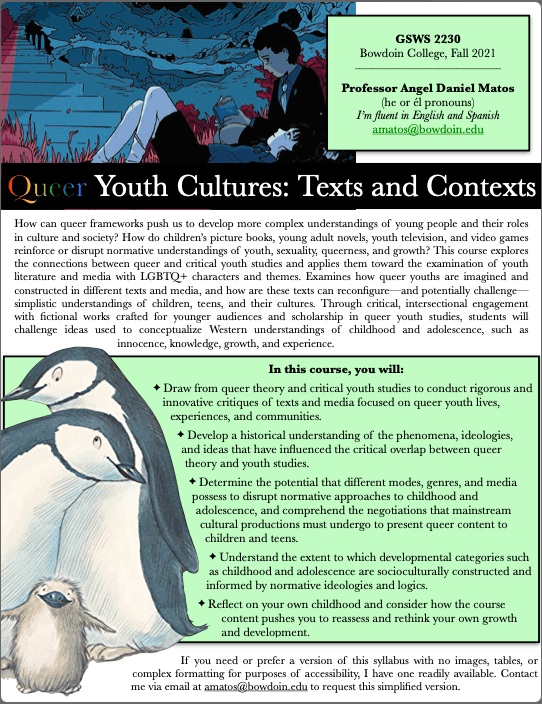
Queer Youth Cultures: Texts and Contexts
(GSWS 2230, Fall 2021)
Undergraduate course, Bowdoin College
How can queer frameworks push us to develop more complex understandings of young people and their roles in culture and society? How do children’s picture books, young adult novels, youth television, and video games reinforce or disrupt normative understandings of youth, sexuality, queerness, and growth? This course explores the connections between queer and critical youth studies and applies them toward the examination of youth literature and media with LGBTQ+ characters and themes. Examines how queer youths are imagined and constructed in different texts and media, and how are these texts can reconfigure—and potentially challenge—simplistic understandings of children, teens, and their cultures. Through critical, intersectional engagement with fictional works crafted for younger audiences and scholarship in queer youth studies, students will challenge ideas used to conceptualize Western understandings of childhood and adolescence, such as innocence, knowledge, growth, and experience.
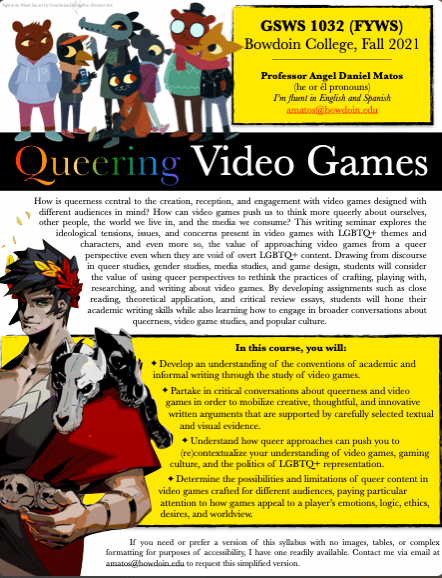
Queering Video Games
(GSWS 1032, Fall 2021)
First year writing seminar, Bowdoin College
Course Description: How is queerness central to the creation, reception, and engagement with video games designed with different audiences in mind? How can video games push us to think more queerly about ourselves, other people, the world we live in, and the media we consume? This writing seminar explores the ideological tensions, issues, and concerns present in video games with LGBTQ+ themes and characters, and even more so, the value of approaching video games from a queer perspective even when they are void of overt LGBTQ+ content. Drawing from discourse in queer studies, gender studies, media studies, and game design, students will consider the value of using queer perspectives to rethink the practices of crafting, playing with, researching, and writing about video games. By developing assignments such as close reading, theoretical application, and critical review essays, students will hone their academic writing skills while also learning how to engage in broader conversations about queerness, video game studies, and popular culture.
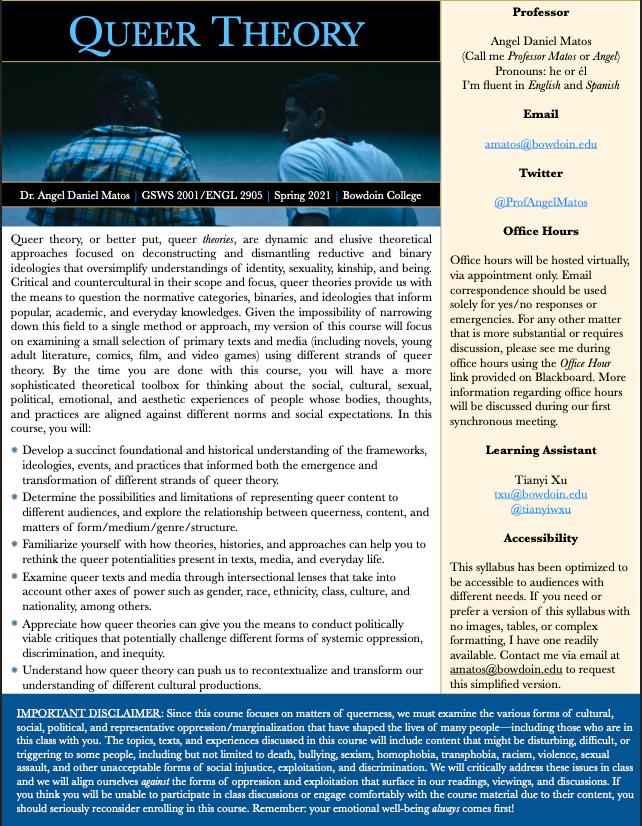
Queer Theory (Online Course)
(GSWS 2001/ENGL 2905, Spring 2021)
Undergraduate course, Bowdoin College
Course Description: Queer theory, or better put, queer theories, are dynamic and elusive theoretical approaches focused on deconstructing and dismantling reductive and binary ideologies that oversimplify understandings of identity, sexuality, kinship, and being. Critical and countercultural in their scope and focus, queer theories provide us with the means to question the normative categories, binaries, and ideologies that inform popular, academic, and everyday knowledges. Given the impossibility of narrowing down this field to a single method or approach, my version of this course will focus on examining a small selection of primary texts and media (including novels, young adult literature, comics, film, and video games) using different strands of queer theory. By the time you are done with this course, you will have a more sophisticated theoretical toolbox for thinking about the social, cultural, sexual, political, emotional, and aesthetic experiences of people whose bodies, thoughts, and practices are aligned against different norms and social expectations. In this course, you will: 1) Develop a succinct foundational and historical understanding of the frameworks, ideologies, events, and practices that informed both the emergence and transformation of different strands of queer theory; 2) Determine the possibilities and limitations of representing queer content to different audiences, and explore the relationship between queerness, content, and matters of form/medium/genre/structure; 3) Familiarize yourself with how theories, histories, and approaches can help you to rethink the queer potentialities present in texts, media, and everyday life; 4) Examine queer texts and media through intersectional lenses that take into account other axes of power such as gender, race, ethnicity, class, culture, and nationality, among others; 5) Appreciate how queer theories can give you the means to conduct politically viable critiques that potentially challenge different forms of systemic oppression, discrimination, and inequity; and 5) Understand how queer theory can push us to recontextualize and transform our understanding of different cultural productions.
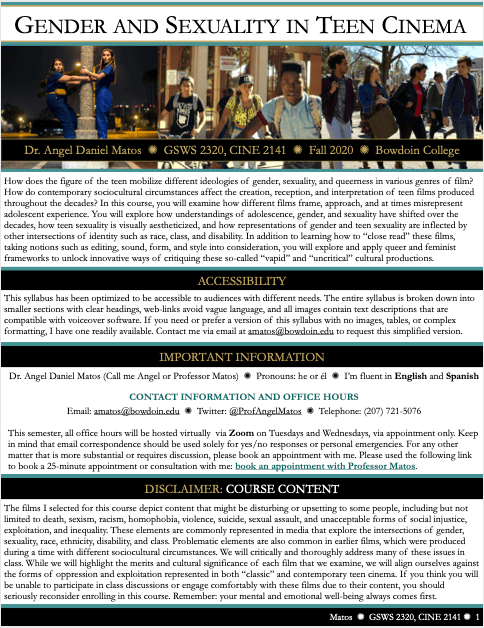
Gender and Sexuality in Teen Cinema (Online Course)
(GSWS 2320/CINE 2141, Fall 2020)
Undergraduate course, Bowdoin College
Course Description: How does the figure of the teen reflect and mobilize different ideologies of gender, sexuality, and queerness in various genres of film? To what extent do contemporary sociocultural circumstances affect both the reception and interpretation of teen films produced throughout the decades? In this course, we will examine mainstream and independent cinema from the 1950s to the present in order to examine how they frame, approach, and at times misrepresent adolescent experience. We will pay close attention to how understandings of adolescence, gender, and sexuality have shifted over the decades, how teen sexuality is visually aestheticized, and how representations of gender and sexuality are inflected by other domains of identity, including race, ability, and class. In addition to learning how to “close read” these films, taking notions such as editing, sound, form, and style into consideration, we will also determine the extent to which queer and feminist approaches can unlock unprecedented and politically viable ways of critiquing these so-called “vapid” and “uncritical” cultural productions.
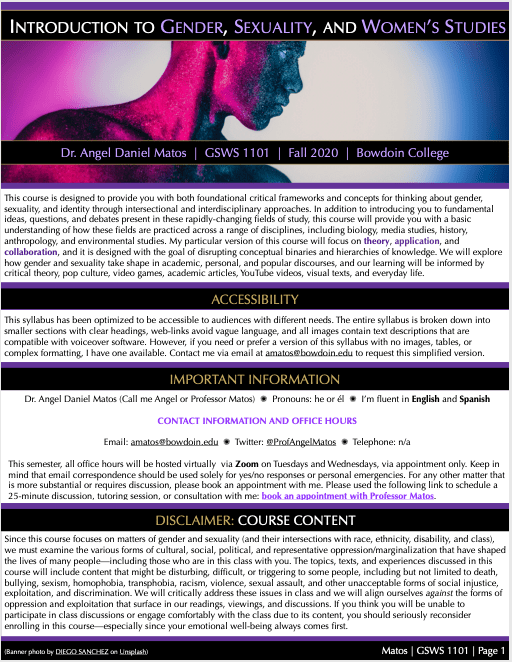
Intro to Gender, Sexuality, and Women’s Studies (Online Course)
(GSWS 1101, Fall 2020)
Introductory undergraduate course, Bowdoin College
Course Description: This course is designed to provide you with both foundational critical frameworks and concepts for thinking about gender, sexuality, and identity through intersectional and interdisciplinary approaches. In addition to introducing you to fundamental ideas, questions, and debates present in these rapidly-changing fields of study, this course will provide you with a basic understanding of how these fields are practiced across a range of disciplines, including biology, media studies, history, anthropology, and environmental studies. My particular version of this course will focus on theory, application, and collaboration, and it is designed with the goal of disrupting conceptual binaries and hierarchies of knowledge. We will explore how gender and sexuality take shape in academic, personal, and popular discourses, and our learning will be informed by critical theory, pop culture, video games, academic articles, YouTube videos, visual texts, and everyday life.
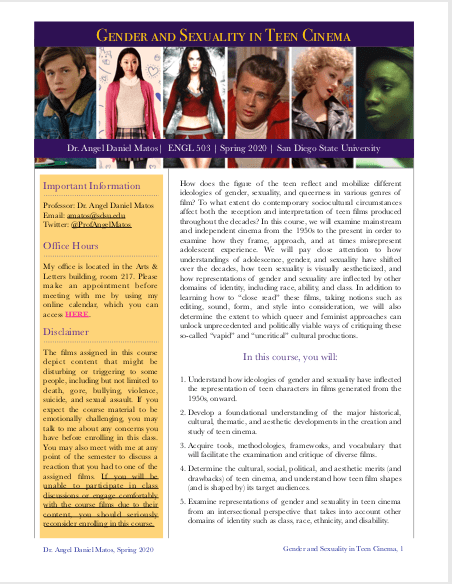
Gender and Sexuality in Teen Cinema (ENGL 503, Spring 2020)
Advanced undergraduate course, San Diego State University
Course Description: How does the figure of the teen reflect and mobilize different ideologies of gender, sexuality, and queerness in various genres of film? To what extent do contemporary sociocultural circumstances affect both the reception and interpretation of teen films produced throughout the decades? In this course, we will examine mainstream and independent cinema from the 1950s to the present in order to examine how they frame, approach, and at times misrepresent adolescent experience. We will pay close attention to how understandings of adolescence, gender, and sexuality have shifted over the decades, how teen sexuality is visually aestheticized, and how representations of gender and sexuality are inflected by other domains of identity, including race, ability, and class. In addition to learning how to “close read” these films, taking notions such as editing, sound, form, and style into consideration, we will also determine the extent to which queer and feminist approaches can unlock unprecedented and politically viable ways of critiquing these so-called “vapid” and “uncritical” cultural productions.
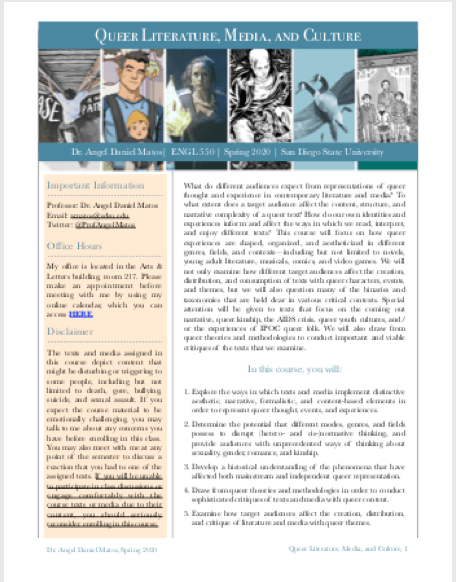
Queer Literature, Media, and Culture (ENGL 550, Spring 2020)
Advanced undergraduate course, San Diego State University
Course Description: What do different audiences expect from representations of queer thought and experience in contemporary literature and media? To what extent does a target audience affect the content, structure, and narrative complexity of a queer text? How do our own identities and experiences inform and affect the ways in which we read, interpret, and enjoy different texts? This course will focus on how queer experiences are shaped, organized, and aestheticized in different genres, fields, and contexts—including but not limited to novels, young adult literature, musicals, comics, and video games. We will not only examine how different target audiences affect the creation, distribution, and consumption of texts with queer characters, events, and themes, but we will also question many of the binaries and taxonomies that are held dear in various critical contexts. Special attention will be given to texts that focus on the coming out narrative, queer kinship, the AIDS crisis, queer youth cultures, and/ or the experiences of IPOC queer folk. We will also draw from queer theories and methodologies to conduct important and viable critiques of the texts that we examine.
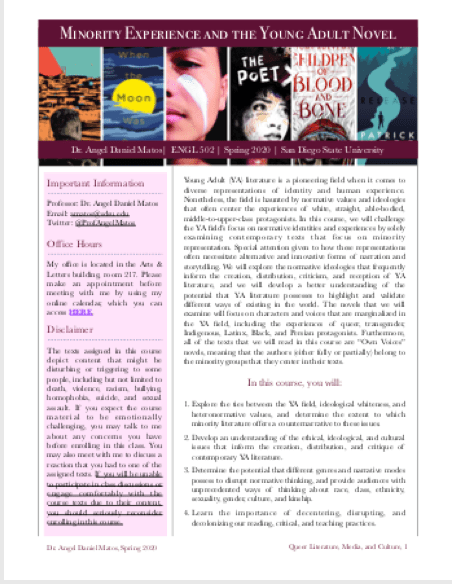
Minority Experience and the Young Adult Novel (ENGL 502)
Advanced undergraduate course, San Diego State University
Course Description: Young Adult (YA) literature is a pioneering field when it comes to diverse representations of identity and human experience. Nonetheless, the field is haunted by normative values and ideologies that often center the experiences of white, straight, able-bodied, middle-to-upper-class protagonists. In this course, we will challenge the YA field’s focus on normative identities and experiences by solely examining contemporary texts that focus on minority representation. Special attention given to how these representations often necessitate alternative and innovative forms of narration and storytelling. We will explore the normative ideologies that frequently inform the creation, distribution, criticism, and reception of YA literature, and we will develop a better understanding of the potential that YA literature possesses to highlight and validate different ways of existing in the world. The novels that we will examine will focus on characters and voices that are marginalized in the YA field, including the experiences of queer, transgender, Indigenous, Latinx, Black, and Persian protagonists. Furthermore, all of the texts that we will read in this course are “Own Voices” novels, meaning that the authors (either fully or partially) belong to the minority groups that they center in their texts.
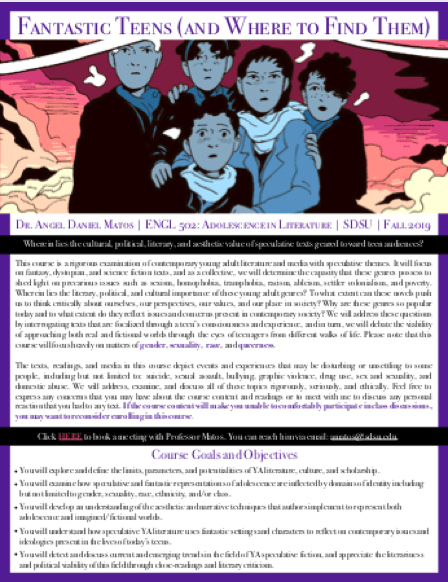
Fantastic Teens (and Where to Find Them) (ENGL 502, Fall 2019)
Advanced undergraduate course, San Diego State University
Course Description: This course is a rigorous examination of contemporary young adult literature and media with speculative themes. It will focus on fantasy, dystopian, and science fiction texts, and as a collective, we will determine the capacity that these genres possess to shed light on precarious issues such as sexism, homophobia, transphobia, racism, ableism, settler colonialism, and poverty. Wherein lies the literary, political, and cultural importance of these young adult genres? To what extent can these novels push us to think critically about ourselves, our perspectives, our values, and our place in society? Why are these genres so popular today and to what extent do they reflect issues and concerns present in contemporary society? We will address these questions by interrogating texts that are focalized through a teen’s consciousness and experience, and in turn, we will debate the viability of approaching both real and fictional worlds through the eyes of teenagers from different walks of life. This course focuses heavily on matters of gender, sexuality, race, and queerness.

Ideologies of Childhood, Adolescence, and Adulthood (ENGL 401)
Introductory general education course, San Diego State University
Course Description: Why are the divisions between developmental stages such as childhood, adolescence, and adulthood so difficult to sustain? Why are an increasing number of adults reading texts that are crafted with a younger audience in mind? How can youth literature push older readers to acknowledge the value of keeping your “inner-child” intact, and what do we even mean when referring to our “inner-child”? This course is a broad introduction to the overarching issues and ideological concerns that arise in the study of children’s and young adult literature. We will develop answers to the questions above by examining a series of “classic,” popular, and award-winning youth texts that interrogate, challenge, and/or subvert the dichotomy between childhood and adulthood. Furthermore, we will challenge the impulse to approach youth literature as “simple,” “unsophisticated,” and “didactic” by examining the literary and cultural merits of these texts. By the time the course is over, you will develop a sophisticated understanding of how complex, deep, and meaningful children’s and young adult literature can be.

Queer Young Adult Literature (ENGL 2803/GSWS 2403, Fall 2017)
Intermediate undergraduate course, Bowdoin College
Course Description: How do literary texts communicate ideas that are supposed to be “unspeakable,” especially to a younger audience? In this course, we will explore contemporary young adult literature that represents the experiences of lesbian, gay, bisexual, transgender, and queer adolescents. We will not only scrutinize the complex relationship that exists between narrative, sexuality, gender, and audience, but we will also determine how certain genres and narrative modes enable or limit representations of queerness. Drawing from temporal and affective approaches to queer studies, we will examine the genre’s attempt to encapsulate an enduring change in terms of how queer adolescence is (or can be) represented, perceived, and experienced. Throughout this course, you will: (a) Explore how authors implement innovations of content and narrative form to represent contemporary queer adolescence; (b) Draw from queer theories and methodologies in order to conduct sophisticated critiques of texts with LGBTQ themes and content; (c) Understand the narrative and sociopolitical role of affect and temporality in queer young adult literature; (d) Engage with theorizations of the queer child/adolescent, and determine how contemporary young adult fiction complicates or reaffirms these categorizations.
 Angel Daniel Matos