We Are the Stories We Tell: Patrick Ness’ [More Than This]

(Major spoilers ahead. You’ve been warned!)

Front cover of Patrick Ness' More Than This
Front cover of Patrick Ness’ More Than This (2013)

“People see stories everywhere,” Regine says. “That’s what my father used to say. We take random events and we put them together in a pattern so we can comfort ourselves with a story, no matter how much it obviously isn’t true.” She glances back at Seth. “We have to lie to ourselves to live. Otherwise, we’d go crazy.” (Ness 217)

The notions of storytelling and narrative are central to Patrick Ness’ 2013 young adult novel entitled More Than This. As can be seen in the quote above, Regine, an important character in the novel, demonstrates awareness of the cognitive function of narrative: it is a method of organizing the world to make sense of it and to interpret it. In other words, it is an ordering or sequencing of events that conveys a particular set of ideas, beliefs, or functions. Through the implementation of metafictional elements and characters who are aware of the nature of storytelling and narration, Ness’ novel brilliantly subverts many of the grand narratives present in young adult literature, and fiction in general.

More Than This is a young adult novel that is difficult to describe. On one hand, it is a philosophical exploration of narrative, the afterlife, the nature of storytelling, and reality. On the other hand, it is a young adult dystopian novel that explores topics such as death, sexuality, family, and friendship. More than a novel, Ness’ work is an exhilarating narrative experiment: through the exploration of adolescence in a post-apocalyptic context, Ness pushes us to question the value of stories in our lives, regardless of whether said stories are real or fabricated.

In the novel’s introduction, Ness challenges the expectations that we have of narratives by beginning the story in an unexpected fashion. Although death is traditionally viewed as the endpoint of a narrative, it marks the beginning of the story being told in More Than This. The novel opens with Seth, the protagonist, committing suicide by drowning himself at sea. He immerses himself into violent and cold waters found in the Pacific Northwest area of the United States, and he is thrashed against some unforgiving rocks by the relentless waves:

The impact is just behind his left ear. It fractures his skull, splintering it into his brain, the force of it also crushing his third and fourth vertebrae, severing both his cerebral artery and his spinal cord, an injury from which there is no return, no recovery. No chance.

He dies. (Ness 3)

The introduction of the novel is thus a reversal of the usual teleology that we have come to expect in traditional narratives (particularly young adult narratives) which focus on the linear development or the transition of a protagonist from point A to point Z. Like most young adult novels, More Than This does focus on transition–but said transition is triggered through death rather than adolescence.

After killing himself, Seth awakens in a perverse version of his childhood home in England. Although Seth recognizes this home, he notices dramatic differences between the place that he knew and its current condition: thick ashen dust has covered nearly every surface, and everything seems abandoned and mistreated–as if nobody has lived in the house for decades. Seth soon realizes that he is alone in this strange place, and he comes to the conclusion that he is living in “A hell built exactly for him” (20).

What is fascinating about More Than This is its ambiguity. At first we are led to believe Seth’s interpretation of his surroundings as a personal hell, but as the novel develops, we receive conflicting events and pieces of information that make it difficult to fully understand and know the setting of the novel. Various theories develop as the narrative progresses. Although Seth believes that he is in hell, paying consequences for actions he committed in life, the narrative takes a dystopic, post-apocalyptic turn. It is revealed that Seth is now living in the “real” world, and that the world that he used to live in was merely a virtual (online) space that society created to escape the pressures of living in a decaying and fractured world (this is actually a very complicated part of the story that’s difficult to summarize, so bear with me).

The novel, however, complicates the reader’s ability to fully believe this dystopian narrative. Seth understands that the presence of a digital alternate reality does explain many things about the “real” world, but he also admits that this explanation is full of gaps. Further complicating Seth’s ability to trust in the “real” post-apocalyptic world are the inexplicable coincidences that he encounters regularly: loose ends tie a little too nicely, Seth is always rescued from danger at the last possible moment, and things sometimes materialize when he thinks about them. His distrust in his current reality begins to peak when he encounters two other people, Regine and Tomasz, who rescue him right before he is attacked by an ominous, Death-like presence known as the Driver, who travels around in a black van: “Something’s still not right about this. These two just happened  to be there when he was running toward the hill, just happened to stop him before he made contact with the black van, just happened  to find  the perfect place to hide from the Driver?” (183, emphasis in original).

Because of the factors mentioned above, Seth begins to believe that what he is experiencing is simply a “story that he’s telling himself” (250)–and this is where the novel becomes increasingly interesting from a (meta)fictional perspective. The novel’s metafictional aspects are highlighted earlier in the novel, when Seth encounters a book that he read as a child. While re-reading this novel, he reflects on the nature of books, and how these objects are able to contain a reality within their pages: “A book, he thinks at one point, rubbing his eyes, tired from so much focused reading. It’s a world all on its owntoo. He looks at the cover again. […] A world made of words, Seth thinks, where you live for a while (135, emphasis in original). Although Ness uses italics to mark thoughts that are substantiated in Seth’s mind, one cannot help but notice how these italics inevitably highlight key phrases and ideas. These italicized words bring many thoughts to mind:

  1. Seth is a protagonist who literally lives in a world made of words.
  2. Through reading More Than This, we as readers end up living in a world made of words for a while.
  3. It is possible that Seth’s current reality is nothing more than a world made of words.

The possibility of Seth’s reality being a story that he is telling himself becomes even more of a possibility towards the end of the novel, where he makes predictions based on past narratives that he’s encountered before. The most jarring of these predictions occurs after Seth, Regine, and Tomasz first destroy the Driver:

The Driver seems clearly dead, but Seth notices how slowly they’re all moving, as if at any second they expect it to surge back to life and attack them.

That’s what would happen if this were a story, Seth thinks. The villain who wouldn’t stay dead. The one who has to be stopped over and over again. That’s what would happen if this were all just my mind trying to tell me something. (407, emphasis in original)

As can be expected, the villain does not stay dead. Towards the novel’s conclusion, the Driver appears out of nowhere to stop the characters from re-entering the virtual world with their current knowledge of the “real” world. After defeating the Driver, once again, Seth, Regine, and Tomasz question whether the reality they are currently experiencing is no different from the virtual world that they managed to escape–whether they are all, in due course, a figment of Seth’s imagination. This is especially true after they witness Seth’s ability to predict the outcome of events that they face. The novel, however, refuses to provide readers with any answers to this question, and instead embraces ambiguity as an alternative to knowing:

He’s uncertain what’s going to happen next.

But he is certain that that’s actually the point.

If this is all a story, then that’s what the story means.

If it isn’t a story, then the exact same is true. (471, emphasis in original)

More Than This is thus a testament to the power of fiction and storytelling. Seth is the story that is told… we all are the stories that we tell. Regardless of whether said stories are true or fictional, they still have the power to produce meaning, to produce knowledge, and to produce selves. The narrative refuses to provide readers with direct answers, but this refusal, in due course, gives us the power to make what we want out of the story. We do not know if Seth is experiencing the “real,” whether he is living a narrative that his mind created to cope with his suicide, or whether he is simply a character lost within a sequence of random events. But this novel is precisely about not being able to know–and how by not knowing, we are able to stitch together an infinite amount of patterns and events to comfort ourselves, to orient ourselves, and find ourselves.

This post does not do justice to the philosophical richness, complexity, and brilliance of Ness’ work. More Than This also contains illuminating discussions on notions such as queerness, sexuality, loss, and relationships. Seth is also one of the most complex gay characters that I’ve encountered in young adult fiction (yes, the protagonist is gay, and his sexuality is a major component of the narrative). I wholeheartedly concur with John Green’s assessment of this novel: “Just read it.”

You can purchase a copy of More Than This by clicking here.

Work Cited

Ness, Patrick. More Than This. Berryville: Candlewick Press, 2013. Print (paperback edition)

Cover/featured image by Diane Yuri. Original version cropped and flipped.

Escaping the Labyrinth: Suffering in YA Fiction and the Case of John Green’s [Looking for Alaska]

Front cover of John Green's Looking for Alaska (2005)
Front cover of John Green’s Looking for Alaska (2005)


How will we ever get out of this labyrinth of suffering? –A.Y.

– John Green, Looking for Alaska (p. 158)

What is the role of suffering in young adult literature? I’ve been obsessed with answering this question since one of my dissertation committee members asked me it a couple of weeks ago. My desire to answer this question has further increased as I continue to teach a course on young adult fiction this semester. I am constantly thinking about what defines this genre of literature, especially when considering that the line between literature written for adults and young adults is so thin. Part of this has to do with the ambiguity of what a young adult is, but for the most part, the trouble in defining young adult literature is found in the plasticity of the genre itself.

Young adult literature has become an umbrella term for an ever-expanding collective of novels, dealing with everything from the real, the everyday, the fantastical, the impossible, the painful, and the imaginary. Since the scope of young adult literature is so embracing, however, it becomes increasingly difficult to establish parameters for what it can or cannot be. Does a YA novel simply require a teenage protagonist in order for it to be categorized as such? An adolescent protagonist is definitely a must–but is there a further narrative strand that binds this collective of novels together? Perhaps an exploration of suffering in these novels can provide some answers.

I’ll be the first to admit that suffering is perhaps a universal element of most, if not all novels. After all, most events that a protagonists face are in some way driven by dissatisfaction or displeasure. However, it seems that most young adult novels go at great lengths to highlight the role of suffering in aiding the development of a character over a particular span of time. In the course that I’m currently teaching, we’ve read novels such as J.D. Salinger’s The Catcher in the Rye, Katherine Paterson’s Bridge to Terabithia, and Stephen Chbosky’s The Perks of Being a Wallflower. Arguably, all of these novels center wholeheartedly on a protagonist’s suffering. Holden Caulfield is tormented by phoniness and hypocrisy–including his own. Jess copes with the death of his best friend, Leslie. Charlie is distressed by his obsession for observation and his struggle to become an active participant. This week, as we begin our discussion of John Green’s Looking for Alaska, the notion of suffering has become front and center due to the novel’s explicit and reiterative questioning of the nature of torment and dissatisfaction in the lives of contemporary teenagers.

In a nutshell, the novel centers on a year in the life of Miles Halter (a.k.a. “Pudge”), a resident of Florida who moves to a boarding school in Alabama during his junior year to seek a “Great Perhaps” (5). It is during this year that Pudge befriends colleagues such as the Colonel, a lower-class math genius with a stoic attitude and sarcastic personality, and Alaska Young, an intelligent, free-spirited, impulsive young woman (and the source of the novel’s title). Much attention is given to Pudge’s somewhat unrequited desire for Alaska, and his attempts to understand her despite her impulsiveness and her candidness.

The novel is structured into two parts: Before and After. The Before section of this novel can be approached as a countdown, in that every chapter tracks the days that are left until an unknown event occurs. With this in mind, the reader approaches this first section with an awareness that a major, plot-shifting event is about to occur–thus creating an anticipation for the event that will mark the beginning of the After section (MAJOR SPOILERS AHEAD). This event happens to be Alaska’s death, as she dies when drunkenly driving to her mother’s grave to leave flowers on the anniversary of her death. The novel, however, is unclear as to whether or not this death was intentional. Thus, the After section, which comprises about 1/3 of the novel, focuses mostly on Pudge’s and the Colonel’s attempt to cope with the grief and guilt instilled by Alaska’s passing. Although Alaska’s death certainly comes as a shock, the novel foreshadows this event various times, the most notable instances being:

  • When Pudge questions why Alaska smokes cigarettes so quickly, she responds by saying “Y’all smoke to enjoy it. I smoke to die” (44). This claim gives the reader insight into the fast-paced fashion in which Alaska lives, and furthermore, it possibly indicates an affinity that Alaska has with the death drive.
  • Further exemplifying Alaska’s connection to the death drive and self-harm, when Pudge suggests that Alaska should stop drinking so much, she responds with the following: “Pudge, what you must understand about me is that I am a deeply unhappy person” (124).

What is interesting about this novel is that although Pudge is undoubtedly its protagonist, its narrative is driven primarily by Alaska’s suffering. Her unhappiness can be traced back to her early childhood, where she witnessed her mother dying of an aneurysm, yet was too shocked and confused to help her at the moment. According to Pudge, her impulsiveness and her desire to continue moving forward is her way of making up for her supposed lack of inaction as a child. Alaska’s dissatisfaction with life, and her connection with the notion of suffering, are narratively framed by intertextual references, the most notable being a reference taken from Gabriel García Márquez’s The General in His Labyrinth–a historical novel on Simón Bolívar. Alaska points out that Bolívar’s last words are “How will I ever get out of this labyrinth!” (19). From this moment on, Bolívar’s last words become a significant motif in the novel.

The motif of the labyrinth becomes quite significant in an instance in which Pudge and Alaska are discussing futurity. Alaska expresses her disdain for the future, for it lures people into the trap of focusing on the not-yet-here rather than the here. It is in this rejection of futurity (a foreshadowing of her death, perhaps?) that the image of the labyrinth becomes associated with Alaska’s ideas of suffering:

You spend your whole life stuck in the labyrinth, thinking about how you’ll escape it one day, and how awesome it will be, and imagining that future keeps you going, but you never do it. You just use the future to escape the present. (54)

What is significant about this passage is that Alaska clearly believes that there is no way of escaping the labyrinth that we are stuck in. The passage is imbued with a crushing pessimism–to the point where Alaska is unable to envision any reality besides the one she lives. Alaska views suffering as a static presence in her life. Suffering is so crippling for her, that she is ultimately unable to envision a way of being that is different to the reality she is currently living–which leads her to reformulate the question originally penned by García Márquez: “How will we ever get out of this labyrinth of suffering?” (158). In due course, Alaska’s reformulation of this question becomes the question that haunts the novel’s characters. How do they escape the labyrinth of suffering erected by Alaska’s death?

While the novel eerily suggests that death is the only way of escaping this labyrinth, I find it interesting how the novel ultimately emphasizes the importance of the labyrinth in our everyday existence. As Pudge reflects on Alaska’s reconfiguration of the big question, he recognizes a shift in his way of thinking. Originally, Pudge thinks that the only way to cope with the labyrinth of suffering was by pretending “that it did not exist, to build a small, self-sufficient world in a back corner of the endless maze and to pretend that I was not lost, but home” (219). Pudge’s moment of growth occurs when he realizes that the labyrinth is ultimately an inseparable part of life. To live is to suffer. Life is more than the maze, but the maze is still an integral component of life. Pudge realizes that by trying to escape the maze, or by ignoring it, he is setting aside the very experience of navigating the maze, and he is focusing on the end rather than on the events that led him to the end. This exemplifies a moment of growth for Pudge, for it is here that he begins to distance himself from teleological notions: the process of navigating the maze is just as important as the process of escaping it.

The novel thus concludes with a glorification of adolescence, precisely because it is a middle ground between the beginning and the end. It is a time in which uncertainty reigns supreme–where possibilities are endless. It denotes the moment in which we navigate the maze, not when we enter it or escape it. As Pudge states in his teenage manifesto:

When adults say, “Teenagers think they are invincible” with that sly, stupid smile on their faces, they don’t know how right they are. We need never be hopeless, because we can never be irreparably broken. We think that we are invincible because we are. We cannot be born, and we cannot die. Like all energy, we can only change shapes and sizes and manifestations. They forget that when they get old.  (220)

John Green’s Looking for Alaska has given me serious food for thought, not only when it comes to the role of suffering in YA literature, but also in when it comes to considering how suffering is connected to the sense of invincibility and infinity associated with the concept of adolescence. Through the act of looking for Alaska, we find not only ourselves, but we also find more interesting ways of navigating labyrinths. When it comes to the labyrinth of young adult literature, perhaps it is time to stop finding a way out of it, and focus our energies in co-existing with it. Perhaps it is time to relish the interconnectedness of YA fiction–its ability to be all-encompassing, ever-expanding, and invincible.

Work Cited

Green, John. Looking for Alaska. New York: Dutton Books, 2005. Print (Hardcover Edition).

You can purchase a copy of Green’s novel by clicking here.

Candle cover image by coloneljohnbritt.

On Closets and Straight Gazes – Bill Konigsberg’s [Openly Straight]

Front cover of Bill Konigsberg's Openly Straight
Front cover of Bill Konigsberg’s Openly Straight (2013)

I was thinking about how snakes shed their skin every year, and how awesome it would be if people did that too. In a lot of ways, that’s what I was trying to do.

As of tomorrow, I was going to have new skin, and that skin could look like anything, would feel different than anything I knew yet. And that made me feel a little bit like I was about to be born. Again.

But hopefully not Born Again.

-Bill Konigsberg’s Openly Straight (p. 4)

Bill Konigsberg’s delightful and heartwarming novel, Openly Straight, pushes readers to question the possibilities that “shedding one’s skin” offers, and the consequences that arise when reinvention threatens our sense of self. The novel is narrated by Seamus Rafael Goldberg (who usually goes by Rafe), a high school student from Colorado who transfers to Natick–an elite, all-boys school in the New England area. Although Rafe is openly gay, he decides to conceal his homosexuality while attending Natick to live a life free of labels, and to explore the possibilities of living a life unhindered by the so-called burdens of queerness.

Rafe, at first, claims that “The closet is when you say you’re not gay” (132). Problematically, he views the closet as a singular and individualistic space created by self-denial–and he fails to recognize that the act of being “out” relies on the obliteration of the many closets that appear and re-appear in our everyday lives. As pointed out by Eve Kosofsky Sedgwick in Epistemology of the Closet

every encounter with a new classfull of students, to say nothing of a new boss, social worker, loan officer, landlord, doctor, erects new closets whose fraught and characteristic laws of optics and physics exact from at least gay people new surveys, new calculations, new draughts and requisitions of secrecy or disclosure. Even an out gay person deals daily with interlocutors about whom she doesn’t know whether they know or not. (68)

Rafe’s initial failure stems from his inability to understand that stepping out of the closet is not a one-step process, for it comprises an act of revelation and disclosure each time a new closet is erected in one’s life. I was impressed with how Konigsberg manages to invoke Sedgwick’s ideas of closetedness, especially as they are experienced by contemporary youths. Given that the novel takes place in a time where homosexuality is becoming more and more acceptable by mainstream society, I was delighted that Openly Straight explores the nuances and effects of closetedness in our brave new world. As evidenced by the novel’s protagonist, closetedness can still haunt even those who are out, open, and accepted.

Rafe is born into a family that readily and openly embraces his gay identity. However, Rafe is unable to appreciate his privilege because he deems that his homosexuality eclipses the other identities that he can embody–to the point where all he is able to see when looking in the mirror is the gay subject he is expected to perform, rather than the self:

Where had Rafe gone? Where was I? The image I saw was so two-dimensional that I couldn’t recognize myself in it. I was invisible in the mirror as I was in the headline the Boulder Daily Camera had run a month earlier: Gay High School Student Speaks Out. (3)

Rafe realizes that decision to hide his homosexuality and to pass as straight do come with certain perks. He is quickly accepted by the jocks at his new school, he is able to shower with his soccer team without worrying about the repercussions of the “straight gaze,” and traits other than his queerness are recognized. His ability to keep his self-imposed secret, however, is thwarted as he grows closer to Ben, a fellow jock and philosophy enthusiast who studies at Natick. As Ben begins to show signs of fluid sexuality, and as the two boys grow closer, Rafe reflects on how the perks of his reinvention come with the cost of being able to love truly and openly.

My favorite aspect of the novel is the complex relationship between Rafe and Ben. This relationship makes you feel all the warmth that you expect in young adult novels, yet this warmth is accompanied by realistic depictions of frustration and heartache. This is unsurprising, since Rafe and Ben’s relationship is based on experimentation and sexual confusion, even though one of the two characters definitely isn’t confused. This complex relationship ultimately leads Ben and Rafe to reflect on the nature of love–how it is possible to love people in different ways, and how it is possible for different types of love to overlap. This reflection leads to my favorite passage in the novel, in which Ben contemplates his non-normative affinities with Rafe:

I guess I’d like to think of what we have as agapeA higher love. Something that transcends. Something not about sex or brotherhood but about two people truly connecting. (225)

One another note, Openly Straight, in its essence, is about gazes, and how they control how we perceive ourselves and how others perceive us. Rafe’s decision to go back into the closet is driven by the fact he is tired of being viewed as a queer object by his friends, family, and peers. Rafe’s views are not entirely unfounded–he is constantly asked by friends and teachers to give his input as a queer subject. His attitudes, beliefs, and actions are constantly being traced back to his homosexuality by other characters. Rafe, understandably, feels the weight of queerness on his shoulders–and this weight is unshakable.

Rafe, nevertheless, complains about the gaze that others fixate on him, without coming to grips with the ways he gazes at others. In one of the later chapters of the novel, Rafe finds himself scrutinizing one of his queer peers at a Gay/Straight Alliance meeting–remarking on everything from his peer’s clothes to his haircut. As Rafe’s eyes remain fixated on his peer, he remarks how this other boy could pass for a woman if he wanted to. When Rafe’s peer notices that he is staring, Rafe becomes self-conscious about his gazing. It is at this moment that Rafe realizes that he is guilty of performing the very act of “straight gazing” that drove him back into the closet in the first place:

I was staring at this effeminate kid, and judging my own masculinity, or lack thereof. And was I so different from everyone else? Who was to say that Mr. Meyers in Boulder was thinking about when he looked at me? How come I was assuming that his staring at me had anything to do with me? (306)

Gazing, according to Rafe, is not a fixation based on rejection, pity, or disgust, but rather, it is a discursive relationship between the self and an other. Thus, the gazer reflects on his or her own selfhood as contrasted to another person–which leads Rafe to deduce that he could “spend a little less time worrying about what people thought about [him], since they probably weren’t thinking about him at all” (307). In other words, Rafe realizes that the fault and blame lies in the eyes of the gazer and not on the person being gazed.

I love this novel. I have been reading queer YA fiction for years, and I must say that Openly Straight astounds me on many levels. It is a testament to how much queer YA literature has evolved over time, and it makes me feel very optimistic about the present and future of the genre. I foresee that young readers will be particularly drawn to the humor and cleverness of this work. I also admire the fact that this novel offers readers the opportunity to explore a compelling, funny, and heartfelt narrative that doesn’t shy away from the complexities of contemporary queerness.

Works Cited

Konigsberg, Bill. Openly Straight. New York: Arthur A. Levine Books, 2013. Print.

Sedgwick, Eve Kosofsky. Epistemology of the Closet. Berkeley: University of California Press, 1990. Print.

You can purchase a copy of Konigsberg’s novel by clicking here.

Queer Time in Edmund White’s [A Boy’s Own Story]

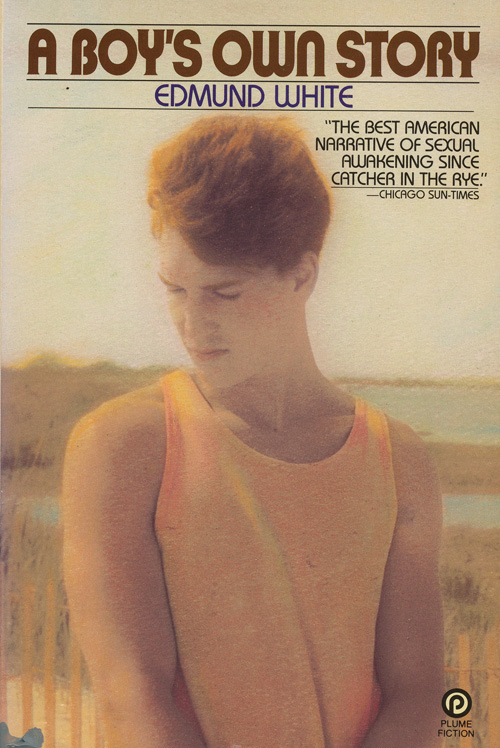
Front cover of Edmund White's A Boy's Own Story (1982)
Front cover of Edmund White’s A Boy’s Own Story (1982)

Edmund White’s A Boy’s Own Story is a coming-of-age novel centered on the sexual awakening of a queer teenage boy in the Midwest during the 1950s. The novel discusses topics such as the corruption of innocence, the pressures of masculinity in the lives of young boys, the emergence of childhood sexuality, and the exploration of humanity through the lens of homosexuality. The unnamed narrator of the novel quickly addresses the issues that he has in terms of his body and his sense of masculinity. He feels as if his “feminine” qualities–such as his voice, his mannerisms, and his overall attitudes– not only prevent him from bonding with other people, but that they also prevent him from obtaining any of the power that promised to those who embody the masculine myth. The narrator notices that everything from the way he sits to the way he acts marks his body as Other, and he even goes as far as to point out that he often fails small and meaningless quizzes used to assess his masculinity:

A popular quiz for masculinity in those days asked three questions, all of which I flunked: (1) Look at your nails (a girl extends her fingers, a boy cups his in his upturned palm); (2) Look up (a girl lifts her eyes, a boy throws back his whole head); (3) Light a match (a girl strikes away from her body, a boy toward–or perhaps the reverse, I can’t recall). (9)

The structure of this novel can seem slightly confusing, especially since it deviates from the traditional linear narrative that we have come to expect when reading coming-of-age novels. The first chapter, for instance, begins when the narrator is fifteen years-old. In this chapter, he painstakingly describes a relationship that he has with Kevin, the twelve year-old son of a guest that visits his summer home. In this chapter, the narrator describes how he paradoxically wants to be considered heterosexual while still being loved by a man. His relationship with Kevin slowly but surely starts to teach him how sex is not only a physical act, but how it is also a discursive act–leading him to realize that sex is also “a social rite that registered, even brought about shifts in the balance of power, but something that was discussed more than performed” (198). Because of this realization, he notices how performance and discourse shapes and forms his relationships with other men. For instance, he approaches Kevin as the “older” and more “dominant” person in the relationship because he is the more confident person of the two, and because he controls what happens during sexual intercourse:

I was chagrined by [his] clowning because I’d already imagined Kevin as a sort of husband. No matter that he was younger; his cockiness had turned him into the Older One (23).

The first chapter concludes by depicting how the narrator and Kevin part ways, and the second chapter goes back an entire year, allowing the narrator to discuss events that shaped who he is in his present day. Subsequent chapters go back in time even further, depicting events that the narrator encounters when he was twelve and seven years-old. The jumping back and forth between the past and the present not only disrupts the linearity of the coming-of-age narrative, but it also presents, as Elizabeth Freeman would put it, a manifestation of queer time. 

In Time Binds: Queer Temporalities, Queer Histories, Elizabeth Freeman describes queer time as a “hiccup in sequential time” that “has the capacity to connect a group of people beyond monogamous, enduring couplehood” (3). Furthermore, queer time allows queer subjects to envision alternative structures and forms of belonging, precisely because it deviates from the linearity and “productivity” of chrononormativity–in which human bodies arrange their time and bodies towards maximum productivity. In A Boy’s Own Story, queer time manifests through this combination of the past and the present, precisely because the narration deviates from the productive and generative elements that are closely associated with narratives of personal development. White, rather than depicting growth and development as sequential events, the narrator approaches them as fractured and disjointed processes. Rather than offering readers an equation, in which event 1, event 2, and event 3 equal the narrator, White disrupts temporality by beginning with event 3, going back to event 1, and covering the decimal points (small or micro events) that occur between these numbers. I think that this novel embraces queerness through it’s denial of both chronos (sequential time) and kairos (significant time), in favor of small non-sequential and non-significant time. This is particularly clear in the fourth chapter of the novel, in which the narrator breaks the fourth wall and addresses the reader:

in writing one draws in the rest, the forgotten parts. One even composes one’s improvisations into a quite new face never glimpsed before, the likeness of an invention. Busoni once said he prizes the most those empty passages composers make up to get from one “good part” to another. He said such womanlike but minor transitions reveal more about a composer–the actual vernacular of his imagination–than the deliberately bravura moments. I say all this by way of hoping that the lies I’ve made up to get from one poor truth to another may mean something–may even mean something most particular to you, my eccentric, patient, scrupulous reader, willing to make so much of so little, more patient and more respectful of life, or a life, than the author you’re allowing for a moment to exist again. (84)

I believe that this passage is quite significant, because it highlights the role that queer time plays in the novel’s political agenda. By disrupting linearity and by painstakingly focusing on minor events, the reader must develop patience and spend more time concentrating on the narrator’s words rather than on major events. The narrator affirms that by reading his words, the reader becomes not only more respectful of the narrator’s life, but the reader also brings the narrator back into existence. Therefore, through the act of reading, one gives the narrator a sense of legitimacy that was denied to him during his childhood. This interpretation gains even more validity when taking into account that most of the novel is focused on the narrator’s struggle to survive in his society, and even more so, his struggle to be approached and categorized as a legitimate human being. The narrator, for instance, acknowledged that he has little time to focus on “theory” or “philosophy” because he is too busy focusing on pragmatic aspects of his life such as survival. This notion is evidenced when the narrator compares himself to his jockish friend, Tom, who spends most of his time daydreaming and philosophizing:

Ironic, then, that [Tom] was the one who did all the thinking, who had the taste for philosophy–ironic but predictable, since his sovereignty gave him the ease to wonder about what it all meant, whereas I had to concentrate on means, not meaning. The meaning seemed quite clear: to survive and then to become popular. (113)

Although popularity may at first be approached as a self-centered and selfish goal, it is important to keep in mind that the narrator believes that popularity will give him the recognition and the legitimacy that he has been denied in his life, not only because he is queer, but also because he is unable to situate himself within the frame of traditional masculinity that his father upholds. Popularity would give the narrator the means to become a legitimate person rather than an unreal subject:

Being popular was equivalent to becoming a character, perhaps even a person, since if to be is to be perceived, then to be perceived by many eyes and with envy, interest, respect, or affection is to exist more densely, more articulately, ever last detail minutely observed and thereby richly rendered. (127)

All in all, A Boy’s Own Story is a rich and provocative novel that definitely raises interesting insights in terms of the role that temporality plays within the issues of livability that haunt all queer lives. The narrative is at times convoluted and difficult to follow, but getting lost is definitely an essential component towards grasping the novel’s central themes and agenda.

You can purchase a copy of White’s novel by clicking here.


Works Cited

Freeman, Elizabeth. Time Binds: Queer Temporalities, Queer Histories. Durham: Duke University Press, 2010. Print.

White, Edmund. A Boy’s Own Story. New York: Plume, 1982. Print.


Fact Versus Fiction: Alan Hollinghurst’s [The Line of Beauty]

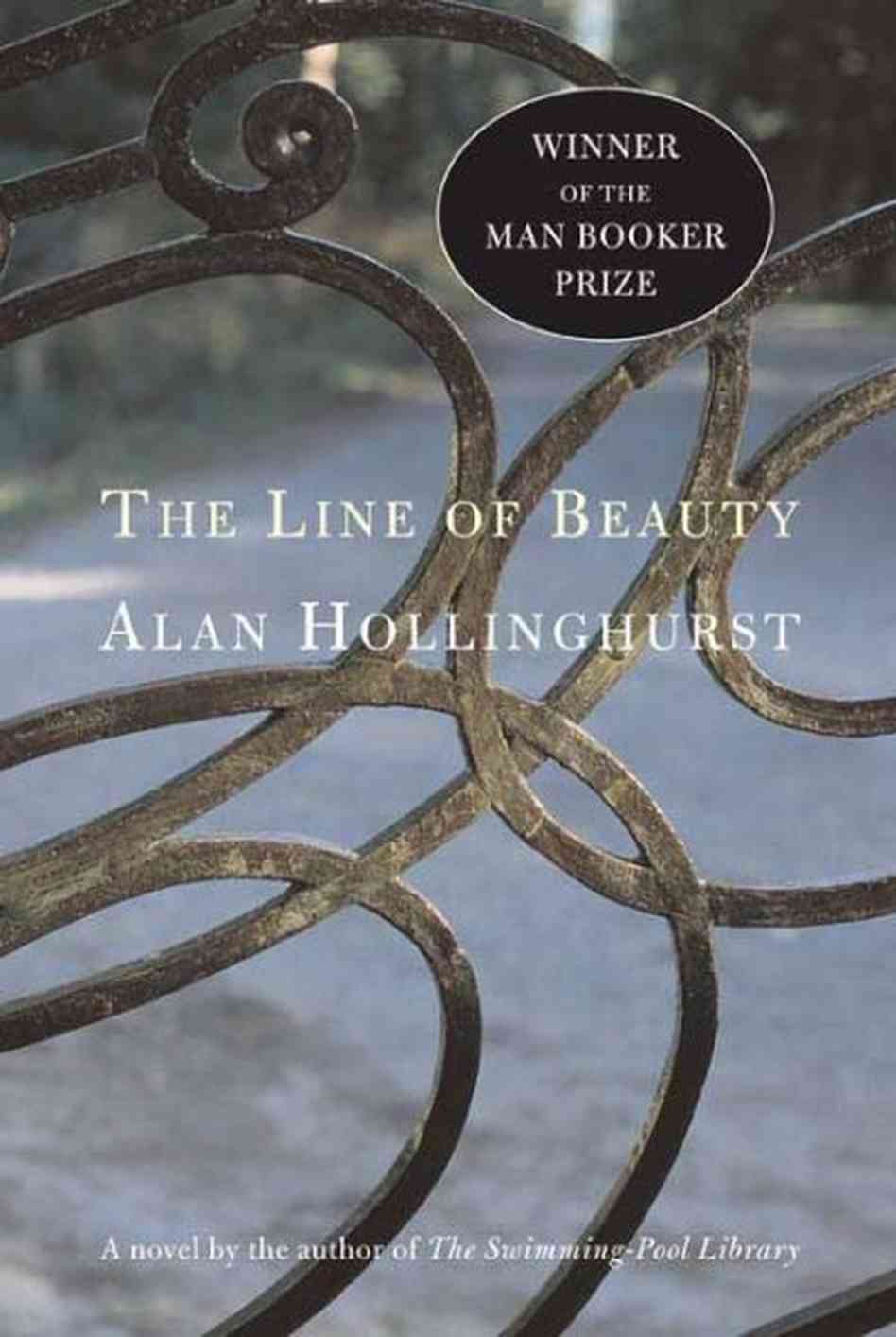
Front cover of Alan Hollinghurst's The Line of Beauty (2004)
Front cover of Alan Hollinghurst’s The Line of Beauty (2004)

I find it so easy to get lost in the elegance and artistry of Alan Hollinghurst’s The Line of Beauty. I originally planned to read this book in a day or two, but it took me a while longer simply because I was so enthralled and moved by the novel’s baroque descriptions and its aesthetic focus on issues pertaining to gayness and queerness during the 1980s. Blurring the lines between gay historical fiction, the Bildungsroman, and the novel of mannersThe Line of Beauty explores the lines that divide British upper-class and middle-class society, and the relationship between homosexual identity and class during the conservative boom in the United Kingdom under the rule of  Margaret Thatcher. Even more so, Hollinghurst’s novel offers readers an opportunity to examine the heartbreaking effects of AIDS during the rise of the disease.

The novel centers on the life and experiences of Nick Guest in his early twenties, as he graduates from Oxford University and begins a postgraduate degree in English at another university–where he specializes on the issue of style in the works of Henry James. Nick becomes close friends with Toby and Catherine, who are the children of Gerald Fedden, a wealthy Member of the British Parliament. Although Toby and Nick are best friends, Nick becomes very close and intimate with Catherine, a manic-depressive. Because of Nick’s ability to understand and help Catherine, Gerald invites Nick to stay in his mansion so that he can keep a watchful eye over his daughter. Nick stays at the Fedden residence for four years; here, he not only learns about the radical differences that exist between the lavish lifestyle of the Feddens and his own middle-class upbringing, but he also begins to explore his gay identity by dating  an older and much more experienced black council worker named Leo. Although Nick is out to the Fedden family, the issue of homosexuality instills a sense of discomfort in Gerald and his wife, Rachel. The family’s attitude towards homosexuality is made apparent early in the novel, when the family discusses the case of Hector Maltby, a junior minister of the Foreign Office who was caught having sex with a rent boy in his Jaguar:

The story had been all over the papers last week, and it was silly of Nick to feel as self-conscious as he suddenly did, blushing as if he’d been caught in a Jaguar himself. It was often like this when the homosexual subject came up, and even in the Fedden’s tolerant kitchen he stiffened in apprehension about what might carelessly be said–some indirect insult to swallow, a joke to be weakly smiled at. (22)

The residents of the Fedden estate are characterized not only by their social hypocrisy, but also by their silences: by refusing to talk of certain issues, they strive to act as if said issues are minor, non-consequential, and non-existent. As a matter of fact, Nick is characterized by his penchant for concealing or hiding information to assure that certain perceptions or attitudes are upheld in the Fedden residence. For instance, at the beginning of the novel, Nick discovers that Catherine, who has already attempted to harm herself, has been storing sharp tools within her bedroom. Rather than discussing this detail with Catherine’s parents, he decides to keep this information concealed to avoid upsetting Gerald and Rachel when they return from their trip. Nick not only conceals truths that he believes will upset the Fedden family, but he also has issues when it comes to separating fact from fiction–which leads to the manifestation of the vicious cycles that are so characteristic of postmodern texts:

In the course of their long conversations about men he had let one or two of his fantasies assume the status of fact, had lied a little, and had left some of Catherine’s assumptions about him unchallenged. His confessed but entirely imaginary seductions took on–partly through the special effort required to invent them and repeat them consistently–the quality of real memories. (24)

Sometimes his memory of books he pretended to have read became almost as vivid as books he had read and half-forgotten, by some fertile process of auto-suggestion. (48)

As evidenced above, Nick not only strives to conceal truth to uphold his social image, but he also fabricates stories to uphold a socially appealing facade. He frets when it comes to revealing his lack of knowledge or his lack of sexual experience–to the point where his fabrications become entirely real to him, or even worse, to the point where he deliberately forgets or represses truths about himself. This is perhaps most apparent when the novel, which is comprised of three parts, transitions from part one to part two. Part one, which takes place in 1983, concludes with Nick and Leo sleeping together in the Fedden’s house. The second part of the book takes place three years later, and it begins with a description of Nick’s affair with Wani Ouradi, a multi-millionaire of Lebanese descent who is engaged to a woman. This temporal leap leaves a gap in the narrative of the story. As readers, we have no clue what happened between Leo and Nick during this three-year span–all we are sure of is that they are no longer together, and that Nick’s relationship with Wani is masochistic and unhealthy. Not only is Wani into promiscuous and unsafe sex with strangers, but he is also addicted to porn and cocaine, and he is also deeply closeted. Nick, however, remains by Wani’s side not because the relationship is practical, but rather, because Wani is beautiful. This connects to one of the novel’s main themes, in which appearances trump pragmatics and livability. This desire for beauty and for appearance ultimately affects Nick’s ability to face his own truths, as is seen in the instance in which he encounters Wani seducing a stranger:

He went across the room and put the car keys down on the side table, and when he looked back Ricky and Wani were snogging, nothing had been said, there were sighs of consent, a moment’s glitter of saliva before a shockingly tender second kiss. Nick gave a breathy laugh, and looked away, in the grip of a misery unfelt since childhood, and too fierce and shaming to be allowed to last. (173)

Later on in the novel, Nick finds out that Leo has died due to AIDS-related complications. As Leo’s sister tells Nick the news, he at first wants to lie to her by stating that Leo dumped him, but he recognizes that this lie would seem petty, especially when considering the fact that Leo is no longer alive. Although Nick convinces himself that Leo was seeing someone else, we realize that he develops this “memory” to conceal the fact that he broke up with Leo soon after finding out that he was sick– “to screen a glimpse he’d had of a much worse story, that Leo was ill” (350). It becomes clear at this point that the three-year gap in the novel represents Nick’s unwillingness to deal with or recall the truths behind his relationship with Leo. Leo’s illness, in Nick’s eyes, would corrupt his beauty and make him imperfect, which is why he pursues a relationship with the physically flawless and beautiful Wani. However, towards the conclusion of the novel, it is revealed that Wani is also dying of AIDS-related complications–thus forcing Nick to meet truth face-to-face, while simultaneously forcing him to confront the realities of his own life.

I find it interesting that Catherine, the manic-depressive sisterly figure of the novel, is represented as the only person capable of dealing with truth and looking beyond the lies fabricated by her peers. For instance, when one of her friends, Pat, dies of AIDS, her family desperately tries to conceal that he died of this illness to prevent themselves being associated with a so-called “gay-related” disease. Catherine, however, forces the family to face the truth about Pat’s death, even though this confrontation leads to public shame and embarrassment. She later tries to convince Nick that “People are lovely because we love them, not the other way round” (304), to make him realize how toxic his relationship with Wani truly is, and to prove to him that the value that we bestow to people and objects should be based on more than just aesthetics. Catherine ultimately induces both the downfall of Nick and of her father, by revealing truths to the press: she not only reveals the fact that her father is having an affair with another woman, but she also reveals how Nick and Wani’s affair is taking place within the Fedden household–thus collapsing the differences between the gay and the straight world upheld by the Fedden family. The novel isn’t explicit of whether Catherine’s thirst for truth is triggered by her depression, or whether her depression was caused by her desire for truth in a mendacious environment–but it is interesting to observe how a character with a non-normative state of mind is able to look beyond the social masks and constructs that haunt the lives of these characters.

I love this novel. It is dense, thematically rich, and it is full of gaps and plot holes. It is not an easy novel to read or follow, but it excels at portraying the triumphs and failures of characters who are enticed and enslaved by the pursuit of beauty, even at the cost of truth, pragmatism, and reality. I also appreciate how this novel uses pastiche in order to invoke historical conceptions of AIDS in a contemporary platform–especially since discussions of AIDS have unfortunately diminished since the normativization of the disease due to the advent of anti-viral medications.

What are your thoughts or impressions of this novel? Feel free to add to this conversation!

You can purchase a copy of Hollinghurst’s novel by clicking here.

Work Cited

Hollinghurst, Alan. The Line of Beauty. New York: Bloomsbury, 2004. Print (hardcover edition).

The Role of Gender and Literature in Alison Bechdel’s [Fun Home]

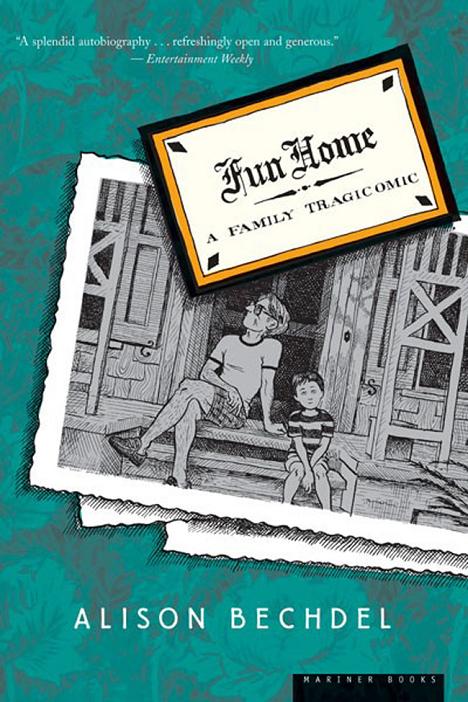
Front cover of Alison's Bechdel's Fun Home (2007 paperback version)
Front cover of Alison’s Bechdel’s Fun Home (2007 paperback version)

Originally published in 2006, Fun Home: A Family Tragicomic is a graphic memoir that led Alison Bechdel to commercial and critical success. Reminiscent of Art Spiegelman’s MausFun Home explores the relationship between Alison and her closeted father, Bruce Bechdel, to shed light on themes such as gender, the coming-out process, and the complicated dynamics of family life. The exploration of these themes are facilitated through discussions of death, life, and literature–triggered by Alison’s efforts to illustrate an accurate portrait of her complicated connection with her father, particularly after he commits suicide.

Alison and her father share many traits: they are both queer (even though the father remains closeted and married to his wife throughout the entire duration of the memoir), they both have a love for reading and for art, and they both wish that they were born the opposite sex. Despite these similarities, they never seem to forge a strong and intense bond due to their reserved personalities and their divergence in terms of gendered affiliations. Whereas Bruce tends to express traits that can typically be approached as feminine, Alison admits that she has been “a connoisseur of masculinity” (95) since she was a child. Thus, even though their share many similarities, their divergence in terms of their gender alignment creates significant tension between the two characters.

Not only does Alison approach herself and her father as “inversions” of each other, but she also makes note of how she struggles to emphasize her masculinity while her father struggles to prevent her from expressing it. She approaches her father’s attempts to feminize her as an almost pathetic effort embody femininity (vicariously) through his daughter, which leads to what Alison calls “a war of cross purposes” that is “doomed to perpetual escalation” (98). Thus, differences of gender are not invoked to uphold the division between men and women, but rather, to illustrate the differences and tensions that exist between Alison and her father.

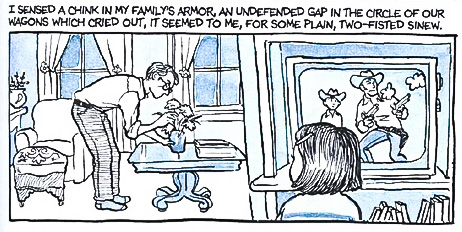
Figure 1. Page 95.
Figure 1. Page 95. Many of the images in Fun Home stress the dichotomous view of Bruce as a feminine presence and Alison as a masculine presence. In the image above, notice how Bruce engages in an activity that is stereotypically approached  as feminine. The wall unit splits this panel into two sections, thus highlighting Alison’s placement in front of the television showing a Western movie. Keep in mind that this memoir is not necessarily upholding gender binaries–a man with feminine characteristics and a girl with masculine characteristics, in due course, challenges the binary in the first place.

Bruce’s reserved and temperamental nature is attributed to the fact that he’s had to keep his sexuality a secret due to his upbringing in a society where homosexuality is considered a disgrace. It is suggested in the memoir that Bruce’s repressed nature, his wife’s request for a divorce, and the fact that Alison is able to live an open life as a lesbian (whereas he was not) are the events that prompt him to commit suicide by running in front of a truck. This suicide is the event that prompts Alison to explore her father’s life through memoir, while in turn coming to a more enlightened understanding of the influence that she and her father had on each other. This exploration, however, does not take place in a linear or organized fashion. Fun Home is as a pastiche or decoupage of many elements presented in a non-chronological fashion. The comic panels are supplemented by snippets of other literary texts, photographs, letters, and even newspaper clippings. Furthermore, the narrative itself is supplemented with Bechdel’s interpretations of the events that she lived, in addition to theoretical interventions from areas such as gender and psychoanalysis.

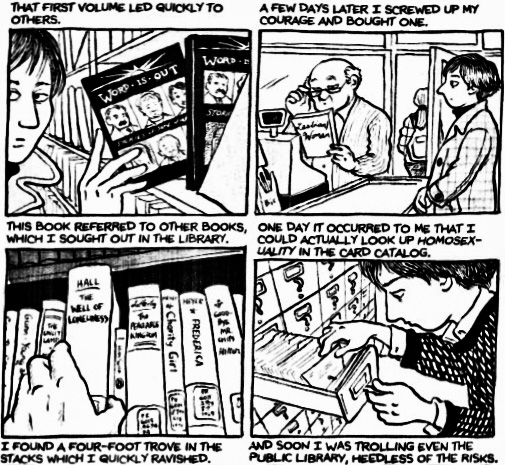
I am deeply interested in the role of literature and literary texts in Fun Home, not only because they add more depth and nuance to the memoir, but also because literature (particularly novels) is a crucial element that must be kept in mind when interpreting and understanding the central developments in the graphic memoir. For instance, literature is the catalyst that helps Alison to discover that she’s a lesbian–leading her to describe her lesbianism as “a revelation not of the flesh, but of the mind” (74). At the age of thirteen, she first encounters the word “lesbian” in a dictionary. She later reads a book focused on offering biographies of queer figures, which leads her on an obsessive mission to read and consume as many queer texts as she possibly can, such as E.M. Forster’s Maurice and Radcliffe Hall’s The Well of Loneliness. 

The very act of accessing and reading this literature is depicted as a deeply political and almost revolutionary act, for it entails developing the courage to buy these books in spite of their overtly queer titles, or to borrow them from public libraries, “heedless of the risks” (75). These books inspire her to attend a gay union meeting at her university, and to come out to her parents in a letter. Whereas her father seems quite accepting of her sexuality, claiming that “everyone should experiment” (77), her mother responds with mild disapproval, approaching her lesbianism as “a threat” (77) to her work and her family.

Figure 2.

Literature is associated with almost every single significant event that takes place in the novel. Alison’s first relationship blossoms when she meets a poet named Joan. Every time they are shown in bed together, they are surrounded by novels and other books. The images depict them reading even when being intimate with one another, and they critique and analyze books even when sprawled naked on their beds (see pages 80-81). The importance of books is her life is unsurprising when taking into account that her father was an English teacher at their local high school, and he spent a lot of time recommending and discussing books with Alison.

Even though Bruce engages in sexual acts with other men, and even boys, the memoir highlights novels and literature as the outlet of escapism that Bruce used to express his sexual frustrations, and even his subconscious sexual desires. His favorite books, such as Fitzgerald’s The Great Gatsby and Joyce’s Ulysses, touch upon matters and themes that are central to Bruce’s characterization. The Great Gatsby, for instance, highlights the pains of yearning for someone or something we cannot possess, whereas Ulysses depicts how characters can cross each other’s paths without affecting one another in a significant way (reflecting Alison’s complex relationship with her father). Given how closely Bruce’s books are tied to his suppression, his secrecy, and his hidden desires, it is no wonder that his wife gets rid of most of his book collection after he dies.

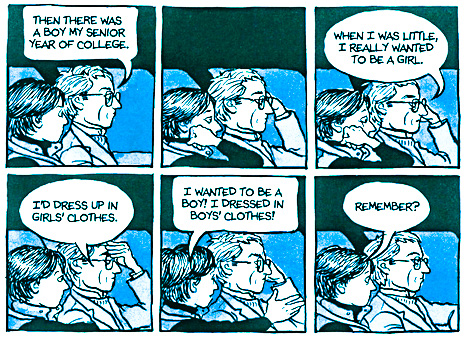
It is literature that allows Bruce and Alison to achieve a degree of closeness that they’ve never felt before. It turns out that Alison ends up taking English with her father in twelfth grade, and she realizes that she really likes the books that her father wanted her to read, such as J.D. Salinger’s The Catcher in the Rye. She becomes deeply invested in discussing these books with her father within the classroom–and her interest leads her to develop “a sensation of intimacy” (199) that she has never felt before with her father. When Alison leaves to college, she grows even closer to Bruce, calling him every once in a while to discuss the books that she reads for her English class. Their connection reaches a peak when Bruce lends his daughter a copy of Earthly Paradise by Colette (an autobiography with lesbian themes) even though she has not revealed her lesbianism to him. The book sparks a conversation between the two, leading Bruce to open and honestly discuss his sexual orientation with Alison for the first time.

Figure 1. Alison and her father have their first frank discussion regarding his sexuality. Although their relationship is cold and distant, this marks one of the moments in which they begin to grow closer to each other.
Figure 3. Page 221. Alison and her father have their first frank discussion regarding his sexuality. Although their relationship is cold and distant, this marks one of the moments in which they begin to grow closer to each other.

Literature becomes the agent that allows Alison to forge a connection with her father. Although she admits that her intellectual connection and her intimacy with her father is seen as unusual to other people, she still seems to thoroughly enjoy and appreciate it. Alison does, however, lament that they “were close. But not close enough” (225). However, despite the fact that they were not as close or as intimate as she wanted them to be, she cherishes the fact that “he was there to catch [her] when [she] leapt” (232).

I can’t even begin to describe how much I enjoyed this memoir. It is complex, rich, funny, heartbreaking, and deeply insightful. I’m sure that this book is going to contribute significantly to my academic work, and I can’t wait to re-read this memoir in the near future.

You can purchase a copy of Bechdel’s memoir by clicking here.

Work Cited

Bechdel, Alison. Fun Home: A Family Tragicomic. Boston: Houghton Mifflin, 2007. Print (Paperback edition).

Connection Failed: An Analysis of Christopher Isherwood’s [A Single Man]

Front cover of Christopher Isherwood's A Single Man (1964)
Front cover of Christopher Isherwood’s A Single Man (1964)

Failure is found at the heart of many great works of fiction. It is a common motif used to spark an emotional connection, sympathy, and at times, anger. Failure is not only the heart of Christopher Isherwood’s A Single Man–is also the blood, the flesh, and the soul of this novel. Centered on a single day in the life of George Falconer–a gay professor from England who teaches literature at a University in Los Angeles–A Single Man traces the protagonist’s psyche as he tries to cope with the stagnant nature of living, and his inability to feel a sense of belonging or connection with those who surround him. Suffering from a chronic depression triggered by the death of his lover (Jim), George desperately struggles to find solace through unsuccessful attempts at forging meaningful interactions and relationships with other people.

The opening event of the novel focuses on George as he wakes up in the morning. Here, we are offered a very detailed and biological account of the processes that take place as a sleeping body is galvanized into a state of alertness. This opening scene creates a split between George’s body and George’s being–a motif that becomes quite prominent within the novel. Throughout the day the novel takes place, George undergoes experiences that separate his thoughts from the actions that his body partakes in–almost as if his body were engaging in auto-pilot mode, leaving the pilot of his consciousness free to do and think whatever he pleases. This auto-pilot mode is activated in many occasions:

  • When George drives to his university, his thoughts wander away as his body automatically drives to its destination: “And George, like a master who has entrusted the driving of a car to a servant, is now free to direct his attention elsewhere” (36).
  • When he teaches, he enters a mode where he begins to spew theory, facts, and jargon without being completely cognizant of what he is saying to his students.
  • When he drinks, he engages in reckless behavior, such as swimming in a rough sea during the night, even though his mind is aware of the dangers of doing so.

The novel’s tendency of splitting George’s mind away from his body fosters an effect in which the reader perceives him as a composition of many selves and not as a single individual–thus emphasizing the novel’s central characteristic of approach life, time, and space as fragmented phenomena. This fragmentation, while very postmodern in effect, serves to illustrate the sense of disconnection and the lack of wholeness that George feels towards his surroundings. Even when looking himself in the mirror, George is unable to see himself as an individualized unit:

Staring and staring into the mirror, it sees many faces within its face–the face of a child, the boy, the young man, the not-so-young man–all present still, preserved like fossils on superimposed layers, and, like fossils, dead. Their message to this live dying creature is: Look at us–we have died–what is there to be afraid of? (11)

While staring at his reflection, George sees the phantoms of his past lives–lives that he considers present but dead; relics of a life that he used to have but that is no longer present. George recognizes this fragmentation, and he struggles to defy it so that others perceive him as ‘the whole George they demand and are prepared to recognize” (11). George is characterized by being overly concerned about what other people think about him. When other characters are talking to him, George’s mind engages in a frantic interpretive mode in which he tries to determine what is going through the other speaker’s mind. However, the inability to know exactly what others are thinking of him leads George to think obsessively about the failure of language to convey ideas in an accurate or precise fashion. Language, therefore, is a contributing factor that adds to George’s notions on fragmentation and the lack of wholeness in his life.

George’s nationality and his sexuality are other elements that fuel his sense of self-fragmentation and his inability to fully connect with others. He constantly claims how his British identity converts him into an Other within academic and non-academic contexts. His sexuality pushes him to feel a desire that is nearly impossible to quench–thus forcing George to live vicariously through small interactions, touches, and brief exchanges that he has with other men. One of these moments takes place when he accompanies one of his students, Kenny, to a book store. Kenny offers to buy George a pencil sharpener, which causes George to blush “as if he has been offered a rose” (81). What is clear here is that George is a man who is starving for connection. He craves to feel part of whole, even if this connection with the whole is momentary. He makes it overtly clear that his nationality, his way of thinking, his sexuality, and even his age puts him in a position in which he is minority. This sense of dissatisfaction with not belonging to a majority leads him to deliver a “sermon” in class, in which he attacks people’s conceptions of minority communities:

A minority has its own kind of aggression. It absolutely dares the majority to attack it. It hates the majority–not without a cause, I grant you. It even hates the other minorities, because all minorities are in competition: each one proclaims that its sufferings are the worst and its wrongs are the blackest. And the more they all hate, the more they’re all persecuted, the nastier they become! Do you think it makes people nasty to be loved? You know it doesn’t! They why should it make them nice to be loathed? (72)

His passionate tirade against minority cultures is longer than the fragment I’ve included above, but I hope this passage emphasizes the degree of self-loathing and confusion that George feels towards himself for being unable to become part of a greater collective. He always has been and always will be a minority. His efforts to be part of something greater than the self always fail–even the connection that he had with Jim is severed with the latter dies in a tragic car accident. George even admits that he is living makes him part of a minority, while those who have joined the rank of the dead are part of a majority:

George is very far, right now, from sneering at any of these fellow creatures. They may be crude and mercenary and dull and low, but he is proud, is glad, is almost indecently gleeful to be able to stand up and be counted in their ranks–the ranks of that marvelous minority, The Living. They don’t know their luck, these people on the sidewalk, but George knows his–for a little while at least–because he is freshly returned from the icy presence of The Majority, which [his dying friend] is about to join. (103-4)

This passage is an eerie foreshadowing to the events that culminate the novel. As George is drunkenly walking towards his usual bar after leaving his friend’s house, he encounters Kenny alone at said bar. The two get really drunk, and they end up swimming together naked in the salty rough waves of the sea in the middle of the night. It is here that George feels a brief connection with Kenny that “transcends” the symbolic. Kenny returns home with George, leading into a scene that seems like an obvious exchange of flirtation between the two. However, despite the fact that George desires to sleep with Kenny, he ends up passing out, awakening alone in his bed–where he decides to masturbate as a way of compensating for his failure to connect with Kenny, sexually speaking.

As the novel comes to a close, George ends up in his bed once again. In a circuitous fashion, the novel ends with George’s mind disconnecting from his body, returning once again to the description of the biological processes that his body is going through as it begins to fall asleep. Unexpectedly, George dies of a heart attack during his sleep. George’s life is characterized not only by a failure to connect with others, but also by a failure to be part of a whole during his life. It’s thus heart-wrenching to realize that the only instance in which he becomes part of a majority is through his death.

This novel is simply beautiful, rich, and complex. There is much more than can be said about this novel, especially in terms of its approaches to time and temporality, especially when contrasting the importance of the past, the present, and the future. This is definitely a novel that I want to revisit once again after I’ve had time to process it a little more.

Comments? Questions? Suggestions? As always, please feel free to add to the conversation!

Work Cited

Isherwood, Christopher. A Single Man. New York: Simon and Schuster, 1964. Print (Hardcover edition).

On the Decentralization of Truth and Memory in Achy Obejas’ [Memory Mambo]

Front cover of Achy Obejas' Memory Mambo (1996)
Front cover of Achy Obejas’ Memory Mambo (1996)

Achy Obejas’ Lambda Award-winning novel, Memory Mambo, is a text that simmers and lingers within the mind long after it is read. I initially decided to read this novel because it centers on the life of a Cuban-American lesbian who administrates a laundry service in the Midwest, however, it is a much more complex and rich read when compared to your average LGBTQ novel. True to its name, I would say that this text is ultimately an exploration of the strengths and fallacies of memory, especially when it comes to understanding and interpreting of truth. Even more so, Memory Mambo, at least in my view, is a novel that is first and foremost about decentralization–or in other words, the redistribution of power and control away from a central unit or “command” center. In the case of this novel, decentralization is focused mostly on the self, and it illustrates how the self is unable to account for the totality of memory and the totality of experience.

Similar to Sandra Cisnero’s 1984 novel entitled The House on Mango StreetJuani, the novel’s protagonist, is not only characterized through her own experiences and trials, but she is also characterized through elaborate stories concerning her relatives and her extended family. The novel is difficult to summarize due to its fragmented and chaotic focus. It begins with Juani questioning the nature of memory as she looks back at her childhood in Cuba. As a child, Juani and her parents escaped to the United States on a boat in an effort to leave behind the social and political climate of the island. The narrative segues into an exploration of Juani’s close family members, such as her mother, her father, her siblings, and her cousins. The first chapter focusing exclusively on her father is very revealing in terms of the novel’s aims and themes. He is described as a fabricator of stories. For instance, he claims to be the inventor of duct tape, and he also accuses the CIA of stealing his invention. The father tells this story to every person he encounters, and every time, the father bends the truth to suit his moods and to appease his audiences’ tastes. The father’s tendency to fabricate and alter stories reifies the novel’s aim of highlighting the flexible and malleable nature of truth, in addition to illustrating how truth and memory are dependent on others besides the self.

Although the novel has multiple story arcs, there are two in particular that stand out:

  • The tumultuous relationship between Juani’s cousin, Caridad, and Caridad’s husband, Jimmy. Jimmy is a chauvinistic, sadistic man who abuses Caridad emotionally and physically–doing things such as beating her, preventing her from going out, and going as far as to buy Caridad a washing machine even when her family owns the local laundry-mat. Juani and Jimmy loathe each other, mostly because Jimmy perceives Juani to be the same way he is. Jimmy perceives Juani’s lesbianism to be a threat, and he is constantly trying to sexually harass her, claiming that she is nothing but a victim of penis envy. One of the novel’s highest poinst of tension occurs when Jimmy covers up a violent incident that Juani is involved in, in order to make Juani feel as if she is indebted to him. Because of this “debt,” Jimmy tries to persuade Juani to cover for him after he is caught sexually molesting Rosa, the baby of Juani’s cousin, Pauli.
  • The “main” arc of the novel would be Juani’s unstable relationship with Gina, a Puerto Rican socialist and activist with strong political convictions and views. Gina is approached as a hypocrite by other characters because although she claims to be a feminist and an activist, she is deeply closeted and refuses to show any signs that she’s going to come out: “Gina wasn’t out, didn’t have any plans to come out, and wasn’t in a hurry to even consider it. For Gina, what we had was wonderful, but passing; thrilling, but temporary; an adventure, but only for memory’s sake” (121). Juani finds herself in a position in which she significantly has to change who she is in order to please Gina–she changes everything from her taste in music to her taste in clothing in order to appeal to Gina’s environmentalist and feminist sensibilities. Gina’s closeted sexuality in addition to her radically different political ideologies, lead to the escalation of tension between her and Juani. This tension explodes with a brutally violent fight between the two women, which leads to broken noses and bitten breasts. Their fight is the incident that Jimmy helps to conceal in order to assure that Juani’s family doesn’t get upset with her.

This novel, as can be seen above, is very violent and charged, but the deep and almost philosophical musings that take place in the narrative certainly compensate for the presence of many shocking and disturbing scenes. Seeing as the novel centers immensely on the notions of memory and truth, I was often captivated and intrigued by the difficulties that Juani had when it came to understanding and accepting events and realities in her life. The first chapter of the novel eloquently opens with a questioning of memory as a distinct, individualistic, and unified phenomenon–leading Juani to question whether her memories are constructions based on the stories told by other people. Because of this, the divides between fact and fiction, and lived reality and narrated reality, collapse from the get go. Even more so, Juani seems to approach memory as an entity that is shared amongst many people–memory, in this case, is approached as a decentralized phenomenon:

Sometimes I’m sure that I couldn’t have heard the stories about the memories anymore than lived through them–that both of the experiences are false for me–and yet the memory itself will be so fresh, so fantastic and detailed, that I’ll think maybe my family and I are just too close to each other. Sometimes I wonder if we’re not together too much, day in and day out, working and eating side by side, sleeping in the same rooms, fusing dreams. Sometimes I wonder if we know where we each end and the others begin. (9)

What I find fascinating about this passage is that memory, rather than being approached as a hard drive or a disk, seems to be depicted in a fashion that is more reminiscent of an internet network, in which memory is shared, interconnected, fragmented, and alterable. In Memory Mambo, it is clearly shown that most of the novel’s major tensions and issues surface when truth, like memory, is approached as an individualistic and solitary force, when in reality, most of these problems could be solved if only the truth were shared and decentralized in a similar fashion to memory. This notion is exemplified with Juani’s discussion of her lesbian cousin, Titi, who has tried to escape Cuba, unsuccessfully, several times. Although Titi does have affairs with other women, these affairs must remain private within the insular confines of Cuba. Juani believes that Titi’s desire to escape Cuba is fueled by her longing to express truth beyond the confines of the private. As Juani asserts, all of Titi’s lovers are unable to satisfy her need “to be loved in daylight–to walk down the street arm in arm with her lover without the pretense of a mere friendship, to be utterly and ordinarily in love” (76).

Titi’s issues mirror Juani’s own issues when it comes to her sexuality. Juani admits that she creates a divide between her family life and her sexuality, deliberately maintaining borders and distance in order to assure that her family isn’t disrupted or disturbed by Juani’s non-normativity. Juani walks the balancing line between complete honesty and secrecy–tethering truth to the unstable power of language. What I mean by this is that although Juani’s family knows about her lesbianism, they do not speak about it because it would reify certain details of Juani’s life that would tarnish the family’s so-called normalcy. Juani’s father, in particular, never seeks the truth from his daughter, and he even goes as far as to help Juani conceal the truth about her sexuality when other family members are probing her. His motivations for doing so are quite selfish and heartbreaking: “His motivation isn’t to spare me discomfort but to save himself. Because he’s afraid I won’t lie, it’s vital to him that I not be provoked into the truth. In my family, this is always the most important thing” (80).

It is when Juani is provoked into truth that she realizes how fragmented and decentralized memory truly is. This moment of truth takes place when Gina asks Juani whether she would have left Cuba if she were old enough to make a choice. This question leads Juani to take a close look at her childhood, but this attempt at introspection is thwarted by her inability to recall any real or factual memories during her time at Cuba:

And I realized that I’d left Cuba too young to remember anything but snatches of color an scattered words, like the cutout letters in a ransom note. And what little I could put together had since been forged and painted over by the fervor, malice and nostalgia of others. What did I really know? And who did I believe? Who could I believe? (133)

In due course, Memory Mambo approaches truth and memory as anything but stable and individualistic phenomena. The end of the novel becomes even more suggestive as Juani deliberately tries to deny or recognize the truth of witnessing Rosa being molested by Jimmy. However, her attempt to avoid remembering this instance is ruined when she discovers that her other cousins know the truth about the incident, leaving Juani in a position in which she is unable to lie or conceal the truth. This final incident goes on to exemplify how truth and memory are decentralized agents, and how they exist in networks that cannot be suppressed or contained.

This novel is definitely worth a read. I can’t even begin to list the wide range of emotions that I felt when reading this book, and my mind is currently on overdrive trying to process everything that it is discussed within its pages. The prose is simple to read, but the structure and ideas present in this work are anything but simple.

As always, feel free to add to this conversation in the comments section below!

Work Cited

Obejas, Achy. Memory Mambo. Pittsburgh: Cleis Press, 1996. Print.

For the source of this post’s cover image (neurons), click here.

Gender and Non-Normativity in Jeanette Winterson’s [Oranges Are Not the Only Fruit]

Front cover of Jeanette Winterson's Oranges Are Not the Only Fruit (1985)
Front cover of Jeanette Winterson’s Oranges Are Not the Only Fruit (1985)

Oranges Are Not the Only Fruit (henceforth OANOF) is a 1985 Bildungsroman (novel of development) centered on the life of Jeanette, a girl who is adopted and raised by a woman who happens to be a fundamentalist Christian. Jeanette’s mother believes in literal translations of the Bible, and she freely uses religious rhetoric to accommodate her black and white fashion of viewing the world. As Jeanette, the narrator, mentions early on in the novel, her mother “had never heard of mixed feelings. There were friends and there were enemies” (3). Although Jeanette happens to feel greatly connected to her church and her church’s teachings, this fidelity towards the supposed perfection of the church becomes challenged as she realizes that she is sexually and romantically drawn towards women. OANOF focuses most of its attention on the tensions and frictions that spark when Jeanette’s sexual life clashes with her religious life, and on the drastic measures that her church takes to drive the “demon” of “unnatural passions” away from her.

Although Jeanette’s development and moral growth is most certainly the focus of this novel, a lot of the content is focused on her strange relationship with her mother, and even more so, on the mother’s blind and ritualistic devotion to her church. The mother desperately tries to shield Jeanette from evils, especially those associated with gender and sexuality. For instance, when Jeanette develops a friendship with an ostensibly lesbian couple that runs a paper shop, the mother soon forbids Jeanette from going to that store because there was a rumor that “they dealt in unnatural passions” (7). Seeing as the mother doesn’t speak to her daughter about matters of gender, sexuality, and the body, Jeanette naively believes that “unnatural passions” are referring to the fact that the couple puts chemicals in their sweets.

This desire to protect Jeanette from evil, in addition to the mother’s penchant for explaining phenomena using religious rhetoric, makes it increasingly difficult for Jeanette to adjust to the outer world. For instance, Jeanette goes deaf for three months in the novel. Rather than taking Jeanette to the hospital, the mother begins to inform everyone that Jeanette is “in a state of rapture” (23), and she prevents people from speaking to her. It is Miss Jewsbury, a closeted lesbian, who brings Jeanette to the hospital to be treated for her condition. Jeanette realizes that her condition is due to biological processes rather than spiritual rapture, and it is in this moment that she begins to question the perfection and infallibility of her church:

Since I was born I had assumed that the world ran on very simple lines, like a larger version of our church. Now I was finding that even the church was sometimes confused. This was a problem. But not one I chose to deal with for many years more. (27)

It is in this moment that Jeanette begins her process of development and maturation: it is the moment in which she realizes that her mother doesn’t have all of the right answers, and neither does the church. Thus, rather than resorting to donning the mother’s ideological perspective of the world, which consists of viewing things as either good or bad, Jeanette must learn to challenge herself to explore areas of contradiction and ambiguity that do not necessarily conform with the notions of right or wrong.

It is  during Jeanette’s time time at the hospital that that the motif of oranges becomes heavily introduced into the narrative, for her mother constantly sends her oranges along with some “get better soon” letters when she doesn’t have the time to visit Jeanette. Throughout the novel, the only fruit that Jeanette’s mother will give to her is the orange, for it is “The only fruit” (29). Little is said as to why oranges are deemed to be the only fruit worthy of consumption. However, the meaning behind the orange is not necessarily based on the fruit itself, but rather, on how the fruit is used. First and foremost, oranges become a way of further characterizing Jeanette’s mother, showing how she perceives the world categorically, and showing how she desires to limit the options that Jeanette can have. Furthermore, since oranges are the only fruit that are validated from the mother’s perspective, all of other fruit go on to lack legitimacy. Much later on in the novel, when Jeanette gets slightly ill, her mother brings her a bowl of oranges, and the following scenario takes place:

I took out the largest and tried to peel it. The skin hung stubborn, and soon I lay panting, angry and defeated. What about grapes or bananas? I did finally pull away the other shell, and, cupping both hands round, tore open the fruit. (113)

In this context, it becomes a little more clear that oranges are representing either gender or heterosexuality. By questioning why she can’t have other fruit, Jeanette puts into question the limitations that are imposed on her in terms of her choices and preferences. Notice that she has trouble accessing the orange’s pulp, which can symbolize the difficulty that Jeanette has towards complying with a simplistic, limited, heteronormative view of the world. It would be much easier for her to eat grapes or bananas, however, we observe that Jeanette’s mother is still coercing her to struggle with oranges.

The entire spectrum of fruit, in this interpretive view, would go on to represent the entire spectrum of gender–the mother’s efforts to impose oranges as the only good fruit go on to represent efforts to approach a single gender or sexual orientation has valid and legitimate. As can be expected, the mother’s views toward fruit also apply towards her views on gender and sexuality: “I remembered the famous incident of the man who’d come to our church with his boyfriend. At least, they were holding hands. ‘Should have been a woman that one,’ my mother had remarked” (127). This leads Jeanette to one of her many philosophical musings, in which she recognizes the fact that her mother is unable to interpret the world without resorting to the use of binaristic thinking. Instead of accepting the fact that these two men are, in due course, simply men, she resorts to approaching one of the men as a woman. But, as Jeanette remarks:

This was clearly not true. At that point I had no notion of sexual politics, but I knew that a homosexual is further from a woman than a rhinoceros. Now that I do have a number of notions about sexual politics, this early observation holds good. There are shades of meaning, but a man is a man, wherever you find it. (128)

The desire to steer away from convention and normativity is a staple of this novel. Just as Jeanette desires another fruit besides an orange, she also desires to be romantically involved with someone besides a man. Jeanette’s penchant for non-normativity is even expressed in her artistic inclinations and projects. While Jeanette is in school, she truly strives to win a prize in the school’s various artistic competitions. While at first she loses these competitions because of her adherence to religious doctrine, she notices that she still continues to lose competitions even when she presents projects that are non-religious in their themes. For instance, in an Easter Egg painting competition, Jeanette creates an elaborate diorama that recreates a scene from Richard Wagner’s Der Ring des NibelungenHowever, she loses to a a student who covers eggs in cotton in order with the title of “Easter Bunnies” (48). Jeanette realizes that even though her masterpiece was definitely the best project submitted to the competition, she loses simply because she steers away from convention. Rather than creating a habitual Easter-themed project for the competition, she strives to be different and creative, which essentially makes Jeanette a queer character in many other aspects besides her sexuality.

As I mentioned previously, Jeanette’s queerness certainly causes her a lot of pain and heartache, which is perhaps epitomized when she is publicly accused for being a lesbian while in church. The church members deem that Jeanette and her girlfriend, Melanie, have engaged in homosexual activity because they are possessed by demons. This accusation sparks a lot of commotion in the church, and thus, one of the most confusing and convoluted sections of this novel takes place. After the accusation, Jeanette escapes the church and goes to Miss Jewbury’s home. Miss Jewbury does her best to comfort Jeanette, and out of the blue, the two have sex: “We made love and I hated it and hated it, but would not stop” (106). When Jeanette returns home after her encounter with Jewbury, the tension of the novel escalates to an unprecedented degree as members of her church congregation perform an intense exorcism on her. The members stay from 8:30 a.m. to 10:30 p.m. “praying over [her], laying hands on [her], urging [her] to repent [her] sins before the Lord” (107). The exorcism ultimately culminates with Jeanette being locked up in a room for 36 hours without food, and she only claims to be repentant in order to get access to food.

The resolution and “conclusion” of the novel focus on Jeanette becoming closely involved with the church as she also begins a relationship with a new church member named Katy. Contrary to the beliefs of her congregation, Jeanette firmly believes that her spiritual and sexual life are able to coexist. She is soon caught in a compromising situation with Katy, and her mother proceeds to kick her out of their home. This so-called failure pushes Jeanette to move to a city and start a new life–while unfortunately being deprived of her family and her history. She eventually returns to her old home to visit her mother, who seems to express a degree of ambivalence towards Jeanette–they do talk, but they never discuss Jeanette’s love life. The conclusion, however, shows a surprising revelation: Jeanette’s mother starts its first mission with black people–and she serves them pineapple because “she thought that’s what they ate” (172). Because of this, Jeanette’s mother ends up eating many dishes with pineapple in it, while claiming, philosophically, that “oranges are not the only fruit” (172). Thus, while the novel certainly ends in a sad note, indicating that many people still believe that Jeanette is possessed, the mother’s acceptance of other fruit leads the reader to believe that perhaps the mother is not viewing the world in the conceptually simplistic fashion that she used to. Just like white and black communities are starting to coexist in the mother’s church, the mother’s black and white conceptual distinctions start to blur.

On a personal note, this novel is fabulous. It is touching, shocking, and even funny at times. This novel is definitely a cornerstone of LGBTQ lit, even though the author does not necessarily consider OANOF to be a lesbian novel.  While I do recognize the universality of the themes present in the novel, I can particularly see how LGBTQ readers would appreciate and love this masterpiece.

You can purchase a copy of Winterson’s novel here.

Thoughts? Comments? Opinions? Please feel free to engage in this conversation using the comments section below!

Work Cited

Winterson, Jeanette. Oranges Are Not the Only Fruit. London: Pandora, 1989. Print (paperback edition).

Masculinity in Robert Cormier’s [The Chocolate War]

Front cover of Robert Cormier's The Chocolate War
Front cover of Robert Cormier’s The Chocolate War

It’s 1:53 a.m. and I currently can’t sleep because of this book. I was going to wait and write about it in the morning, but I really need to engage in the cathartic process of writing in order to make sense of all of the thoughts that are fireworking in my head. I was expecting a tale that discusses the triumph of good over evil–a tale of empowerment for individualistic resistance over systematic injustice. I received the opposite. Don’t get me wrong, I think The Chocolate War has earned a place in my top-ten list of favorite YA novels, but I will warn you that the book is ultimately very bleak and depressing. If your positive judgment of a book depends on a happy ending, then I suggest that you skip this novel.

The Chocolate War is a book that is told from a subjective third person point-of-view, but this perspective carousels through the thoughts and emotions of particular students at Trinity School: a private, religiously-affiliated high school in the New England area. Although the story centers on the thoughts of various students in the school, it can be said that Jerry Renault is the novel’s protagonist, and he is also the source of the novel’s main tension. Although the Trinity School is technically run by the Brethren that teach and administer the educational system, the thoughts and actions of students are also dictated by a secret school society known as The Vigils, who use scare tactics and intimidation in order to secure their influence.

Students are often given “assignments” by The Vigils, which can be approached as a type of hazing that the secret society uses to assure that it is perceived as a force to be reckoned with. Assignments can include mundane things such as forcing students to get up from their seats every time a teacher mentions the word “environment,” to more serious matters, such as destabilizing all of the desks and chairs in a classroom. During the school’s annual chocolate fundraiser, Jerry Renault is given the assignment to deny selling chocolates for ten days–a problem, seeing as every student besides Renault decides to sell chocolate. The main issue in the novel arises when Jerry continues to resist selling chocolates after the ten day period in an act of defiance towards The Vigils and the school administration. The bulk of the novel focuses on the ostracism that Jerry faces when trying to defy The Vigils, and the measures that they take to assure their power and dominance in Trinity School. By taking a stand, Jerry tries to follow and understand the words of T.S. Eliot by asking himself whether he dares to “disturb the universe,” (see Eliot’s “The Love Song of J. Alfred Prufrock“) a quote found on a poster that Jerry has in his locker.

The Chocolate War is a very gendered novel, which is partly unsurprising given the fact that Trinity School focuses on single-sex male education. Various elements within the novel emphasize maleness and the traits that are usually (and stereotypically) associated with it, such as power, dominance, and violence. Sports such as boxing and football are the most popular and revered activities that take place within the school; their practice often demonstrates how physical prowess often trumps intelligence and creativity in this environment. All teachers within the school are religiously affiliated men, and they are addressed as Brother by students. As a matter of fact, there is little to no feminine or maternal presence in the novel. When girls are mentioned by students, they are usually presented as objects of sexual attraction. Even Jerry is known for his lack of a maternal figure, since early in the novel it is established that his mother passed away during the spring before his freshman year (the time period in which the novel takes place). This lack of a feminine presence is in no way a mishap, and it actually serves as a motif to foreground the power struggles and dynamics that are in the heart of The Chocolate War. 

The characters’ efforts to uphold a visage of traditional masculinity is overwhelming. Whenever certain characters, such as Archie (the novel’s twisted and manipulative villain), encounter another figure that is trumping them in terms of authority, they automatically regress into an irrational inner struggle of Patrick Bateman-esque proportions. Take for instance, Archie’s reaction when The Vigils’ president threatens him:

Blood stung Archie’s cheeks and a pulse throbbed dangerously in his temple. No one had ever talked to him that way before, not in front of everyone like this. With an effort he made himself stay loose, kept that smile on his lips like a label on a bottle, hiding his humiliation. (187)

Many other characters in the novel are unable to contain their fits of tears and frustration when encountering the many injustices triggered by the rule of The Vigils. However, the most salient trait that is exemplified through this constructed masculine space would be violence–not only subjective violence, as in fist-fights, bullying, and physiological reactions, but also objective violence as represented through hate speech and through the manipulation and control enforced by the secret society and the school administration (please see Zizek’s Violence for more information on these types of violence). At first, Jerry’s decision to refuse selling chocolates can be considered an act of resistance towards the objective violence that is systematically imposed upon all students at Trinity High. The downward spiral for Jerry, however, occurs when this objective violence flourishes into downright brutal and subjective violence. The moment of this transition is seen quite literally in the novel, when a bully by the name of Janza is blackmailed into harassing Jerry to the point that he reciprocates violence with more violence (rather than resistance). As can be seen in the following exchange between Jerry and Janza:

“Hiding what? Hiding from who?” [Jerry]

“From everybody. From yourself, even. Hiding that deep dark secret.”

“What secret?” Confused now.

“That you’re a fairy. A queer. Living in the closet, hiding away.”

Vomit threatened Jerry’s throat, a nauseous geyser he could barely hold down.

“Hey, you’re blushing,” Janza said. “The fairy’s blushing . . .”

“Listen . . .” Jerry began but not knowing, really, how to begin or where. The worst thing in the world–to be called queer. (211-212)

After this exchange, Jerry retorts by calling Janza a “son of a bitch,” which leads Janza to summon a group of kids that brutally bash Jerry. Note here that what fuels Jerry’s wrath is the fact that he is called queer. Up to that point, he had done a decent job of resisting the taunts and threats of his peers due to his refusal to sell chocolates. What I find interesting in this chapter is that in essence, Jerry can be approached as a queer (or non-normative) character due to the fact that he denies engaging in the activity that will make him normal or orthodox–if he didn’t want to set himself apart, all he had to do was sell chocolates. His resistance, however, can be approached as queer resistance because he wanted to break away from the norm: “Mainly, he didn’t want to fight for the same reason he wasn’t selling the chocolates–he wanted to make his own decisions, do his own thing, like they said” (211).

Despite his penchant for non-normativity, being called a queer was too offensive and disruptive given the masculine attitudes that permeate his surroundings. Thus, Jerry’s hatred towards Janza for calling him queer even pushes him to engage in the boxing match at the end, a boxing match that leads to his demise. The final chapters of the novel end with Jerry proclaiming his regret towards being non-normative, he proceeds to think about how one must ultimately comply with the will of “superior powers” and authority figures if one desires to have a livable life. He thinks about the new “knowledge” he has obtained as he lies bloodied and broken in the arms of his friend, Goober:

He had to tell Goober to play ball, to play football, to run, to make the team, to sell the chocolates, to sell whatever they wanted you to sell, to do whatever they wanted you to do. He tried to voice the words but there was something wrong with his mouth, his teeth, his face. But he went ahead anyway, telling Goober what he needed to know. They tell you to do your thing but they don’t mean it. They don’t want you to do your thing, not unless it happens to be their thing, too. It’s a laugh, Goober, a fake. Don’t disturb the universe, Goober, no matter what the posters say. (p. 259)

The ending may be bleak and downright depressing, but I don’t necessarily think that the novel is designed to perpetuate a dislike of rebellion, nor do I think that it presents all resistance movements as futile. I think that Jerry’s loss of faith in himself and in his ability to disturb the universe rests not on his failure, but on the fact that he was left alone in his pursuit of non-normativity. What I found deeply disturbing is that nobody takes a stand for Jerry during the boxing match that leads to his demise, not even his close friend, Goober, who just sits and watches Jerry be beaten to a pulp with the rest of the students from Trinity High. Without a doubt, Jerry is presented as a scapegoat figure, meant to absorb all of the negativity, the tensions, and the evils of his community that are perpetuated through masculinity and through corrupt power.

The novel is ambiguous in terms of its stance on disturbing the universe. On one hand, we can accept Jerry’s defeat as a cautionary tale. On the other hand, we can accept it as a challenge to ourselves–a challenge that pushes us to question the extent to which we can or should disturb the universe ourselves.

Do yourself a favor, and read the book! And as always, please feel free to add to this conversation or to challenge anything discussed in this post!

You can purchase a copy of Cormier’s novel here.

Work Cited

Cormier, Robert. The Chocolate War. New York: Dell Laurel-Leaf, 1974. Print.