J.C. Lillis’ [How to Repair a Mechanical Heart]: A Gay YA Novel on Fandom, Religion, and Canonicity

Front cover of J.C. Lillis' How to Repair a Mechanical Heart (2012)
Front cover of J.C. Lillis’ How to Repair a Mechanical Heart (2012)

If there is one thing that gay young adult fiction should be thankful for, that thing would be the internet. Because of the advent of the web, we have witnessed the increase of self-published e-novels distributed through online stores such as Amazon and Barnes and Noble. Self-publishing, in my opinion, greatly expands the possibilities of gay young adult fiction, not only because authors are free to be more experimental and explicit when it comes to the novel’s content and structure, but also because they do not have to comply with the expectations and demands of a publishing house or an editor. J.C. Lillis’ How to Repair a Mechanical Heart (2012) is definitely one of the most unique gay YA novels that I have read this year, not only in terms of its content, but also in terms of its narrative techniques and devices. Although, on the surface level, the novel is centered on the blossoming relationship between two teenage boys, How to Repair a Mechanical Heart, offers readers a fresh take on the uneasy tension that exists between religion and homosexuality.

Now, religion is a topic that is found in many YA books dealing with homosexuality. Some of these novels, such as Alex Sanchez’s The God Box, take a more didactic and realistic approach to the issue, going as far as to present characters that discuss homosexuality by directly citing a barrage of Biblical rhetoric. Other novels, such as Timothy Carter’s Evil?, take a more fantastical and satirical (and hilarious) approach to the tension between religion and homosexuality through the incorporation of characters such as demons and fallen angels. How to Repair a Mechanical Heart tackles the issue of religion and homosexuality through a realistic approach, however, the exploration of this issue is framed through an exploration of fandom subculture. Although at first I was skeptical about whether a gay YA novel could pull off discussing tough issues through fan culture (which includes Comic Con-esque events, the reading and creation of fan fiction, and even the critique of television shows via vlogs), by the end, I thought that Lillis managed to pull it off beautifully. This novel turned out to be an entertaining, complex, and funny read in spite of its often heavy-handed themes and events.

The novel focuses on Brandon and Abel, two fans of a science fiction show entitled Castaway Planet. This show centers on the space adventures of two main characters: Cadmus, a hot-headed, impulsive, and unpredictable explorer; and Sim, an android who is intelligent, calculating, and incapable of feeling human emotion. Brandon and Abel are the hosts of a Castaway Planet vlog, where they deconstruct episodes of the television series, and where they offer critiques of Castaway Planet fan fiction that they dislike. The fan fiction that really grind their gears, however, would be those that ship Cadmus and Sim, for they deem that this relationship is absolutely implausible and disjointed from the themes and reality of the show. Their dislike for this type of fan fiction leads them to partake on a road trip across the country with their friend, Bec, in order to interview the show’s actors in hopes of discrediting any fanfic author who ships Cadmus and Sim. Their anger toward this shipping arises from the fact that Brandon and Abel believe that it demonstrates “zero respect for canon or for Cadmus or Sim as characters” (Lillis).

Throughout this road trip, Brandon and Abel not only develop an increasing appreciation towards the shipping of the Castaway Planet characters, but they also discover their true feelings towards each other. However, these feelings are complicated by the fact that Brandon is still unable to let go of the Catholic doctrine that has shaped his views and understanding of amorous relationships. Brandon is ultimately constructed as a dualistic character in that his mind has come to terms with his sexual orientation, but his heart has not. Brandon’s struggles are intensified not only because his childhood priest approaches celibacy as the only viable life choice for a Catholic gay man, but also because Abel previously has had his heart broken by Jonathan, a boy who decided to end their relationship due to the tension that it caused with his religion. Whenever Brandon is engaging in behavior that may be deemed “gay,” Catholic guilt manifests within his consciousness in the form of his childhood priest, who often reprimands him for his poor decisions that supposedly contradict the teachings of the Catholic church.

Lillis’ novel does an excellent job of creating a multi-layered text in which all the layers are not only interconnected but also capable of illuminating important tensions and resolutions in the novel. While at first fandom, fan fiction, Catholism, and homosexuality seem to have little to no relation to one another, Lillis combines them in a unique way that sheds light not only on the construction of identity, but also the personal negotiations that individuals must undergo when facing cultural demands and when fabricating narratives. For instance, discussions of Cadmus and Sim obviously reflect the tensions that exist between Brandon and Abel. Brandon considers that religion has made his heart mechanical in that it runs in an automated fashion that cannot be fixed or controlled. This motif is central in the novel, for religion is approached as the element mechanizes Brandon’s heart and prevents him from fully loving Abel with no regrets or qualms. Abel, on the other hand, resembles Cadmus, for he is approached as an impulsive character who carelessly disregards the difficulties that Brandon faces when trying to repair his mechanical heart.

Surprisingly, fandom and fan fiction were also very useful and illuminating motifs that Lillis incorporates into the novel in order to offer a unique spin on the treatment of homosexuality within the gay YA novel. Fan fiction, most of the times, disregards realism and canonicity in favor of crafting a narrative that goes in accordance with the tastes, expectations, and desires of the fan fiction writer. Fan fiction is a particularly noteworthy genre of writing because it becomes a venue that allows viewers to assume an active role within the fictional universe created by a show, a book, or a movie. Furthermore, fan fiction allows the recipients of a cultural artifact to explore alternative narratives, outcomes, and possibilities that are not restricted to canonical norms. For instance, if I’m upset that Ross and Rachel end up together in the series finale of Friends, I can write a fanfic in which Rachel ends up going to Paris and begins a life without Ross.

The creation of fan fiction can be approached as a very queer process, especially when it comes to its focus on alternative outcomes, non-normativity, and a mode driven purely by individualistic desire. In How to Repair a Mechanical Heart, the act of participating within the fan fiction universe is linked to the process of embracing a gay identity, for it involves a refutation of rules and so-called truths in order to seek life alternatives that invoke comfort and livability. Fan fiction and queerness entail a refusal of a normative entity (the canon or heteronormativity) that seeks to regulate “sub par” existences and fictions. This notion becomes particularly apparent near the novel’s conclusion, when Brandon meets the creator of Castaway Planet. When Brandon seems to approach fan fiction with slight “disgust,” and when he approaches the creator of the show as the sole bearer of the show’s truth, the creator reacts very harshly to Brandon’s assumptions:

“Listen, you runt. I saw that self-righteous eyeroll when you said fanfiction. Let me tell you something: I fucking love fanfiction. Why do you think I made up these characters? So I could play with dolls in public and tell everyone else ‘hands off’? So I could spoon-feed you stories from on high about the mysteries of love and free will and giant alien spiders?” He shows me his palms, then the backs of his hands. “I am one man with a laptop. When I give the world my characters, it’s because I don’t want to keep them for myself. You don’t like what I made them do? Fucking tell me I’m wrong! Rewrite the story. Throw in a new plot twist. Make up your own ending. Castaway Planet is supposed to be a living piece of art! (Lillis, location 3278)

The show’s creator overtly refutes any desire to regulate how his characters are used or appropriated. He expresses how people should feel free to take the “truth” depicted by the canon and transform it in ways that go in accordance with their individual wants and desires. The canon is not mechanical in that it requires preciseness and exactness to function, but rather, it is approached as a living entity capable of transformation. In due course, Brandon begins to approach religion in a similar fashion, realizing that he can grow comfortable with belief in a God if he accepts that certain elements within the doctrine are not only open to interpretation, but can also be rewritten to go in accordance with an alternative truth.

Although How to Repair a Mechanical Heart, at times, seems slightly moralizing and repetitive in its treatment of religion, it presents one of the freshest approaches towards spirituality and belief within the confines of a gay YA novel. I think that this novel is very innovative in terms of framing its central issues through fandom subculture, and I especially enjoyed the novel’s overt and explicit decoupage of narrative conventions. While the structure of this text generally follows the linear conventions found within most gay coming-of-age fiction, it consciously employs the style and conventions of the fan fiction genre to add some much needed flair and whimsy to the often stale and dry treatment of religion and homosexuality in YA fiction. I highly recommend this novel for its likable characters, its queer potentiality, and its unique structure and motifs.

You can purchase a copy of Lillis’ novel here, and you can read more about it by clicking here

Work Cited

Lillis, J.C. How to Repair a Mechanical Heart. Amazon Digital Services, 2012. Kindle text.

John Barth’s “Lost in the Funhouse”: A Postmodern Critique of the Developmental Narrative

“Lost in the Funhouse” is a short story in John Barth’s book of the same name, originally published in 1968.  The stories within this collection are typically approached as postmodern due to their self-reflexivity, their self-awareness, and their use of self-reference. The short story “Life in the Funhouse,” in particular, is known for its active destabilization of truth, linearity, and structure, and it is an ideal text to study when engaging in the frustrating exercise of defining postmodernity as it pertains to the study of literary texts.

Plot-wise, not much occurs within this narrative. In a nutshell, a teenage boy named Ambrose travels with his family to Ocean City, Maryland, where they spend most of their time sunbathing at the beach, going on amusement park rides, and entertaining themselves with games at the Ocean City boardwalk. Ambrose is nervous because he really likes this girl named Magda, and wants to develop the courage to confess his love for her. Although he eventually invites Magda to go into a funhouse with him, Magda eventually trails off with Ambrose’s brother, Peter, leaving him alone and isolated within the dark confines of the funhouse. The rest of the narrative traces Ambrose’s thoughts and dissatisfaction caused not only by his inability to express his feelings, but also  by his inability to escape from the funhouse.

This plot, however, constitutes a really small part of the narrative. “Lost in the Funhouse” is peppered with moments of self-reflexivity and meta-awareness, and the narrator often deviates from the plot in order to make claims regarding the intricacies of language, the difficulties of writing, and the impossibility of literary innovation. Within this narrative, we have a triangulation of three perspectives: the perspective of the protagonist, the perspective of the author, and the perspective of the speaker/narrator (who also shares most of the meta-fictional elements within the short story). Given the fact that this text is a meta-fiction, the elements within the story should be approached not only by how they develop the plot, but also by their commentary as pertaining to the acts of writing and reading fiction. This is particularly why close-reading and deconstruction are crucial in terms of determining what the text is trying to achieve. In an attempt to highlight the complexity and richness of this story, let me turn my attention to unpacking the following passage:

One reason for not writing a lost-in-the-funhouse story is that either everybody’s felt what Ambrose feels, in which case it goes without saying, or else no normal person feels such things, in which case Ambrose is a freak. “Is anything more tiresome, in fiction, than the problems of sensitive adolescents?” And it’s all too long and rambling, as if the author. For all a person knows the first time through, the end could be just around the corner; perhaps, not impossibly it’s been within the reach any number of times. On the other hand he may be scarcely past the start, with everything yet to get through, an intolerable idea. (88)

Although plot-wise there is an actual or concrete funhouse, the term is also being invoked as a symbol for narrative, fiction, or perhaps even the mind of the protagonist. “Lost in the Funhouse” is an exploratory narrative that delves into the woes that Ambrose faces when analyzing his own precociousness, and when confronting the confusing and contradictory issues that arise when one grows up–making the story, in essence, a coming-of-age narrative. In the passage above, the narrator uses quotation marks to bring up the tired and overwrought nature of the coming-of-age genre. Furthermore, the quote asks readers to reflect on how sensitive protagonists within this genre suffer from the woes of over-thinking, and how they often share thoughts that are deemed to be too advanced or “unrealisitic” given the protagonist’s age.

It becomes important to question why Barth shares this critique of the “lost-in-the-funhouse” narrative when the story itself incorporates every single element that is critiqued: the protagonist of the story is a sensitive character, who often offers long, rambling, and contradictory interpretations of himself and the people that surround him. The text explores the perceived incongruity of sensitive adolescents expressing ideas that surpass their faculties, at least within fiction: “Is it likely, does it violate the principle of verisimilitude, that a thirteen-year-old boy could make such a sophisticated observation?” (70). Despite this questioning, the protagonist still  engages with intense philosophical and existential ideas, leading the reader to come with their own answers to the aforementioned question. Not only can this be approached as an attempt to destabilize stereotypes in terms of what adolescents are or are not capable of deliberating, but it also pushes the reader to question the foundations that generate these so-called truisms and verisimilitudes.  Is it possible for a teen to conceive of sophisticated ideas? Is there a specific age that a person must reach before being able to formulate complex ideas?

It can be said that the narrator considers the coming-of-age genre to be important or useful given its universality, but at the same time, the text makes overt critiques on the use of conventions and patterns to portray universal themes. Growth, development, and linearity (both from a textual and non-textual perspective) are thus prominent themes that are scrutinized within the depths of the funhouse.

Narrative
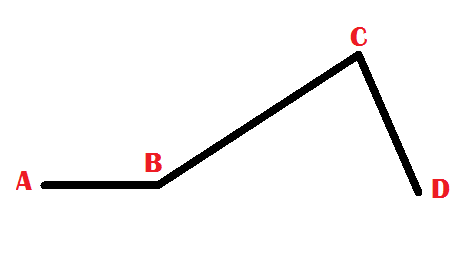
Figure 1. This graphic is a replication of the diagram found in page 91 of “Lost in the Funhouse,” in which the narrator discusses the general pattern that most fictional narratives follow: exposition, conflict, complication, climax, and resolution.

The narrator of the story makes a critique of patterns by illustrating the conventions that narratives usually appropriate in order to assure that they are effective. The text painstakingly depicts the usual structures and conventions that narratives employ to deliver a story (see Figure 1). “Lost in the Funhouse” deviates immensely from the conventional and linear plot, and it is self aware of this deviation: “The beginning should recount the events between Ambrose’s first sight of the funhouse early in the afternoon and his entering it with Magda and Peter in the evening. The middle would narrate all relevant events from the time he loses his way; middles have the double and contradictory function of delaying the climax while at the same time preparing the reader for it” (74). Although the narrator stresses that this is how stories should be structured, “Lost in the Funhouse” deliberately refutes these conventions by delivering a narrative with a prolonged exposition that is contradictory and that does not follow typical patterns of resolution. Details of the plot’s so-called climax, introduction, and conclusion are also scrambled throughout the text, and are not found within the expected locations. Although the narrator admits that this deviation forsakes “the effects of drama” that are possible in the short story, he also makes it clear that this deviation of narrative conventions “can better effect” the dramatic possibilities of the story (91).

With this in mind, it can be argued that the narrator is not necessarily refuting the importance of fiction with sensitive adolescents, but rather, he is contesting the usefulness of a linear narrative to do justice to the multifaceted, complicated, and fragmentary nature of the issues that are faced during the coming-of-age process. I thought this notion was particularly apparent as Ambrose ventures through the maze of mirrors in the funhouse. As Ambrose sees multiple selves being reflected as he tunnels through those mirrored paths, he realizes the futility of trying to approach the self as a single, atomized unit:

Stepping from the treacherous passage at last into the mirror-maze, he saw once again, more clearly than ever, how readily he deceived himself into supposing he was a person. He even foresaw, wincing at his dreadful self-knowledge, that he would repeat the deception, at ever-rarer intervals, all his wretched life, so fearful were the alternatives. (90)

The passage above is one of the most overt critiques on linearity, development, and the conventions that are usually invoked when writing developmental narratives. It attacks the notion of teleology and fulfillment, going as far as to argue that development is not always achieved by following points A to D. Furthermore, this passage refutes the notion of self-fulfillment by highlighting the cyclic nature and the folly of trying to pin down a clear and clean definition of the self. The self is always more fragmented and unreachable than narratives of development usually convey, and the self is always found in a state of constant change and growth. Thus, “Lost in the Funhouse” offers an alternative way of thinking about and approaching the process of development. The narrative implies that it would be foolish to approach an individual’s development through how well he or she complies with conventions of growth, maturation, and development–just as it would be equally foolish to judge this text by how well it adheres to narrative conventions.

When it comes to truth, perhaps the narrator is right when asserting that “we will never get out of the funhouse” (74).

Work Cited

 Barth, John. Lost in the Funhouse. New York: Bantam Books, 1980. Print.

On Asexuality and Kinship: Ellen Wittlinger’s [Hard Love]

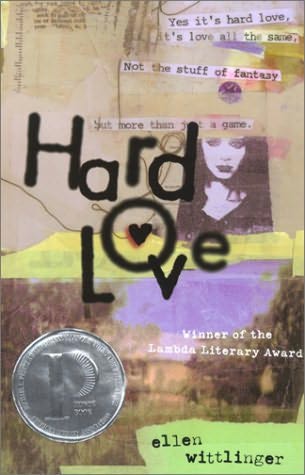
Front cover of Ellen Wittlinger's Hard Love
Front cover of Ellen Wittlinger’s Hard Love

Ellen Wittlinger’s Hard Love is at its core a novel about love, but it is quite different from other young adult novels on the subject that were written in the late 1990s. The narrative is centered on John Galardi (known by some as Gio), a junior in a high school who is still haunted by the ghosts of his parents’ divorce. On one hand, his father abandoned John and his mother because they did not comply with his self-image as an elitist literary publisher and playboy; on the other hand, because of John’s resemblance to his father, his mother has avoided physical contact with her son for over six years (no hugs, no physical proximity, nada). Because of this, John not only has difficulties expressing his emotions, but he also prevents other people from reaching out to him in order to avoid being hurt. He he poingnantly expresses this notion in a letter to his mother:

So I took all of the sadness of the divorce, and all the love I’d once had for both of you [his parents], and all the fear I had of being alone, and turned it into a stone wall to hide behind. To protect myself. I’m so protected now, dear mother, sometimes I feel like I’m barely alive. I am immune to emotion. And I hate you for it. (139)

John’s thoughts and feelings are shared with others anonymously through a zine he writes and publishes titled Bananafishwhich he writes after being inspired by a series of zines he read at a record store. He is particularly drawn to a zine titled Escape Velocitywritten by someone named Marisol, who is a self-proclaimed “Puerto Rican Cuban Yankee Cambridge, Massachusetts, rich spoiled lesbian private-school gifted-and-talented writer virgin looking for love” (9). Drawn to the rawness and honesty of Escape Velocity, John devises a way to meet Marisol at the record store the day she delivers her publication for distribution. Tethered by their emptiness, confusion, and lack of experience, John and Marisol become quick friends–and seeing as Marisol is the first person that John was able to connect to, he falls in love with her. The main tension within this novel arises through this love–John truly believes that their connection transcends labels of sexuality and sexual orientation, whereas Marisol is certain that she’s a lesbian and she can never envision herself dating a man. The narrative then explores whether their friendship can survive the incongruity that exists in terms of their love for each other.

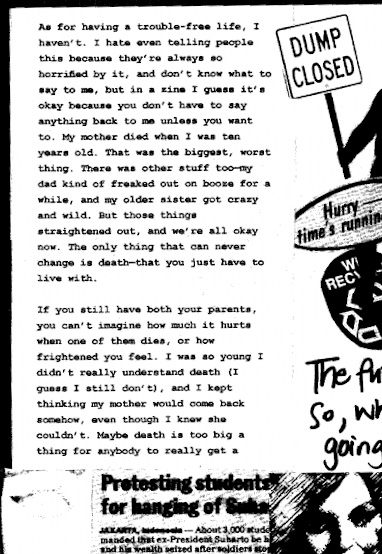
Excerpt from page 93 of Ellen Wittlinger's Hard Love. The novel is mostly told through the protagonist's perspective, and this perspective is enhanced with the novel's zine-like structure. Text is written in different fonts, images and text are combined in unique ways, and the pages sometimes give the impression that they are collages of letters, newspaper clips, and clip art.
Excerpt from page 93 of Ellen Wittlinger’s Hard Love, illustrating one of the many zines that John reads throughout the narrative. The novel is mostly told through the protagonist’s perspective, and this perspective is enhanced with the novel’s zine-like structure. Text is written in different fonts, images and text are juxtaposed in unique ways, and the pages sometimes give the impression that they are collages of letters, newspaper clips, and clip art.

As can be seen in the image above, Hard Love is structurally interesting because it is presented as a collage-like collection of letters, narrative, images, newspaper clippings, poems, autobiographical pieces, and general musings that attempt to replicate the feel of an actual zine. All of these mediums work together to give us a snapshot of John’s mind. The fragmented feel of the novel does an exemplary job of concretely depicting John’s anger, confusion, and truth while at the same time leaving enough room for the protagonist to be ambiguous and difficult to understand.  John’s characterization was very intriguing to me, not only because of the novel’s structure, but also because of his gender identity and sexuality. For instance, early on in the novel, John expresses his inability to find women attractive, and he often expresses his disdain towards his friend Brian because of the latter’s overly enthusiastic attraction to women that he has never spoken with. As a matter of fact, for a while I was convinced that John was asexual, which would’ve been amazing given that as of yet,  I’ve not encountered an explicitly asexual character in a young adult novel. I got this sense in passages such as the following:

I can’t stand it anymore, the constant talk about girls and sex. I just don’t feel like thinking about that stuff. Waybe it’s weird, but I’m not interested in it. I mean, it worries me a little sometimes, because I guess guys my age are supposed to be like Brian, lusting after pouty lips and big boobs. But to me, the mystery of female body parts is one I’d just as soon not solve. Not that I’m interested in boys either–I’m just not interested in the whole idea of locked lips or proclamations of love. (19)

John’s sexual ambiguity and his inability to discern his sexual inclinations becomes a prominent issue in the early chapters of Hard Love, and there are instances in which John is unable to deduce whether he can potentially be attracted to any sex at all. At one point, John admits to Marisol that he possible could be gay, but he hasn’t taken a moment to contemplate this possibility. My initial reading of John as potentially asexual was further evidenced by Marisol’s attempt to fix up John with her gay friend, Birdie. This fix up fails, however, because Birdie thinks John is heterosexual based on his behavior and attitudes. Let me turn my attention to the following exchange between Birdie and John after the latter is accused of not being gay:

“What do you mean? I’m not  even sure myself if I’m gay or not. I mean, I’ve been thinking maybe I am.”

You have? Are you attracted to men?” Birdie asked.

“Well, no. But I’m not attracted to women either.”

“Oh, well, that’s just dysfunctional, not gay,” Birdie announced confidently. I was lost for a comeback. (52-53)

Marisol then asks whether John was disappointed to find out that he is not gay, to which he responds “It’s just Birdie’s opinion” (53). Now, there are obvious issues of asexual representation in the exchange between Birdie and John, because asexuaity is viewed as a dysfunction rather than an alternative way of being. It is possible to perceive a tension between John’s attempt to define his sexuality while at the same time having it defined by others. John’s non-normative sexual behavior and attitudes certainly make him queer to some extent, but this queerness is somewhat subdued when John “discovers” his heterosexuality through his attraction to Marisol. Although he confesses his love to Marisol, she does not reciprocate his feelings. She admits she loves him, but only “as much as [she] can” (223). Although he is attracted to Marisol, who is a woman, John suggests that his love is not a matter of genitalia and sex, but rather, who is capable of seeing one for who they truly are:

To tell the truth it couldn’t matter less

who wears the pants or the dress, but only

who becomes visible to whom.

You saw me truly, and I saw all you let me;

I’m not lying now, and I hope I never will. (205)

What makes this novel unique is that it is a love story that focuses on a protagonist who views love as a matter of connection rather than of sex or sexual orientation–although this in turn is problematic, mostly because at times it seems like John hopes that his love for Marisol could provoke her to overcome her lesbianism. This does not happen, and thus, this novel is anything but a young adult version of Kevin Smith’s Chasing Amy. The novel also attempts to reconfigure the reader’s perceptions of friendship and family, ultimately presenting alternative ways of kinship that are not necessarily sexual or heteronormative in nature. Although it seems that John is in due course heterosexual and not asexual, there is an ambiguity and openness about him that is both refreshing, intriguing, and queer. Now, my question is: when will we have a great young adult novel with an asexual protagonist? Does anyone know about one?

You can purchase a copy of Hard Love here.

Work Cited

Wittlinger, Ellen. Hard Love. Simon Pulse, 2001. Print. (Paperback edition)

Growth and Development in Stephen Chbosky’s [The Perks of Being a Wallflower]

Update: The content of this blog post was developed into an academic article that was published by The ALAN Review. I’m thrilled to announce that this article obtained the Nilsen-Donelson award for the best academic article published in 2013. Click on the following link to download a PDF version of the full article: Writing Through Growth, Growth Through Writing: [The Perks of Being a Wallflower] and the Narrative of Development

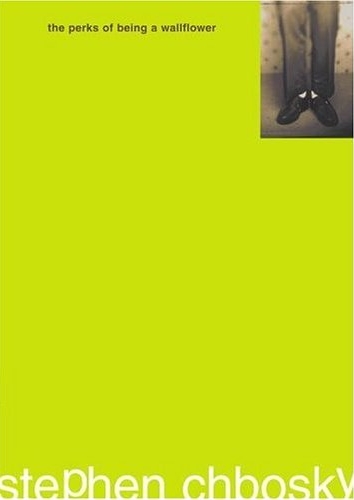
Original cover of Stephen Chbosky’s “The Perks of Being a Wallflower” (1999)

I remember the first time that I held that bright green cover in my hands early in the morning during the Christmas of 2002. In all honesty, I had no concrete clue of what the novel was about. I just remember surfing through the web, looking for young adult books to get me through the holidays, and the title of this novel caught my attention: The Perks of Being a Wallflower. Now, it was an unusually complex title for a young adult novel, but seeing as I myself felt like a wallflower at times, something about the title spoke to me. Little did I know that I was about to read the book that led to a shift in my being… a book that affected me on levels beyond comprehension… a book that almost 14 years later continues to shape who I am.

When people ask me what is my favorite text of all time, they would probably expect me to say something that any other literary scholar would say: Shakespeare’s dramas, Milton’s poetry, Dickens’ novels, or maybe even Thoreau’s philosophies and discussions. However, my answer would undoubtedly be the aforementioned book titled Perks of Being a Wallflower, written by Stephen Chbosky. Sure, the book is not a book for everyone. Many people become “nauseated” with the protagonist’s overly sentimental musings, and others simply get angry with the protagonist’s lack of action (these were reactions that some of my past students had when first reading the novel). Others accuse the book of being a rip-off of J.D. Salinger’s The Catcher in the Rye; true, it is unsurprising to see that Salinger’s text was indeed an influence for Chbosky’s work (it is even one of the many novels that the protagonist encounters throughout the narration), but comparing the two works would be like comparing apples and pears: they have similar textures and flavor profiles, but in the end they are different fruits that possess different forms.

I consider the novel to be one-of-a-kind. Charlie, the protagonist, is one of the most vulnerable, raw, real, and honest literary characters that I have encountered within the realm of young adult fiction (and arguably, all genres of fiction). The novel is one of the few instances in which readers have the opportunity to witness the uncensored perspectives of a male character who is not afraid to share his thoughts and sentiments. As of now, it has been the only book that has been capable of making me cry. True, I read the novel during a vulnerable time: like Charlie, I was lost, and confused, and I was looking for someone to speak to. Charlie, the protagonist of the novel, ultimately became that person. But, even when reading Perks numerous times after escaping my own period of vulnerability, it still continues to “listen” to me, and to speak to me. It still continues to haunt me. And every time I read it, it says something different to me.

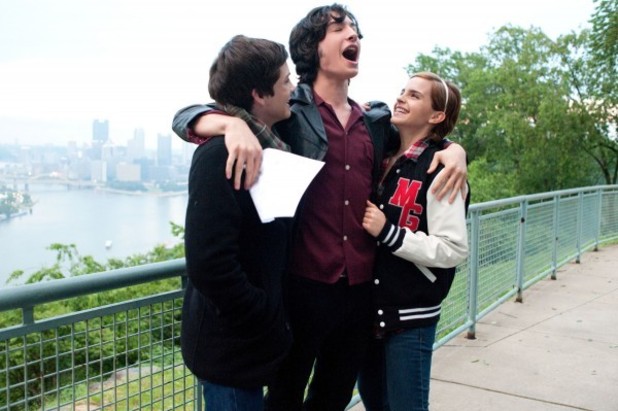
The film was superbly acted by Emma Watson as the vivacious and complex Samantha, and Logan Lerman as Charlie, the film’s heart-breaking and fractured protagonist.

The reason I’m bringing this book up is because I finally was able to see the film adaptation of this novel, which was written AND directed by Stephen Chbosky himself. The movie was only being shown in select theaters, but this weekend, it finally was shown in theaters across the nation. Truth be told, I was rather afraid to see the film. When our favorite books are adapted to the silver screen, there is always the fear that the adaptation won’t live up to our expectations, and that the film will never reach the standards of the original source. However, after seeing the movie last night, I realized that my feelings were misguided. The film adaptation of Perks was endearing, touching, and thought-provoking. But even more so, the movie was crafted for a generation who grew up with the ideals and thoughts manifested in Chbosky’s original text: originality, uniqueness, and loyalty. The movie invites us to ultimately find a sense of belonging in “the island of misfit toys.”

Overall, the film has received very positive reviews. It currently has a score of 8.4/10 in IMDB, and it was certified as a fresh film in Rotten Tomatoes, with a current approval rate of 86% among critics and 95% among audience members. And in all honesty, those who don’t understand the movie, or that consider it another bland coming-of-age story either fail to sympathize with the hurdles that the protagonist had to overcome, or they find it hard to connect with the notion of being an outsider (after all, not everyone is aware of the unique perspective that one develops when “standing on the fringes of life”).

In due course, the film left me inspired, and it pushed me to submit an article that I wrote on the novel last semester to the ALAN Review, the nation’s leading journal on the study and teaching of young adult literature. Frankly, I had reservations in terms of submitting the article for review, mostly because I feel like I cannot effectively do justice to my favorite novel of all time. In addition, I am aware that the article is far from perfect. However, just like Charlie had to learn how to participate, I needed to step out of the shadows and take an academic risk. I have no idea whether or not the article will be accepted for publication, but I guess there was no harm in trying.

Anyway, to conclude today’s post, I will include an excerpt from the article that I submitted. Wish me luck!

Excerpt of “Writing through Growth, Growth through Writing: The Perks of Being a Wallflower and the Narrative of Development” written by Angel Daniel Matos:

[…]

Although Perks is certainly considered epistolary in terms of its form and delivery, its content and function are definitely attuned towards the aims of developmental fiction. Given that the protagonist depicts his own developmental process through his writing, and given that the novel is written via a series of letters, it is imperative that the reader becomes attuned to how the process of writing and the process of Bildung work together to fulfill and challenge the nuances of development within the literary scope. The process of writing in Perks manifests primarily in two ways: through the letters that Charlie writes to the anonymous recipient and through the assignments and tasks that he completes for his English class in high school. Fascinatingly, Charlie’s writing is very much reflective of his own development as a person, and the writing that we encounter in the first letters of the book is more scrambled, disorganized, and “immature” in comparison to the prose found in his final letters.

For instance, here’s an example of Charlie’s writing at the beginning of the novel: “Aunt Helen told my father not to hit me in front of her ever again and my father said this was his house and he would do what he wanted and my mom was quiet and so were my brother and sister” (Chbosky, 1999, p. 6). This sentence exemplifies the writing style that is predominant during the first letters of the novel: the prose is peppered with run-on sentences, he has not mastered the art of punctuation, and his ideas many times lack coherence and cohesion. We see that his writing style, and even the topics that he discusses in his letters, begin to evolve and mature as Charlie gains more experience with the art of writing, and as he begins to delve in increasingly complicated efforts to understand himself and the people around him. Charlie’s English teacher, Bill, assumes the role of Charlie’s mentor not only from an educational standpoint, but from a formational one as well. Charlie also takes Bill’s advice and suggestions quite seriously, and although he always gives Charlie A’s on his report cards, he always labels his essays with a lower grade as a way of challenging him:

First of all, Bill gave me a C on my To Kill a Mockingbird essay because he said that I run my sentences together. I am trying now to practice not to do that. He also said that I should use the vocabulary words that I learn in class like “corpulent” and “jaundice.” I would use them here, but I really don’t think they are appropriate in this format. (Chbosky, 1999, p. 14)

After Bill’s recommendations, Charlie’s letters increasingly avoid the use of run-on sentences, and his prose becomes much clearer and more efficient, saying more using less words. It is also interesting to note that when Charlie writes about the books that Bill assigns to him, he manages to use writing as a way of evaluating the actions of the characters in the books he reads, and he always tries to establish parallels between his own life and the “life” portrayed in the books.

This notion of comparing and contrasting becomes important in terms of the content depicted in Charlie’s letters, for it is in this instance that he begins to situate himself more prominently in the actions that are represented in the letters. At first, most of what he writes about is concerned with the observations that he makes of his family. This notion of writing “empirical” observations of the people he observes becomes the main focus of Charlie’s letters until Bill begins to notice that Charlie constantly stares at people and scrutinizes them obsessively. He then asks Charlie what he thinks about when he observes people, and after he tells Bill everything he thinks about, the teacher remarks that although thinking a lot is not necessarily a bad thing, “sometimes people use thoughts to not participate in life” (Chbosky, 1999, p. 24). This remark pushes Charlie to further assess his own life and the degree to which he participates in events, talks with other people, and tries to make friends. However, the very process of writing his thoughts obliges him to become introverted and pensive, and he continues to write letters as a way of assessing his own life: “when I write letters, I spend the next two days thinking about what I figured out in my letters. I do not know if this is good or bad” (Chbosky, 1999, p. 28). The effort that Charlie puts in trying to understand his meditations is a clear indicator that Bill was right to some extent, for so much effort is put into trying to understand, that there is little room to actually live and enjoy life.

Despite the mental effort and time required in the crafting of his letters, there seems to be a radical shift in terms of the content being portrayed after Bill warns Charlie about the perils of overthinking. The focus of the letters shifts from a focus on family to a focus primarily on Charlie’s efforts to socialize and make friends. In due course, Charlie becomes very close to a group of seniors at his school, known for not being the most popular and loved people within the premises. The first friend he makes in high school is Patrick, a gay senior with a penchant for jokes and mischief, and who introduces Charlie into the world of drinking, smoking, and the unwritten rules of sexual behavior. He also befriends Sam (short for Samantha), who is Patrick’s stepsister and on whom Charlie develops an obsessive crush. The bulk of the letters depicted after this point discuss the differences that exist between Patrick, Samantha, other friends, and himself, his strivings to understand the motivations behind their thoughts and actions, and more importantly, the arduous process of integrating himself with Patrick and Samantha’s circle of friends.

Charlie develops a clearer sense of the world through this arduous process of integration, and through his immersion in new experiences such as drug use, masturbation, visits to the Rocky Horror Picture Show, and through his exposure to different literatures. His analysis of the content of his letters, and the feedback he gets from his essays at school, demonstrate that Charlie is developing the ability to make his writing more concrete and understandable due to the fact that he is undergoing experiences that provide him with a substantial analytical platform. Even more so, Charlie’s development of his writing prowess leads him to the discovery of the craft he wants to hone as a professional endeavor: “I have decided that maybe I want to write when I grow up. I just don’t know what I would write” (Chbosky, 1999, p. 46). Although at first the letters prevented him from participating due to their introspective and slightly amateurish nature, it is when Charlie combines his writing skills with the experiences that he has obtained that allows him to develop a richer image of who he is and who he wants to be. Interestingly, the more Charlie writes, the more he understands himself, and the easier it is for the recipient of the letters to develop a more defined snapshot of Charlie’s mind. In other words, the more Charlie begins to understand himself, the more others also begin to understand him.

It is unclear whether Charlie keeps copies of the letters for himself; however, Charlie consistently makes reference to past letters. Charlie compares and contrasts experiences illustrated in his letters, and he also revisits previous points of discussion in order to reevaluate his thoughts using the knowledge that his experiences have thrust upon him. For instance, Charlie once reads a poem to his friends titled “A Person/ A Paper/ A Promise Remembered,” written by Patrick Comeaux and given to him by Michael (the friend who committed suicide), which portrays the growth of a boy into a man, and concludes with the speaker’s suicide due to his disillusionment with life. At first, Charlie is unable to understand the poem clearly, and he is unwilling to understand why a person would commit suicide. But, during New Year’s Eve, Charlie writes a letter in which he confesses that a particular experience has unfortunately helped him to grasp the intended meaning of the poem:

I just remembered what made me think of all this. I’m going to write it down because maybe if I do I won’t have to think about it. And I won’t get upset. But the thing is that I can hear Sam and Craig having sex, and for the first time in my life, I understand the end of that poem. And I never wanted to. You have to believe me. (Chbosky, 1999, p. 96)

It is important to note that in this instance, Charlie is using writing for a new purpose: rather than using the letters as a means of interpreting himself and his world, he uses writing as a way of distancing himself from his thoughts, as if writing were a way of draining his worries away from his mind. Even more so, it is through looking back at his own writing that he is able to comprehend how he loses innocence, and how he is able to understand concepts that used to escape his cognizance. It is after this point that Charlie becomes a “rebel” in many aspects: he begins to smoke and drink more than ever; he begins to explore his sexual identity by hanging out more often with Patrick and kissing him every so often, and he secretly offers his sister assistance when she believes she is pregnant.

Charlie begins to realize that life does not have to be lived according to others’ expectations, and if he is to achieve any degree of happiness, he has to find a way to balance his desires and social demand. This stepping away from society’s parameters also manifests within Charlie’s writing, seeing as he begins to experiment with different styles of writing and of conveying ideas: “I wrote a paper about Walden for Bill, but this time I did it differently. I didn’t write a book report. I wrote a report pretending that I was by myself near a lake for two years. I pretended that I lived off the land and had insights. To tell you the truth, I kind of like the idea of doing that right now” (Chbosky, 1999, p. 128). Thus, rather than complying with a formula or a set of rules on how to tackle his literary interventions through writing, he delves into an experimental endeavor in which he filters the information he decodes in the book through his own set of experiences. Rather than simply being a sponge that absorbs and regurgitates ideas, Charlie begins to view the act of writing as a mediation between a conversion taking place, turning him into an active writer rather than a passive one. Thus, the parallels between emotional and mental development, or Bildung, become increasingly tied to the act of writing throughout the progression of the novel. Furthermore, notice that Charlie seems rather pleased with this new direction that he is taking.

Charlie’s progression from a passive to an active participant is not an overnight change, but rather, it is a very difficult and gradual process. Despite his small victories and attempts, Charlie still remains a wallflower towards the concluding letters of the novel. However, in the climactic letter of the novel, Samantha confronts Charlie and obliges him to face the consequences of his lack of action. Sam has broken up with her boyfriend because he was cheating on her, yet Charlie never made an attempt to date Sam now that she was newly single. In a fit of frustration, Sam confronts Charlie with the truth after he confesses that he did not take action because he was more concerned with her sadness than with trying to be with her:

It’s great that you can listen and be a shoulder to someone, but what about when someone doesn’t need a shoulder. What if they need the arms or something like that? You can’t just sit there and put everybody’s lives ahead of yours and think that counts as love. You just can’t. You have to do things. (Chbosky, 1999, p. 200)

And rather than replying to her accusations with words, Charlie approaches Sam and starts to kiss her. They soon end up on the bed, kissing passionately, but just as they are about to go all the way, Charlie begins to have a nervous breakdown. To make a long story short, Charlie slowly but surely remembers the fact that he was sexually abused as a child by his diseased aunt Helen, which explains why Charlie was so repressed and had difficulties participating in life. After a few months in the hospital after his breakdown, Charlie begins to come to grips with his repressed past, and he proposes to move on and change the direction of his life. […] Indeed, the surprising and unprecedented moment in which Charlie reawakens his repressed past is indeed heartbreaking and difficult to tolerate emotionally, but it is the moment in which Charlie truly begins to feel free from the unbearable burden of trying to figure out why he is the way he is, and why he so desperately craves to understand the world around him. And although action leads him to achieve his moment of breakthrough, it is the act of writing that helps him put his life into perspective, and that provides the missing puzzle pieces that complete the image of the self.

[…]

The main characters of “The Perks of Being a Wallflower.” From left to right: Charlie (Logan Lerman), Patrick (Ezra Miller), and Sam (Emma Watson)